
Glossary
Timing in Ballroom Dance
Timing is the dancer’s ability to stay in sync with the music. It’s the difference between a dancer who looks comfortable and one who looks like they’re guessing. Here’s what timing means, how it builds from beat and count, and how beginners develop it.
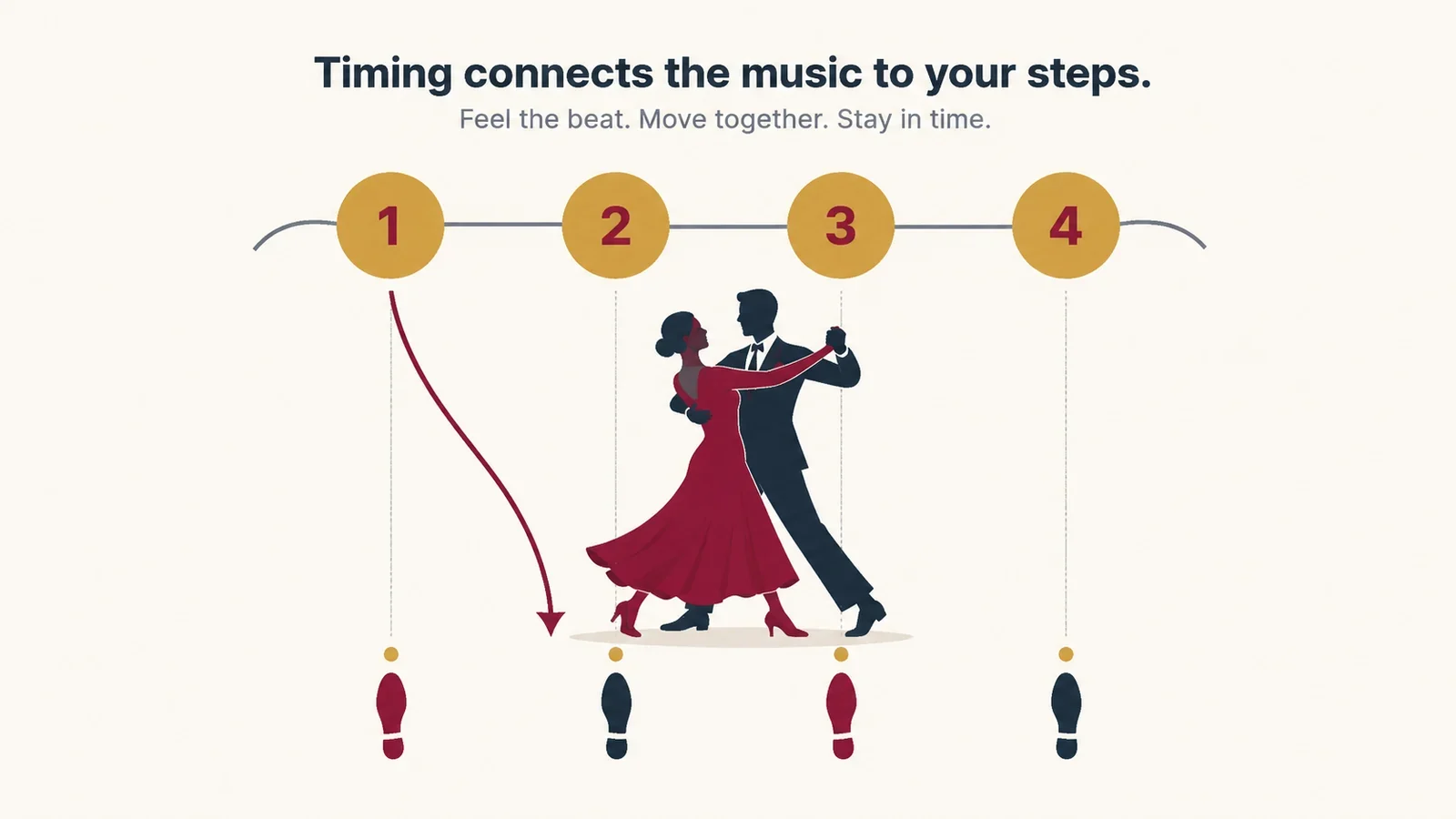
Definition of timing
Timing
- Pronunciation
- tahy-ming
- Skill category
- Music & performance
- Related terms
- beat, count, tempo, rhythm, musicality, syncopation
- Full guide
- How to Count Ballroom Dance Music
In ballroom dance, timing is your ability to stay in sync with the music—hitting steps on the right beats consistently. Timing builds on hearing the beat and learning the count. It’s the foundation skill that makes every other skill (steps, frame, partner work) look right.
Good timing makes a beginner look confident. Poor timing makes an expert look like a beginner.
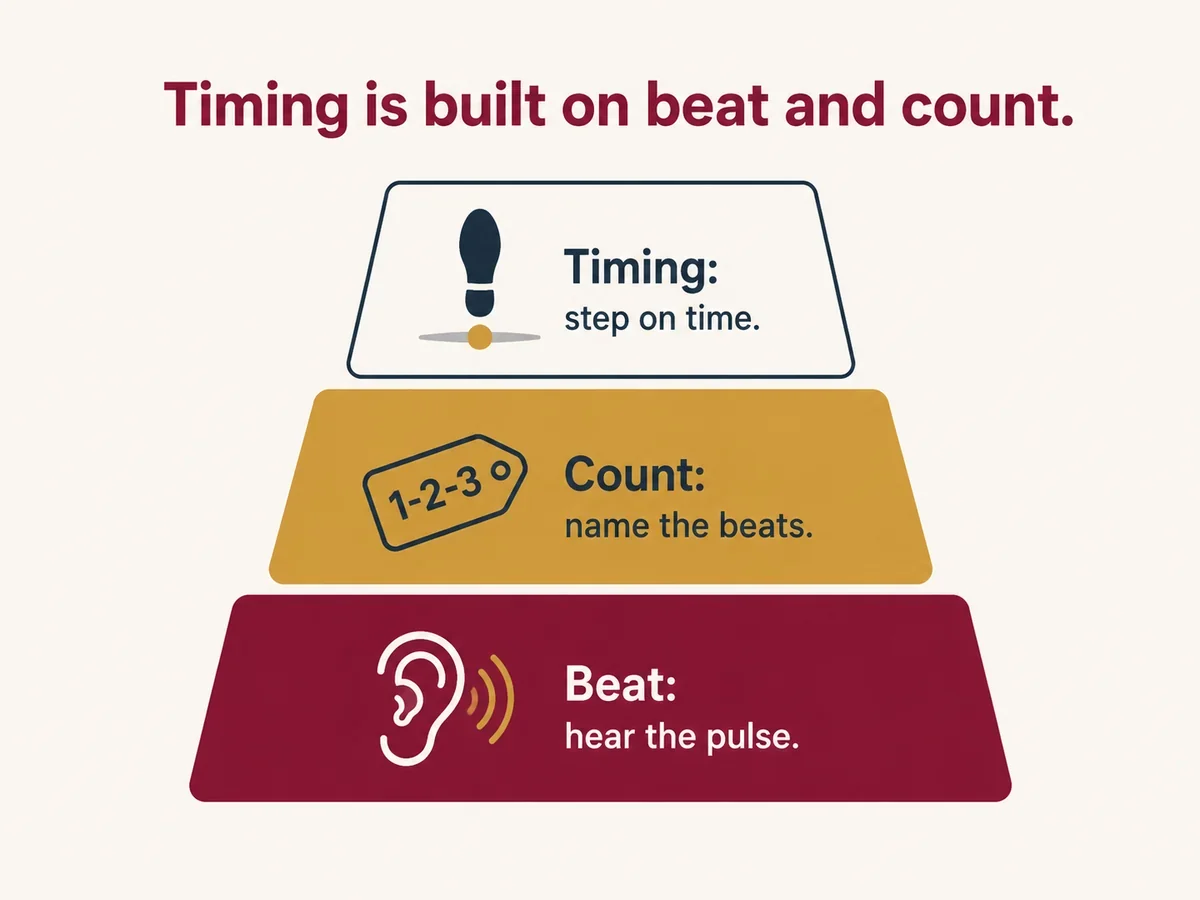
What timing means in ballroom dance
Timing is the skill of moving in sync with the music. When a dancer steps exactly when the music says step, lands their weight changes on the right beats, and finishes a figure as the phrase ends, that’s timing.
It’s separate from knowing the steps. A dancer might know every figure of a Foxtrot routine but execute them off the beat—that’s a timing problem, not a step problem. Conversely, a dancer who only knows a basic step but does it perfectly in time looks competent. Steps without timing look uncertain. Timing without steps looks calm.
Timing is also a skill that compounds. Once you have it, every other ballroom skill becomes easier because you have a steady framework to hang movement on. Learning timing first is one of the highest-leverage things a beginner can do.
Timing vs count vs rhythm vs musicality
Four overlapping ideas that beginners often blur together.
| Term | Plain-English meaning | When it matters |
|---|---|---|
| Count | The spoken rhythm dancers use to organize steps | While learning a new dance pattern |
| Rhythm | The pattern of long/short/accented notes in the music | When choosing how to feel a song’s structure |
| Timing | Your actual ability to stay in sync | Every moment you’re dancing—the result of count + rhythm |
| Musicality | Dancing expressively to the music’s mood and dynamics | Once timing is solid—the advanced layer on top |
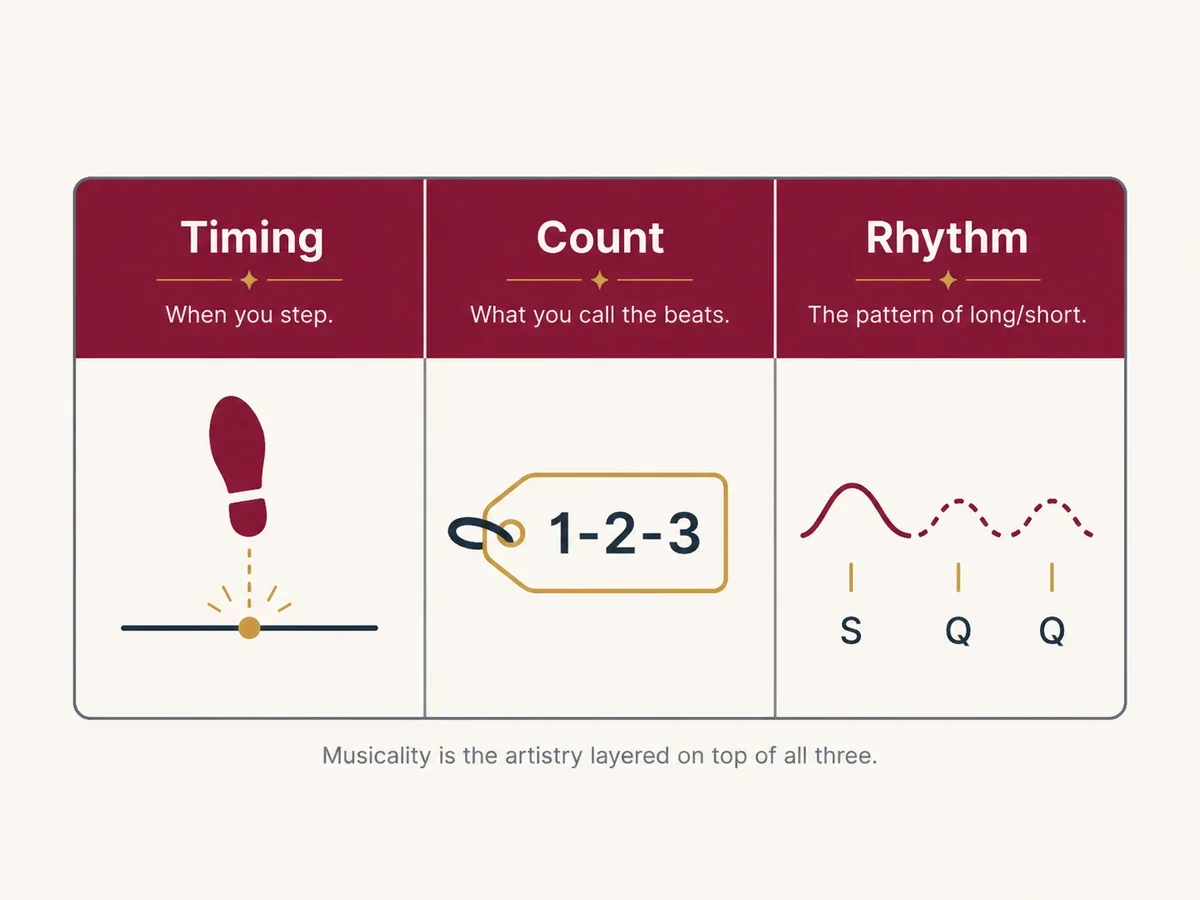
Count and rhythm are inputs you analyze in your head. Timing is what the audience sees on the floor. Musicality is what makes a dancer expressive once timing is automatic.
Why timing matters more than steps for beginners
It’s tempting to focus on learning more steps. New beginners often want to add figures, patterns, and variations as fast as possible. But timing is what makes any step look right.
A basic Waltz box step in perfect timing looks confident and pleasant to watch. The same dancer trying a fancy reverse turn with bad timing looks unsteady, even if the footwork is correct. Audiences—and partners—can feel timing immediately. They’ll notice a missed beat before they notice a wrong foot.
For wedding couples, this is especially important. A simple, on-time first dance looks better than an ambitious off-time routine. See the First Dance Practice Plan for how to build timing-first.
The practical implication: spend at least as much practice time on timing as on steps. Maybe more, early on. The investment pays off across every dance you learn afterward.
How timing develops over time
Timing doesn’t come from thinking harder—it comes from repetition. There’s a typical progression:
- Phase 1 (week 1-2): Counting out loud while dancing. Slow, deliberate, often slightly behind the music.
- Phase 2 (week 2-4): Counting silently. Mostly on time but loses count during transitions or turns.
- Phase 3 (month 2-3): Doesn’t need to count consciously for familiar patterns. Still loses time on new figures.
- Phase 4 (month 3+): Timing is automatic on most dances. Counting returns only when learning something new.
- Phase 5 (year 1+): Timing is internalized. The dancer can play with it deliberately—rushing, holding, accenting—for musicality.
Every dancer goes through some version of this. Skipping phases isn’t possible—you have to count out loud first. But the progression is faster with deliberate practice (counting along to music without dancing) than with random practice.
Timing in different ballroom dances
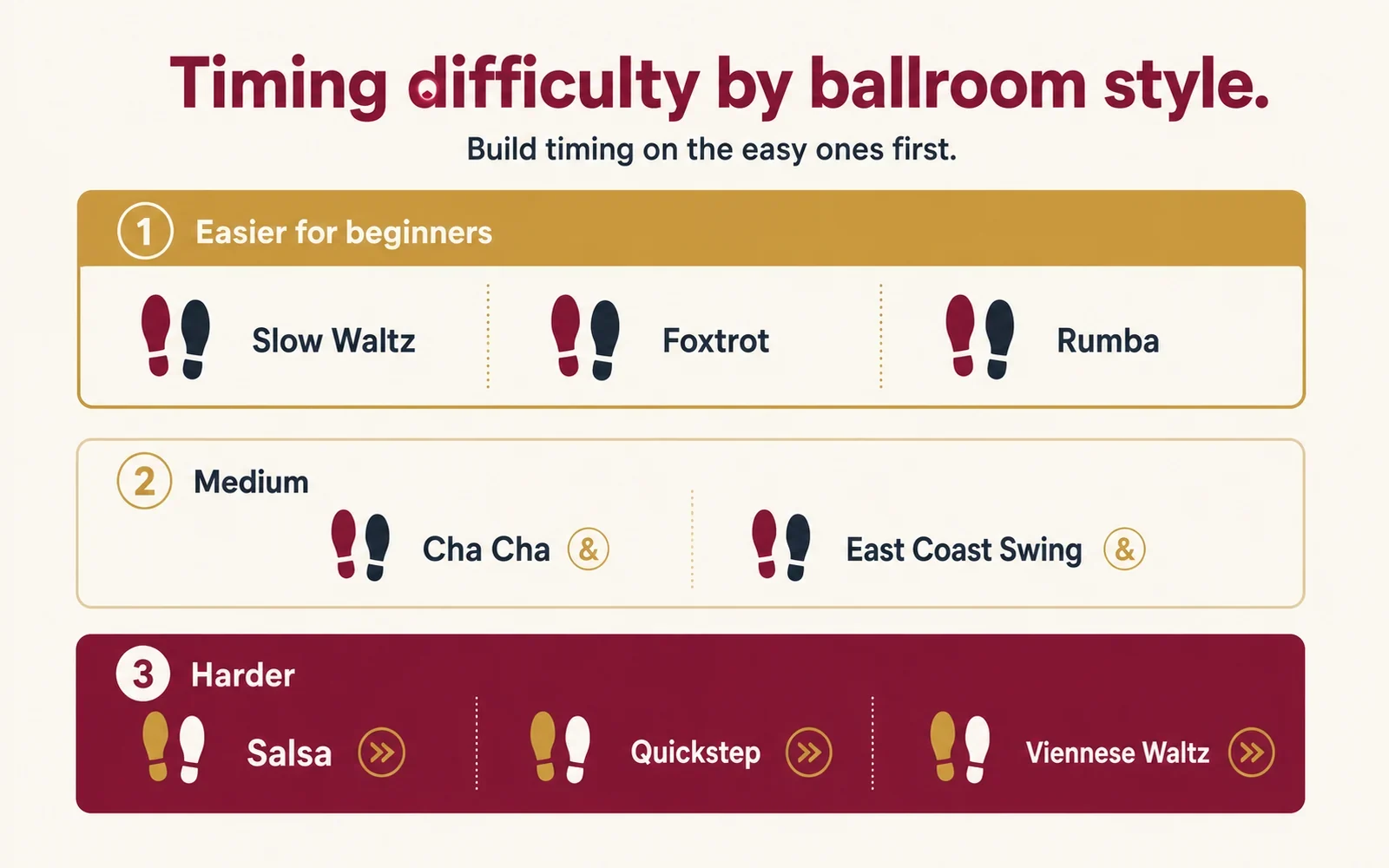
Easier timing (good starting points)
Slow Waltz in 3/4 has the clearest, most predictable downbeat. Foxtrot’s slow-quick-quick pattern is forgiving because slows give you time to catch up. Rumba’s slow tempo lets beginners hear every beat.
Medium timing
Cha Cha’s “2-3-4-and-1” count is harder because it starts on beat 2 and includes a half-beat (“and”). East Coast Swing’s triple-steps require feeling the “and” counts.
Harder timing
Salsa—especially “On 2” salsa—requires you to feel beat 2 as your starting beat, which goes against most pop music intuition. Quickstep is fast (192-208 BPM), which compresses the margin for error. Viennese Waltz at 174-180 BPM is similarly unforgiving.
Beginners should pick easier-timing dances first. By the time you’re comfortable in Waltz or Foxtrot, the harder dances feel more approachable.
Common timing mistakes
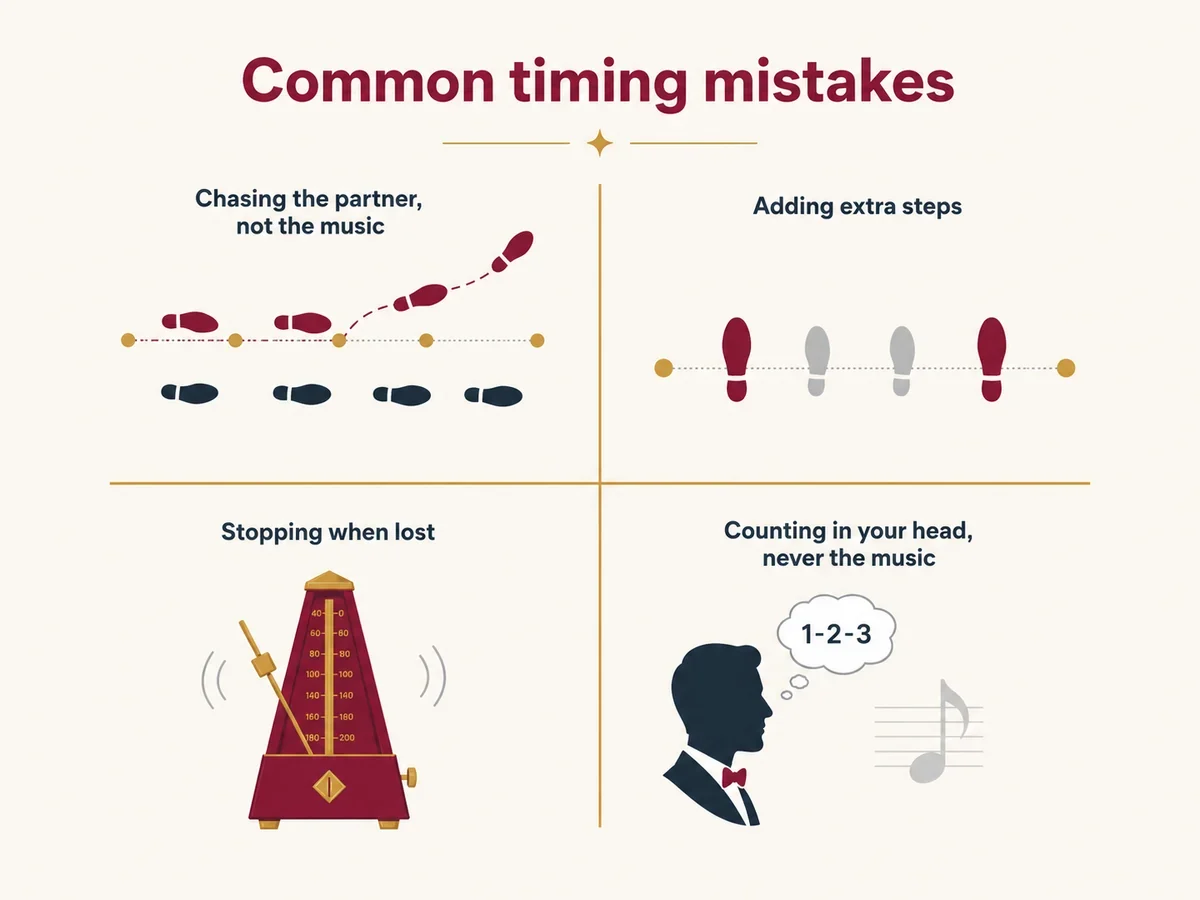
Stopping to count when you lose the beat
Fix: Keep dancing, listen for the next “1”, and pick up from there. Stopping breaks the partnership.
Rushing through the “slows”
Fix: A “slow” count is two beats long. If you finish before the next beat, you’re anticipating—a common bad-timing tell.
Counting your steps instead of the music
Fix: The music sets the count, not your feet. Your steps fit into the music’s timing, not the other way around.
Practicing only with familiar songs
Fix: Real timing means being able to sync with any tempo-appropriate song—not just the practice tracks you’ve memorized.
Holding your breath while counting
Fix: Tense dancers lose timing first. Breathe regularly, even when concentrating on the count.
Treating timing as a fixed skill (“I don’t have rhythm”)
Fix: Timing is a learned skill. Every dancer who has it built it through practice. There’s no “rhythm gene”.
Speeding up when nervous
Fix: Nervous dancers compress the count. If you tend to rush, deliberately wait a half-beat longer than feels comfortable—you’re probably still early.
Practice building timing
The best timing practice happens before you ever try to dance. Sit, stand, or walk to music and count out loud through full songs. When you can do that without losing the beat, add weight shifts. Only then add the full step.
-
Foundation timing (Slow Waltz)
Start here. Strong downbeats, predictable 3-beat measures, room to count carefully.
-
Forgiving 4/4 (Foxtrot)
Slow-slow-quick-quick. The slows let you recover if you lose the beat briefly.
-
Steady Latin (Rumba)
Slow tempo, clear beats. Best for practicing weight-shift timing without rush.
-
BallroomPages Music (Telegram)
Mixed-style practice for building timing across dances.
If your timing feels shaky, record yourself dancing and watch it back. Most people are surprised by how much earlier or later they’re stepping than they thought. Video doesn’t lie.
FAQ
Timing FAQ
What does timing mean in ballroom dance?
Timing is your ability to stay in sync with the music—hitting steps on the right beats consistently. It builds on hearing the beat and learning the count.
Can timing be learned?
Yes. Timing is a skill, not a trait. Every dancer who has it built it through deliberate practice—mostly counting along to music until the rhythm becomes automatic.
How long does it take to develop timing?
Basic timing for one dance usually develops in 4-8 weeks of regular practice. Strong, automatic timing across multiple dances typically takes several months to a year.
Why is my timing worse when I’m nervous?
Nervousness usually compresses timing—dancers tend to rush. Practice counting deliberately slower than feels comfortable; when you’re nervous, you’ll be on time instead of early.
Is timing more important than knowing more steps?
For beginners, yes. A simple step in good timing looks confident. A complex step in bad timing looks uncertain. Focus on timing first; add steps after.
What’s the difference between timing and musicality?
Timing is staying in sync. Musicality is dancing expressively—hitting accents, holding phrases, varying energy. Timing is the foundation; musicality is the layer on top.
Should I count out loud while dancing socially?
Whisper or mouth the count if you need to—don’t shout it. Counting silently in your head is the goal, but if you’re losing the beat, audible counting is better than silent guessing.
Can I practice timing without a partner?
Yes. Solo timing practice (counting along, weight shifts, walking on the beat) is often more effective than partner practice because you can’t blame the partner for your timing issues.
Editorial
Sources and review notes
This glossary entry should be reviewed by a qualified ballroom instructor before launch. Sources include NDCA and WDSF ballroom syllabus materials on timing and musicality, Dance Vision counting/timing resources, and Arthur Murray progression frameworks.
This is dance terminology, not medical advice. Ballroom Pages follows an editorial policy of education-first guidance. Questions? Contact us. Updated May 26, 2026.