
Glossary
Count in Ballroom Dance
A count is the spoken rhythm beginners use to organize ballroom steps to music. Here’s what count actually means, how it differs from beat and tempo, and the count patterns you’ll hear in Waltz, Foxtrot, Rumba, and Cha Cha.
Definition of count
Count
- Pronunciation
- count, rhymes with “mount”
- Skill category
- Music & timing
- Related terms
- beat, tempo, timing, rhythm, measure, slow-quick-quick
- Full guide
- How to Count Ballroom Dance Music
In ballroom dance, a count is the numbered or spoken rhythm used to organize steps to music. Beginners say counts out loud—“1-2-3” for Waltz, “slow-quick-quick” for Foxtrot, “2-3-4-and-1” for Cha Cha—to anchor their footwork to the music.
Think of count as the language that connects the music to your feet.
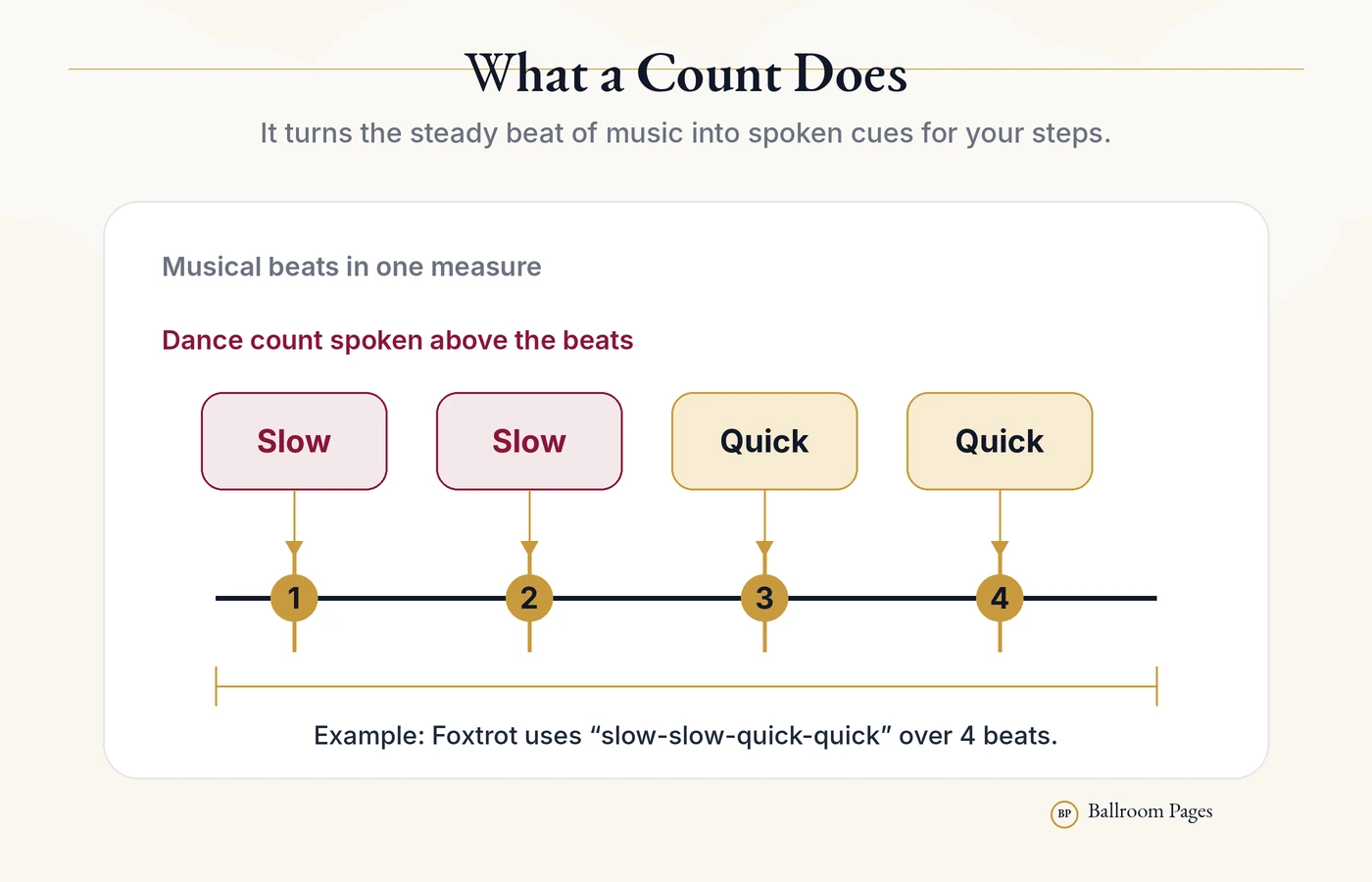
What count means in ballroom dance
A count is the way dancers speak the rhythm of a step. When you hear an instructor say “1, 2, 3” for a Waltz box or “slow, quick, quick” for Foxtrot, that’s the count. It’s a verbal map from the music’s underlying beat to a specific pattern of steps and weight changes.
Different dance styles use different counts even when the underlying music has the same beat. A Cha Cha and a Rumba both move to 4/4 music, but Cha Cha is counted “2-3-4-and-1” while Rumba is counted “quick-quick-slow” or “2-3-4-and-1” depending on the syllabus. The music doesn’t change—the count does, because each dance organizes the same beats differently.
Counts also tell you which steps are emphasized. A “slow” count usually takes two musical beats; a “quick” count takes one. An “and” count splits a beat in half. These small differences are how the same set of beats becomes Waltz, Foxtrot, Cha Cha, or Salsa.
Count vs beat vs tempo vs rhythm vs timing
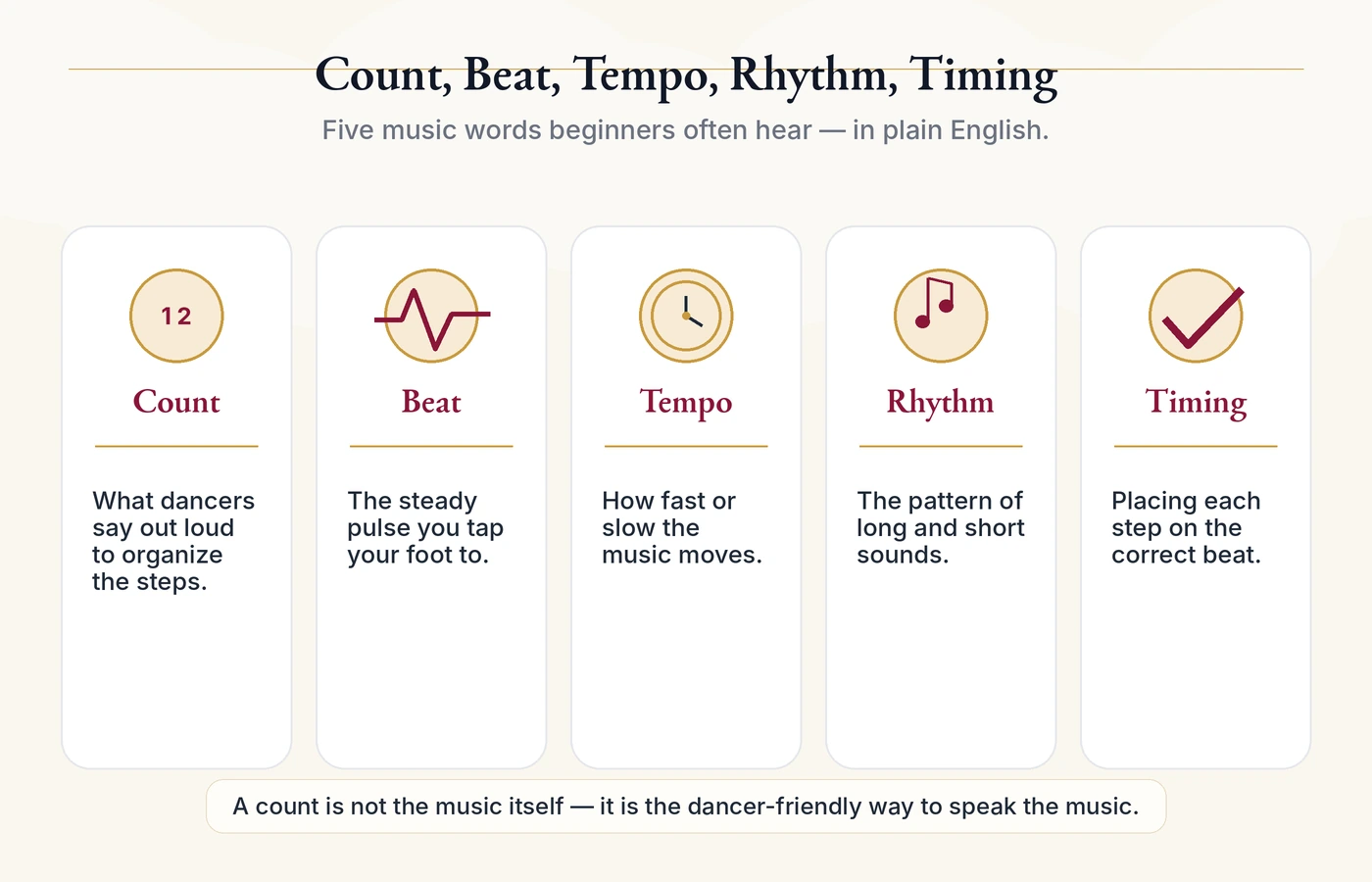
Beginners often blur these five terms. They’re related, but each means something specific.
| Term | Plain-English meaning | How it relates to count | Common beginner confusion |
|---|---|---|---|
| Count | The spoken rhythm used to organize steps to music | Count is the dancer’s way of mapping steps to beats | Treating count as the same thing as beat |
| Beat | The steady underlying pulse of the music | A count is built from beats but is not the same as a beat | Counting every musical note instead of the pulse |
| Tempo | How fast the beats happen (measured in BPM or MPM) | Tempo doesn’t change the count pattern, but does change how quickly you dance it | Slowing down the count when the song is slow |
| Rhythm | The pattern of long, short, and accented notes in music | The dance count typically follows the music’s rhythm but simplifies it | Trying to step on every note instead of the main pulse |
| Timing | The dancer’s ability to step in sync with the music | Counting is one of the easiest ways to develop good timing | Trying to feel the music without ever counting out loud |
Why counting matters for beginners
Counting out loud is one of the fastest ways to develop dance timing. It forces you to hear the music in regular intervals, predict where the next step lands, and stay coordinated with your partner. Almost every experienced dancer counted out loud when they were starting.
Counting helps with:
- Hearing where the dance “1” lands in the music.
- Knowing which foot moves and when.
- Staying with your partner through turns and direction changes.
- Building timing and musical confidence.
- Recovering when you lose your place mid-song.
- Practicing without an instructor or partner.
If you’re brand new to counting, start with the full counting guide—it walks through how to hear the beat in different music styles before you worry about specific dance counts.
Common count patterns by dance style
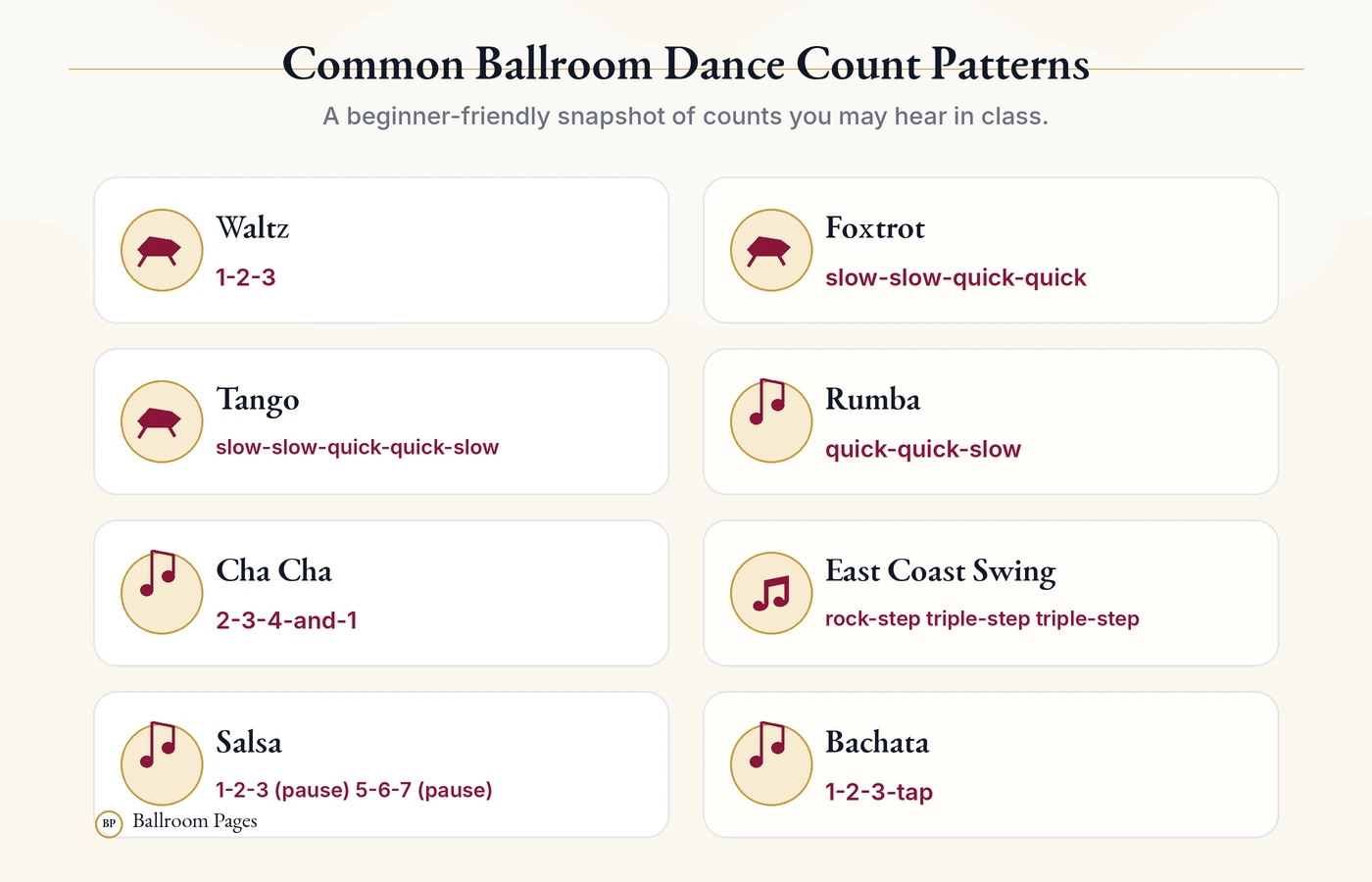
Waltz: 1-2-3
Waltz is the one major ballroom dance counted in three. Each measure has three beats and you take one step per beat. See the Waltz Dance Guide and Waltz music notes.
Foxtrot: slow-slow-quick-quick (or 1-2-3-4)
The basic Foxtrot count is “slow-slow-quick-quick”—two steps that each take two beats, then two steps that each take one beat, for a total of six beats. See the Foxtrot Dance Guide and slow-quick-quick.
Tango: slow-slow-quick-quick-slow
Ballroom Tango uses a slow-slow-quick-quick-slow count over eight beats, with a sharp, staccato character. See the Tango Dance Guide.
Rumba: quick-quick-slow (or 2-3-4-and-1)
Rumba is danced to 4/4 music but the basic count is “quick-quick-slow” over four beats. American and International Rumba differ slightly in which beat they start on. See the Rumba Dance Guide.
Cha Cha: 2-3-4-and-1
Cha Cha shares Rumba’s 4/4 music but adds a triple step (the “cha-cha-cha”) on counts 4-and-1. See the Cha Cha Dance Guide.
East Coast Swing: 1-2-3-and-4-5-and-6 (or rock-step triple-step triple-step)
East Coast Swing uses a rock-step plus two triple-steps over six beats. The count is often spoken as “rock-step triple-step triple-step” for clarity. See the East Coast Swing Guide.
Salsa: 1-2-3-pause-5-6-7-pause
Salsa is counted in 8 over two musical measures, with a hold on counts 4 and 8. “On 1” and “On 2” salsa styles start on different beats. See the Salsa Dance Guide.
Count names and conventions vary by instructor, syllabus, and region (NDCA, WDSF, ISTD, Arthur Murray, social-dance communities). When in doubt, use the count your teacher uses and stay consistent within one lesson.
Common counting mistakes
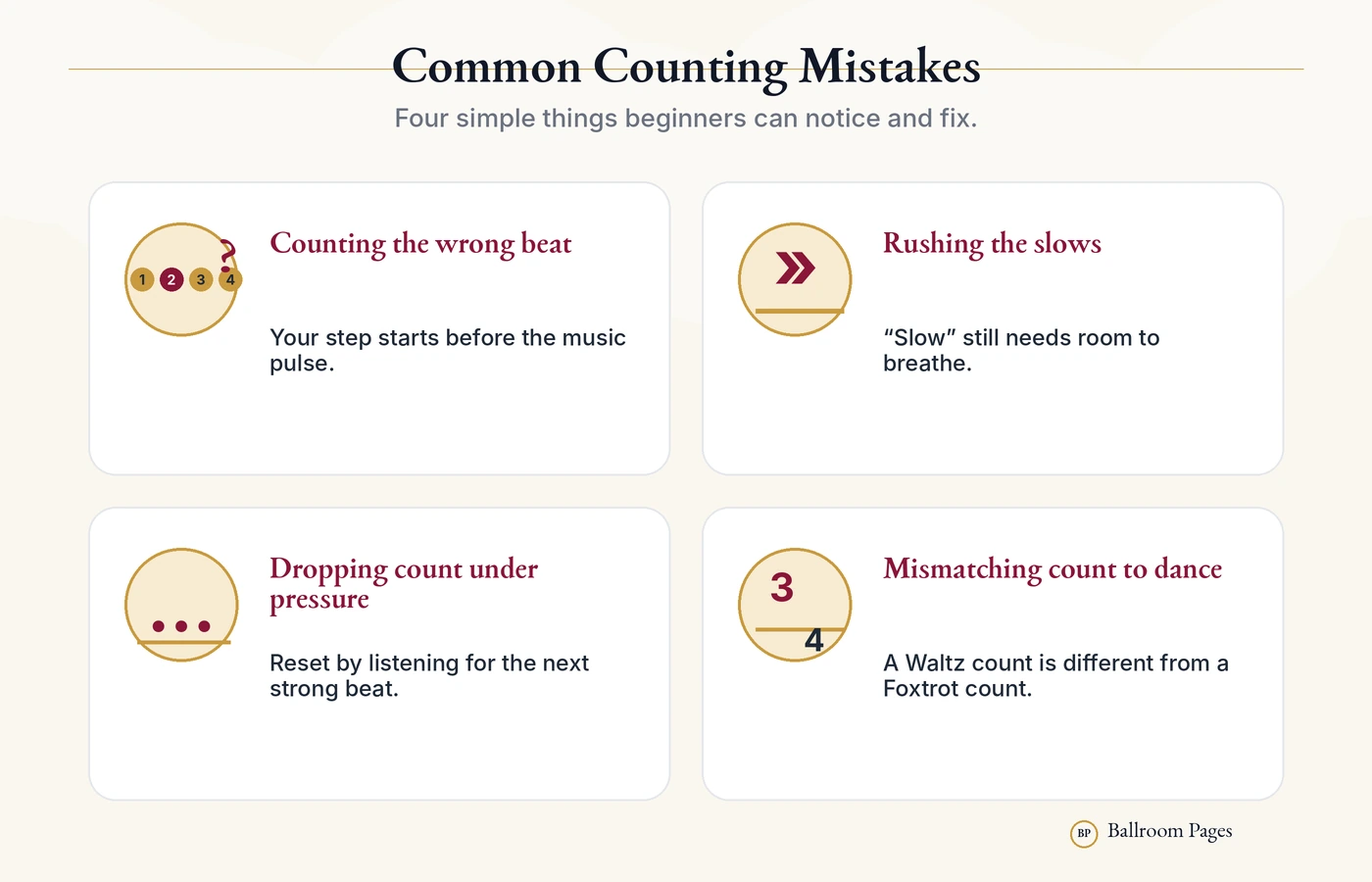
Counting the wrong beat as “1”
Fix: Listen for the strongest, lowest pulse in the music. Tap it for a few measures before starting to dance.
Rushing the “slow” counts
Fix: A “slow” lasts two beats. If you finish before the next beat, you’re rushing.
Counting only in your head when nervous
Fix: Whisper or mouth the count during practice. You can drop it when you stop losing the beat.
Using a Waltz count for non-Waltz music
Fix: Confirm the time signature (3/4 vs 4/4) before deciding which dance fits the song.
Dropping the count after a turn or stumble
Fix: Wait for the next “1” in the music and resume from there. Don’t guess.
Counting steps instead of music
Fix: The music sets the count, not your feet. If a step takes two beats, hold for both.
Counting in “1-2-3-4-5-6-7-8” for every dance
Fix: Match the count to the dance. Waltz is in 3, not 8.
Practice counting with music
The fastest way to internalize a count is to practice it without dancing. Put on a song in the right tempo for the dance you’re learning, sit or stand still, and just say the count out loud through a few measures. When that feels solid, add weight shifts. Only then add the full step.
-
Waltz (1-2-3)
Slow 3/4 music. Easiest count to hear because the “1” is strongly accented.
-
Foxtrot (slow-slow-quick-quick)
4/4 music at a comfortable tempo. Good for practicing slows that last two beats.
-
Rumba (quick-quick-slow)
Slow 4/4 Latin. Practice holding the slow for two full beats.
-
BallroomPages Music (Telegram)
Ongoing music discovery. More count-focused practice tracks for Cha Cha, Salsa, and Bachata are on the way.
If you can’t count along confidently while listening, slow down. Lower the tempo, count without stepping, and add the footwork only when the count feels automatic.
FAQ
Count FAQ
What does count mean in ballroom dance?
A count is the spoken or mental rhythm dancers use to organize their steps to music. Examples are “1-2-3” for Waltz, “slow-quick-quick” for Foxtrot, and “2-3-4-and-1” for Cha Cha.
Is a count the same as a beat?
No. A beat is the steady pulse of the music. A count is the dancer’s mapping of steps to those beats. Multiple counts can fit on one beat (“and” counts), and one count can take multiple beats (“slow” counts).
Why do different dances have different counts?
Each dance organizes the music differently. Waltz uses 3/4 music with three beats per measure. Most other ballroom dances use 4/4 music but emphasize different beats. The count tells you which beats matter for that specific dance.
Should beginners count out loud?
Yes. Counting out loud forces you to hear the music in regular intervals and stay coordinated with your partner. Most experienced dancers counted out loud when they were learning. You can drop it later when timing feels automatic.
What’s the easiest count to learn first?
Waltz’s 1-2-3 count is the easiest to hear because the “1” of each measure is strongly accented in 3/4 music. After that, slow-quick-quick Foxtrot or quick-quick-slow Rumba are good next steps.
How do I find the “1” in a song?
Listen for the strongest, lowest pulse in the music—usually the bass drum or the deepest note. Tap along with that pulse for several measures. The “1” is typically the strongest tap that repeats at regular intervals.
What if I lose the count during a song?
Stop trying to dance, listen, and find the next “1”. Resume from there. It’s better to wait a measure than to guess and end up off-time for the rest of the song.
Can I dance ballroom without counting?
Eventually, yes. Many experienced dancers feel timing without counting consciously. But getting to that point almost always requires counting out loud during practice for weeks or months.
Editorial
Sources and review notes
This glossary entry should be reviewed by a qualified ballroom instructor before launch. Sources used for terminology and editorial review include University of Georgia Ballroom Dance terminology, the NDCA Vocabulary of Dance Positions, Holds and Proximities, WDSF DanceSport disciplines, the Dance Vision counting and timing materials, and Schema.org DefinedTerm documentation. Count conventions vary by syllabus (NDCA, WDSF, ISTD, Arthur Murray) and by region—match your instructor’s convention within a single learning context.
This is dance terminology, not medical advice. Ballroom Pages follows an editorial policy of education-first guidance. Questions? Contact us. Updated May 26, 2026.