
Glossary
Rhythm in Ballroom Dance
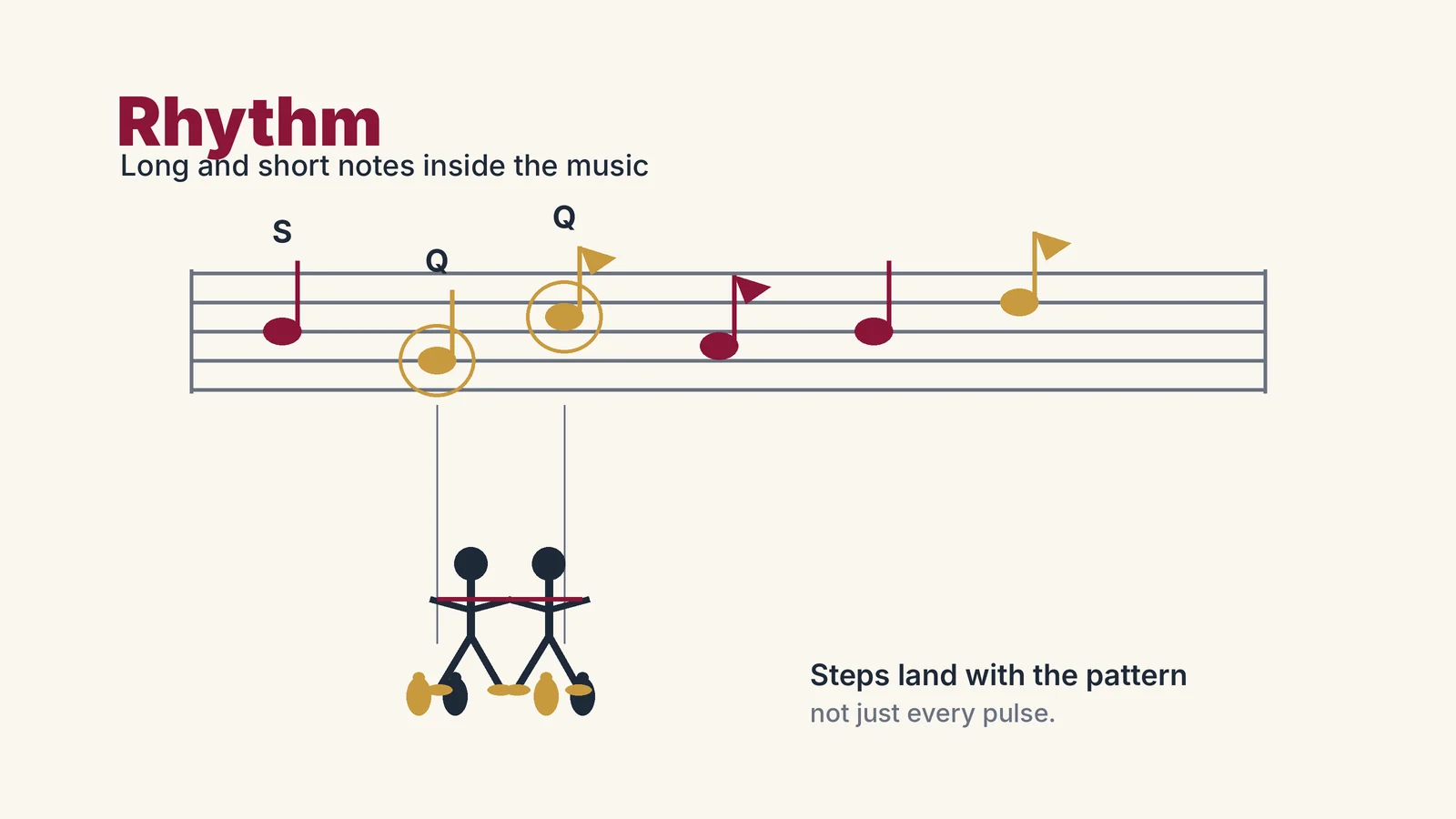
Rhythm is the pattern of long, short, and accented notes inside the music—the part that makes a Foxtrot sound like a Foxtrot and a Cha Cha sound like a Cha Cha. Here’s what rhythm means, how it’s different from beat and tempo, and the rhythm patterns of the main ballroom dances.
Definition of rhythm
Rhythm
- Pronunciation
- rith-uhm
- Skill category
- Music & timing
- Related terms
- beat, count, tempo, timing, measure, syncopation, slow-quick-quick
- Full guide
- How to Count Ballroom Dance Music
In ballroom dance, rhythm is the pattern of long, short, and accented notes within the music—separate from tempo (speed) and beat (the underlying pulse). Two songs at the same tempo can have totally different rhythms. Each ballroom dance has its own characteristic rhythm pattern that gives it its distinctive feel.
Tempo tells you how fast. Beat tells you when. Rhythm tells you what makes the song feel like the dance it is.
What rhythm means in ballroom dance
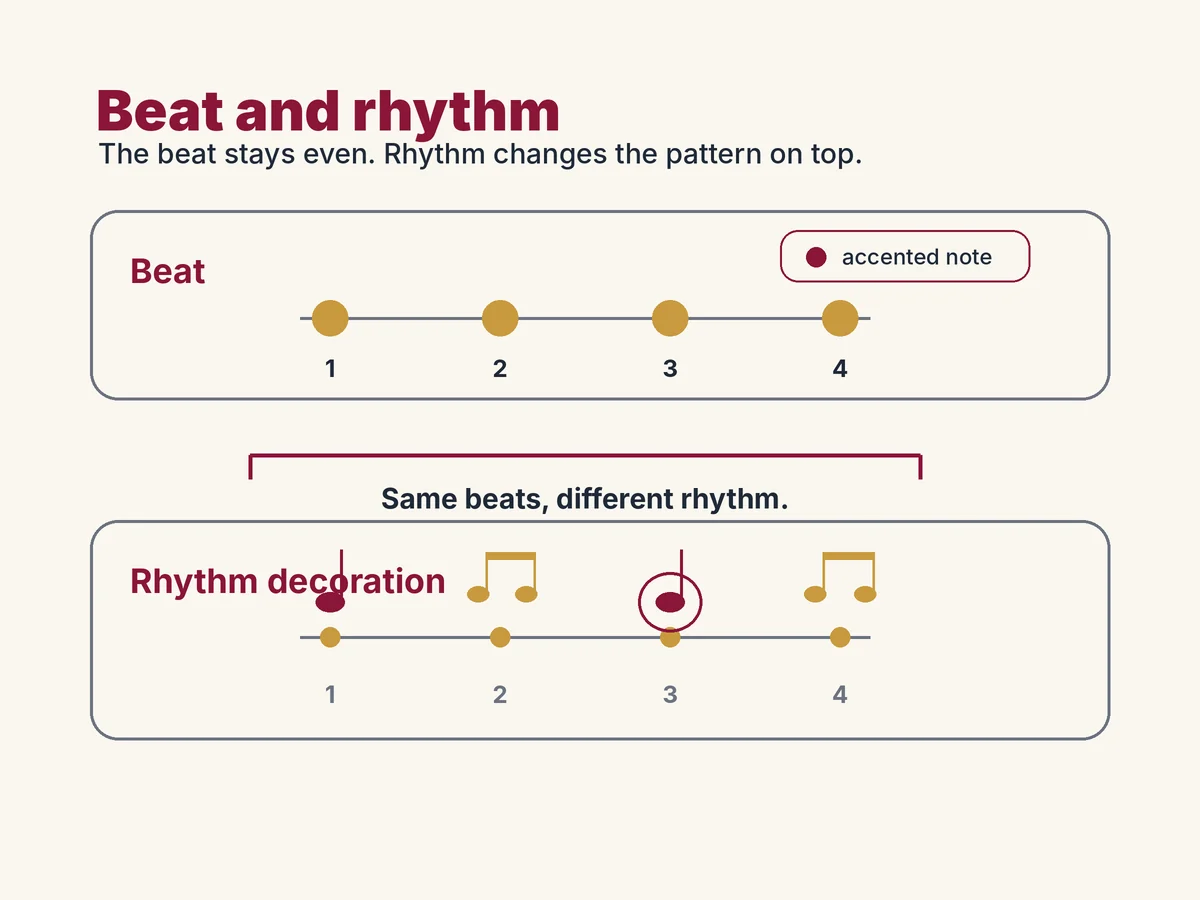
Rhythm is the pattern that sits on top of the beat. If beat is the steady underlying pulse—tick, tick, tick, tick—rhythm is what makes one tick longer, the next two short, and the fourth one accented. The beat is the engine; rhythm is what the engine sounds like.
Two songs at exactly the same tempo and same time signature can feel totally different because of their rhythm. A 120 BPM Foxtrot and a 120 BPM Cha Cha both have four beats per measure, but the rhythm patterns are different—Foxtrot wants long, smooth notes and Cha Cha wants tight, syncopated ones.
For ballroom dancers, rhythm is what tells you which dance fits a song. Genre helps, tempo helps, but the rhythm pattern is the final tell.
Rhythm vs beat vs tempo vs count
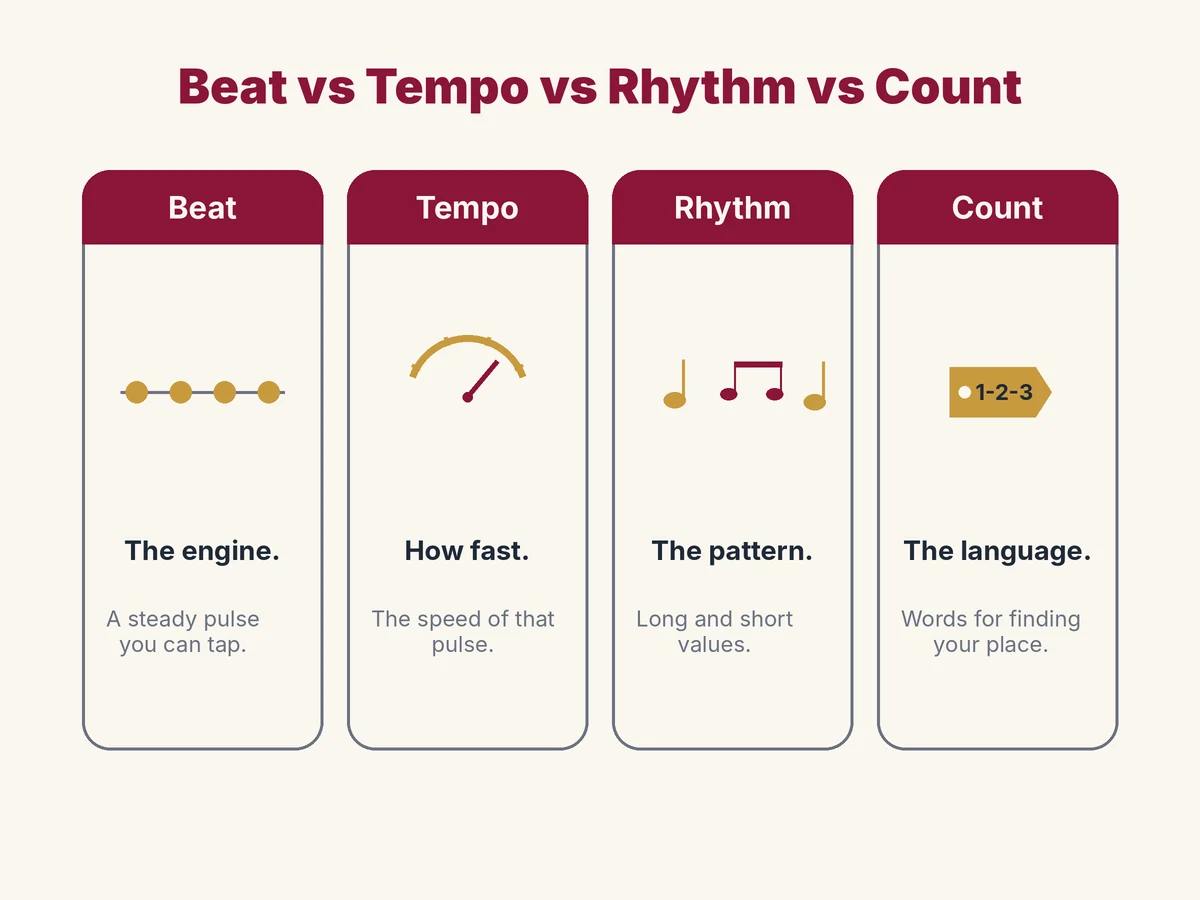
Four terms that sound similar and get mixed up constantly.
| Term | What it is | Example |
|---|---|---|
| Beat | The steady pulse of the music | The tick-tick-tick you can clap along to |
| Tempo | How fast the beats go | 120 BPM (beats per minute) |
| Rhythm | The pattern of long, short, and accented notes | S-Q-Q for Foxtrot; Q-Q-S for Rumba |
| Count | The numbers dancers say out loud | “1-2-3” for Waltz; “2-3-cha-cha-cha” for Cha Cha |
The neat way to remember it: beat is the engine, tempo is the speed, rhythm is the pattern, count is the language. Rhythm and count overlap a lot in practice, but rhythm is the musical idea and count is the spoken shorthand dancers use to teach it.
Why rhythm matters
Beat and tempo get you to step on time. Rhythm is what makes a dance look like the dance it is.
A beginner who steps on every beat but ignores the rhythm pattern will be technically “on time” but the dance will feel flat. Foxtrot without slow-quick-quick just feels like walking. Cha Cha without the cha-cha-cha syncopation feels like Rumba.
Rhythm affects:
- How long each step takes—some steps are slow (two beats), some are quick (one beat).
- Which beats you accent with your body—every dance has its “feel” beats.
- Where syncopation lives (the “&” counts between beats).
- Which dance fits a given song.
- Whether your dance reads as the dance it’s supposed to be.
Rhythm patterns by ballroom dance
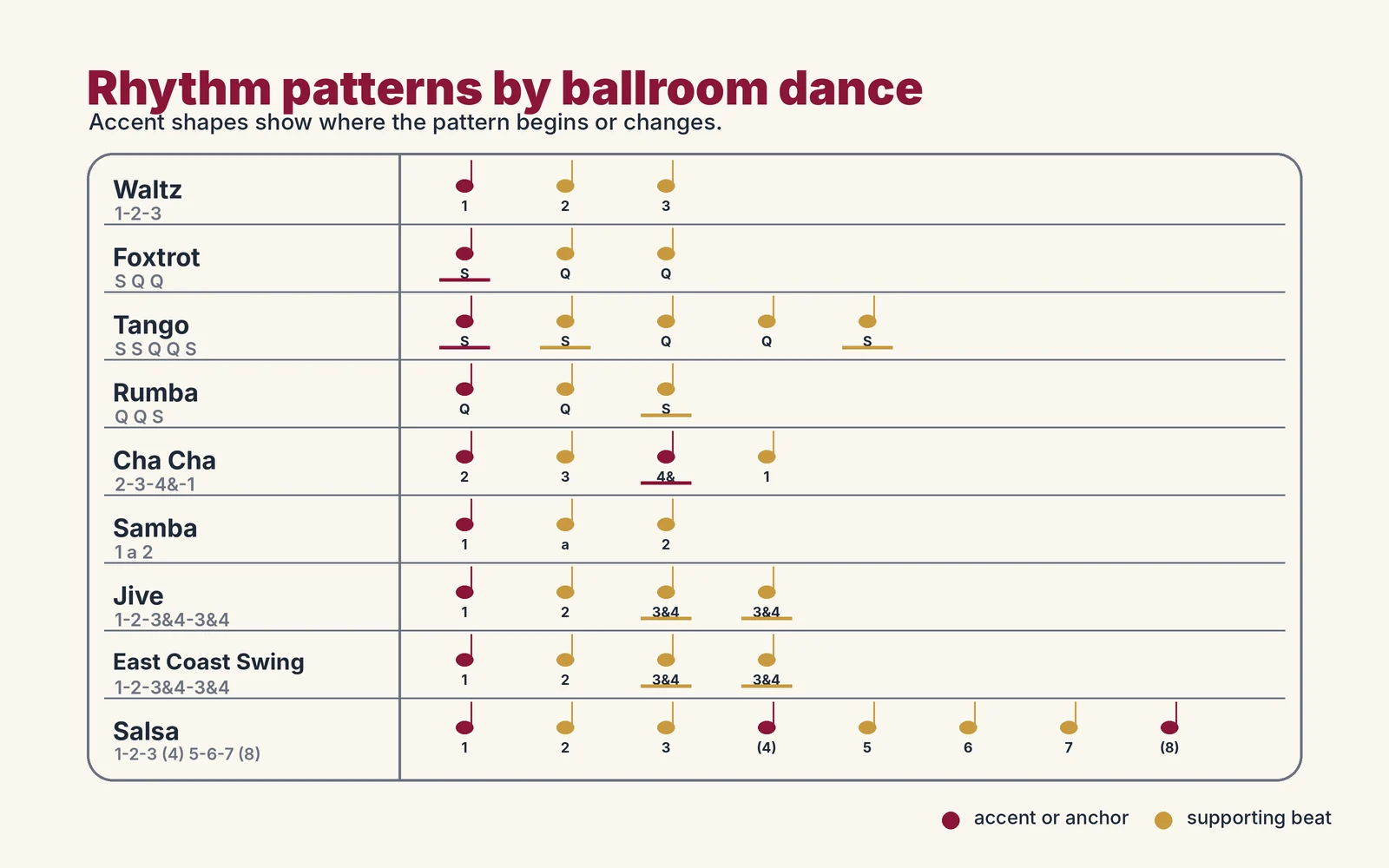
These are the foundational rhythm patterns dancers learn first. Many dances have multiple patterns for different figures; what’s shown below is the standard basic.
Smooth and Standard dances
- Slow Waltz: 1-2-3 in 3/4 time, with a strong accented “1.” All three beats are equal length; the rhythm comes from the rise and fall pattern more than from long/short notes.
- Foxtrot: Slow-Quick-Quick (S-Q-Q) in 4/4. The slow takes two beats, each quick takes one. The S-Q-Q is the signature.
- Ballroom Tango: Slow-Slow-Quick-Quick-Slow (S-S-Q-Q-S) for the basic. Sharp, staccato feel rather than smooth.
- Viennese Waltz: 1-2-3 in 3/4, but at fast tempo (around 174-180 BPM) the rhythm runs continuously—less accent on “1” than Slow Waltz.
- Quickstep: Slow-Slow-Quick-Quick-Slow or Q-Q-S patterns built into longer phrases. Light and bouncy.
Rhythm and Latin dances
- Rumba: Quick-Quick-Slow (Q-Q-S) in 4/4 for the box basic. American Rumba differs slightly from International.
- Cha Cha: 2-3-4&-1 or spoken as “2-3-cha-cha-cha.” The syncopated cha-cha-cha falls on 4-and-1.
- Samba: 1-a-2 with the “a” pickup. Bouncy, with a distinctive bounce action that defines the rhythm as much as the count.
- Jive: 1-2-3a4-3a4—rock step plus two triple-step chasses. Syncopated and energetic.
- Paso Doble: 1-2 in 2/4, sharp marching feel with strong accents.
- Bolero: Slow-Quick-Quick like Rumba but at a slightly different tempo and with more rise and fall.
Swing and Social dances
- East Coast Swing: 1-2-3&4-3&4—rock step plus two triple steps.
- West Coast Swing: 1-2-3&4-5-6 for the basic, with anchor steps that define the WCS feel.
- Salsa: 1-2-3-pause-5-6-7-pause. Eight-count basic with a pause on 4 and 8.
- Bachata: 1-2-3-tap-5-6-7-tap with a hip pop on the tap.
- Lindy Hop: 6-count or 8-count basics, both built on rock-step + triple-step rhythms.
Many of these dances have alternate rhythm patterns for advanced figures. What’s above is the standard basic—learn that first, add variations later.
Common rhythm mistakes
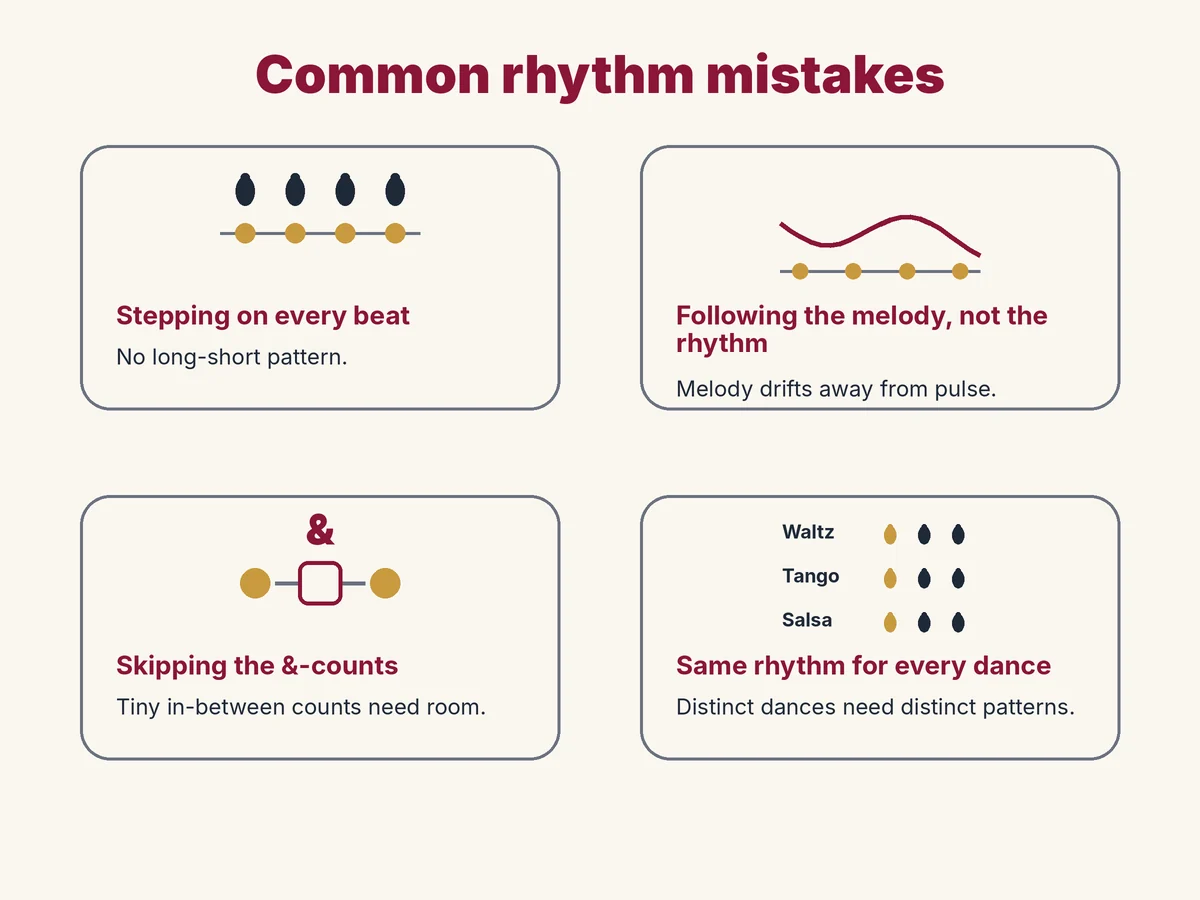
Stepping on every beat regardless of the rhythm pattern
Fix: Match the dance’s rhythm. Foxtrot wants long-short-short, not four equal steps. Slow steps take two beats; don’t rush them.
Treating rhythm and tempo as the same thing
Fix: Tempo is how fast. Rhythm is the pattern. You can speed up or slow down a song without changing its rhythm.
Ignoring the “&” counts
Fix: The “&” (and-counts) are where syncopation lives. Cha Cha’s “cha-cha-cha” lives on 4-and-1. Jive’s triple-steps live on 3-and-4. Skipping them flattens the dance.
Stepping the same way for every dance
Fix: Each dance has its own rhythm. Foxtrot is smooth; Tango is sharp; Cha Cha is syncopated; Samba bounces. Lean into the feel.
Following the melody instead of the rhythm
Fix: Vocals and melody can lead you off-beat. Use the drums and bass to find the rhythm pattern. Snare on 2 and 4 is the classic ballroom anchor.
Confusing “slow” with “late”
Fix: A slow step takes two beats; it’s not late—it’s long. Hold the weight through both beats before stepping again.
Trying to learn rhythm without counting out loud
Fix: Beginners should count audibly while practicing. “Slow-quick-quick” or “1-2-3” or “cha-cha-cha” reinforces the pattern in your body.
Practice with rhythm
Two tools: a rhythm-tagged practice playlist (so you can hear the pattern clearly) and counting out loud. Practice one dance’s rhythm at a time until you can identify the pattern just by listening.
Workflow that works: pick a single dance, play 3-4 songs in that style back-to-back, and count the rhythm pattern out loud (“slow-quick-quick” or “cha-cha-cha”) while listening. Don’t move yet—just listen and count. Once the pattern is locked in your ear, start stepping.
-
Foxtrot rhythm (S-Q-Q)
Practice hearing slow-quick-quick. Smooth, mid-tempo 4/4 songs make the pattern obvious.
-
Waltz rhythm (1-2-3)
3/4 time with a strong “1.” Listen for the heavy downbeat every three beats.
-
Cha Cha rhythm (2-3-cha-cha-cha)
Syncopated Latin 4/4. The cha-cha-cha lives on 4-and-1.
-
BallroomPages Music (Telegram)
Mixed-rhythm practice tracks across multiple dance styles.
Telegram Music hub More rhythm-specific playlists coming soon
If you can’t hear the rhythm pattern clearly, start with the snare drum—it usually hits on the same beats as the dance’s “quick” or accented counts. Once you can pick out the snare, the rhythm follows.
FAQ
Rhythm FAQ
What does rhythm mean in ballroom dance?
Rhythm is the pattern of long, short, and accented notes within the music—the part that gives each ballroom dance its distinctive feel. It’s different from beat (the pulse) and tempo (the speed). Foxtrot’s rhythm is slow-quick-quick; Waltz is 1-2-3 with a strong “1”; Cha Cha is 2-3-cha-cha-cha.
What’s the difference between rhythm and beat?
Beat is the steady underlying pulse—tick, tick, tick, tick. Rhythm is the pattern of long, short, and accented notes on top of those beats. Beat is the engine; rhythm is the pattern the engine makes.
What’s the difference between rhythm and tempo?
Tempo is how fast (measured in BPM). Rhythm is the pattern. You can play the same song at different tempos without changing its rhythm.
What’s the difference between rhythm and count?
Rhythm is the musical idea—the actual pattern of long and short notes. Count is the spoken shorthand dancers use to teach that pattern. Foxtrot’s rhythm is slow-long-short-short; its count is “slow-quick-quick” (or “S-Q-Q”).
How do I learn a dance’s rhythm?
Listen first, step later. Pick 3-4 songs in the dance’s style and count the rhythm pattern out loud while just listening. Once the pattern is locked in your ear, start stepping.
What is syncopation?
Syncopation is when the rhythm accents a beat you wouldn’t expect—usually an off-beat or the “&” between beats. Cha Cha’s “cha-cha-cha” on 4-and-1 is syncopated. Jive’s triple-steps are syncopated. See Syncopation for more.
Can two dances share a rhythm pattern?
Yes—Foxtrot and Bolero both use slow-quick-quick patterns, for example. But the tempo, time signature, and body action are different, so the dances still look and feel distinct.
Why does the same song work for multiple dances?
If the song’s rhythm fits more than one dance’s basic pattern, it can work for either. A 4/4 song at 120 BPM with a smooth feel could be Foxtrot or slow Rumba. The dancer’s rhythm choice decides which dance it becomes.
Editorial
Sources and review notes
This glossary entry should be reviewed by a qualified ballroom instructor before launch. Rhythm patterns follow widely accepted conventions from NDCA, WDSF, ISTD, and Arthur Murray syllabus materials, plus Dance Vision and other standard references. Exact patterns vary slightly by syllabus and competition body—match your instructor’s convention within a single learning context.
This is dance terminology, not medical advice. Ballroom Pages follows an editorial policy of education-first guidance. Questions? Contact us. Updated May 27, 2026.