
Glossary
Downbeat in Ballroom Dance
If you have ever tapped your foot to music, you already feel the downbeat—the strong “one” that anchors every bar. It is the beat dancers count from, start figures on, and land their weight into. Here is exactly what the downbeat is, how it differs from the upbeat, how to find it in any song, and why it matters for every dance you will ever learn.
Definition of downbeat
Downbeat
- Pronunciation
- DOWN-beet
- Skill category
- Music & timing
- Companion term
- Upbeat (the beat that leads into it)
- Related terms
- beat, accent, count, measure, upbeat, off-beat, timing
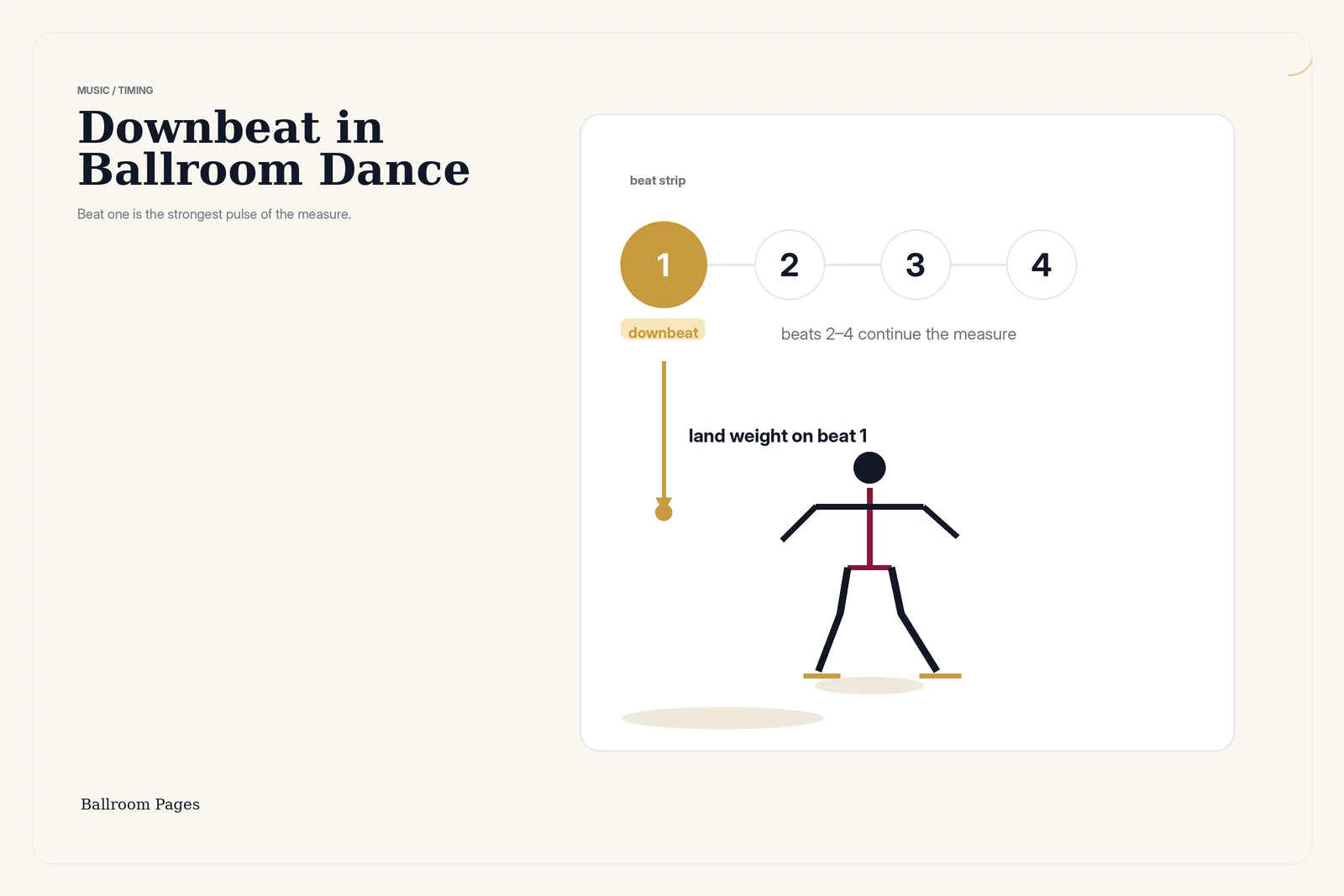
In music and dance, the downbeat is the first beat of a measure—the strongest pulse, usually marked by the bass drum. In ballroom it is where most figures start and where the musical accent usually falls; dancers count it as beat 1.
Find the downbeat and you have found the front door of the music. Everything else is counted from there.
What the downbeat means in music and dance
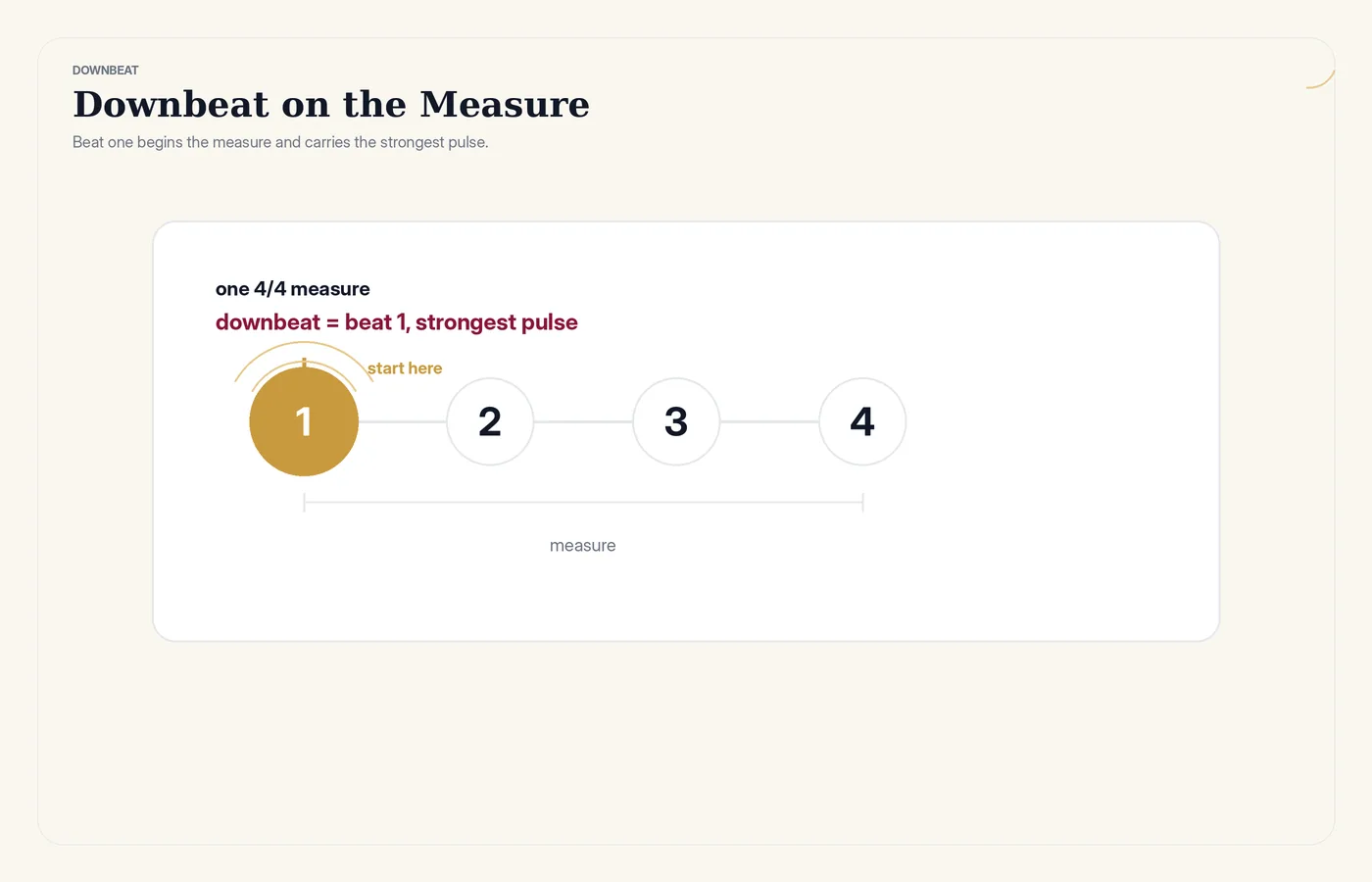
Music is organized into measures—small, repeating groups of beats. The downbeat is the first beat of each measure, and it carries the most weight. It is the pulse you naturally nod your head or tap your foot to, the beat a conductor marks with a downward motion of the baton (which is where the name comes from).
For dancers, the downbeat is home base. It is the beat you count as “1,” the beat most figures begin on, and the beat you sink your weight into. Because it is the strongest pulse, it is also the easiest beat to hear—which is exactly why finding it is the first timing skill every beginner learns. Everything else in a piece of music is counted in relation to the downbeat.
Downbeat vs upbeat
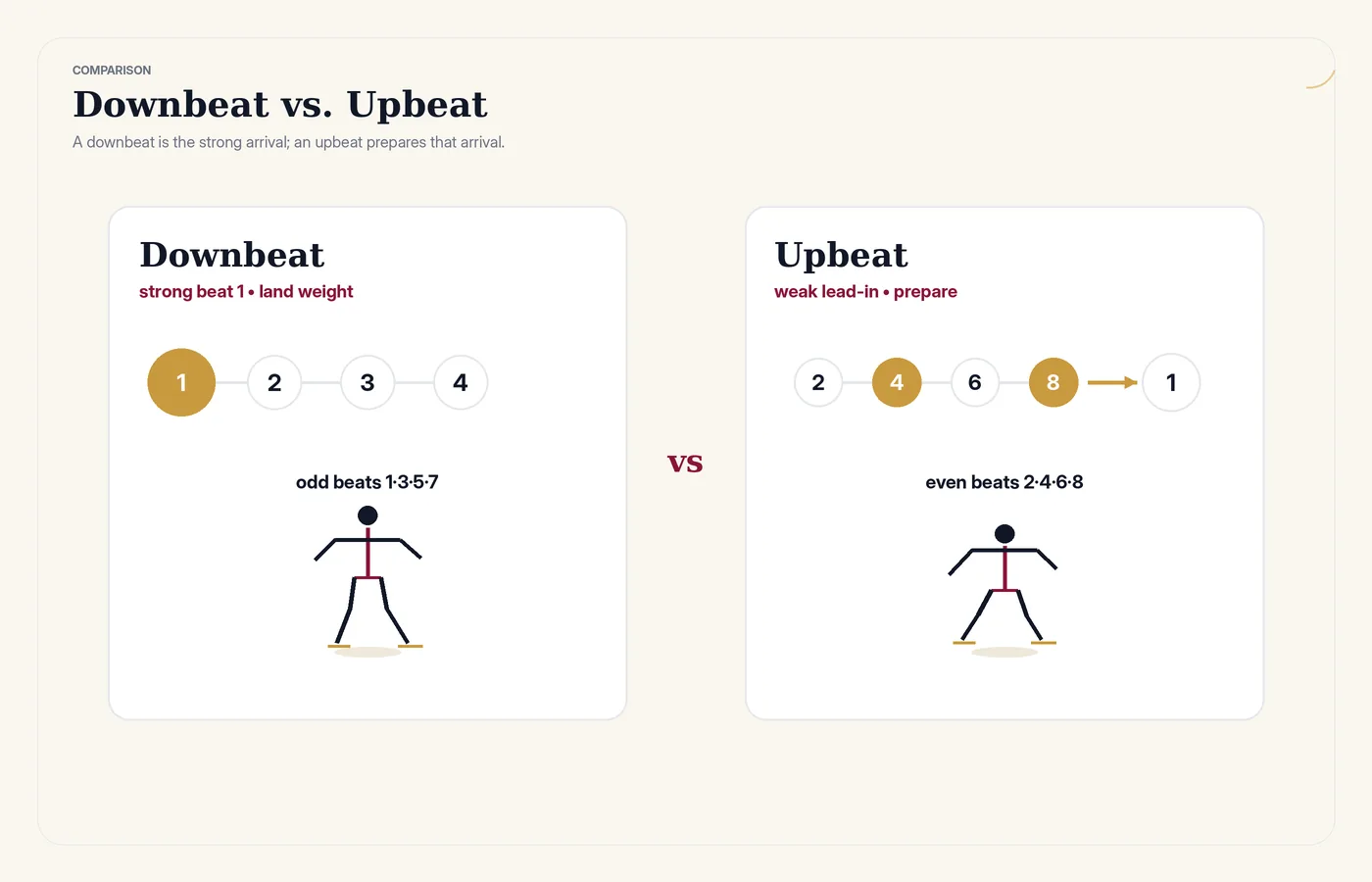
The two work as a pair. The downbeat is the strong beat you land on; the upbeat is the weaker beat that leads into it.
| Downbeat | Upbeat |
|---|---|
| The first, strong beat of the measure | The weak beat that leads into the downbeat |
| Counted as “1” | The “pickup” before “1” |
| Where you land weight | Where you prepare the next move |
| Odd beats: 1, 3, 5, 7 | Even beats: 2, 4, 6, 8 |
How to find the downbeat
Finding “1” is a listening skill you can build in minutes:
Finding beat 1
- Listen for the heaviest pulse. The downbeat is usually the loudest, often the bass drum or bass note.
- Feel where the phrase restarts. Melodies tend to begin again on the downbeat.
- Count in groups. Try counting 1-2-3-4; when the strong beat keeps landing on “1,” you have it.
- Nod, then step. Nod on the strong beat first, then replace the nod with a step.
For a fuller walkthrough, see how to count ballroom dance music.
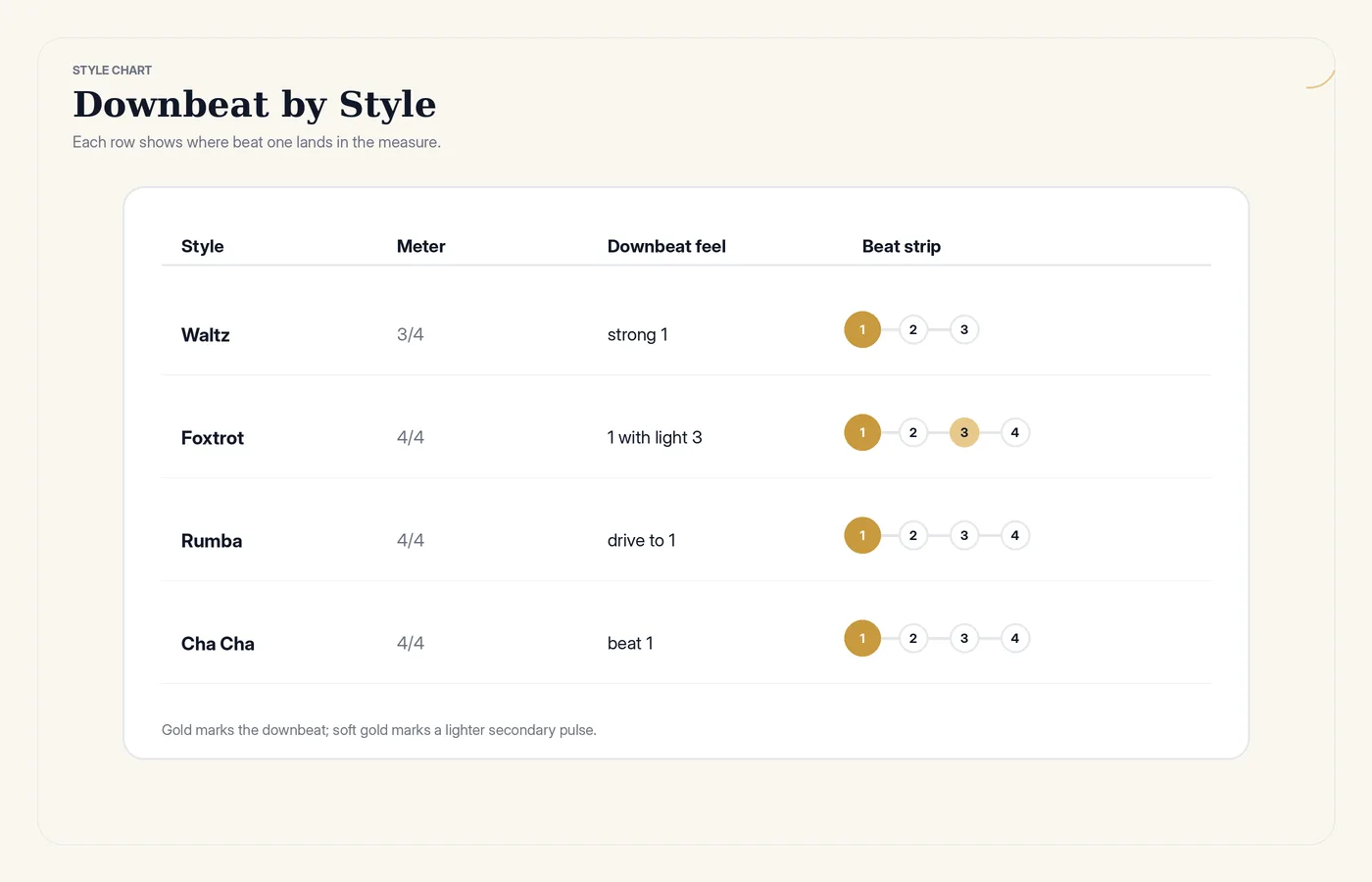
The downbeat by dance style
Downbeat and the accent
The downbeat and the accent are closely linked but not identical. The downbeat is a position—beat 1. An accent is emphasis. Because beat 1 is naturally the strongest pulse, the accent most often lands there, which is why hitting the downbeat makes dancing look musical. But a song can also accent other beats, and dancers can choose to accent the off-beat for contrast. Start by owning the downbeat; add the subtler accents later.
Common downbeat mistakes
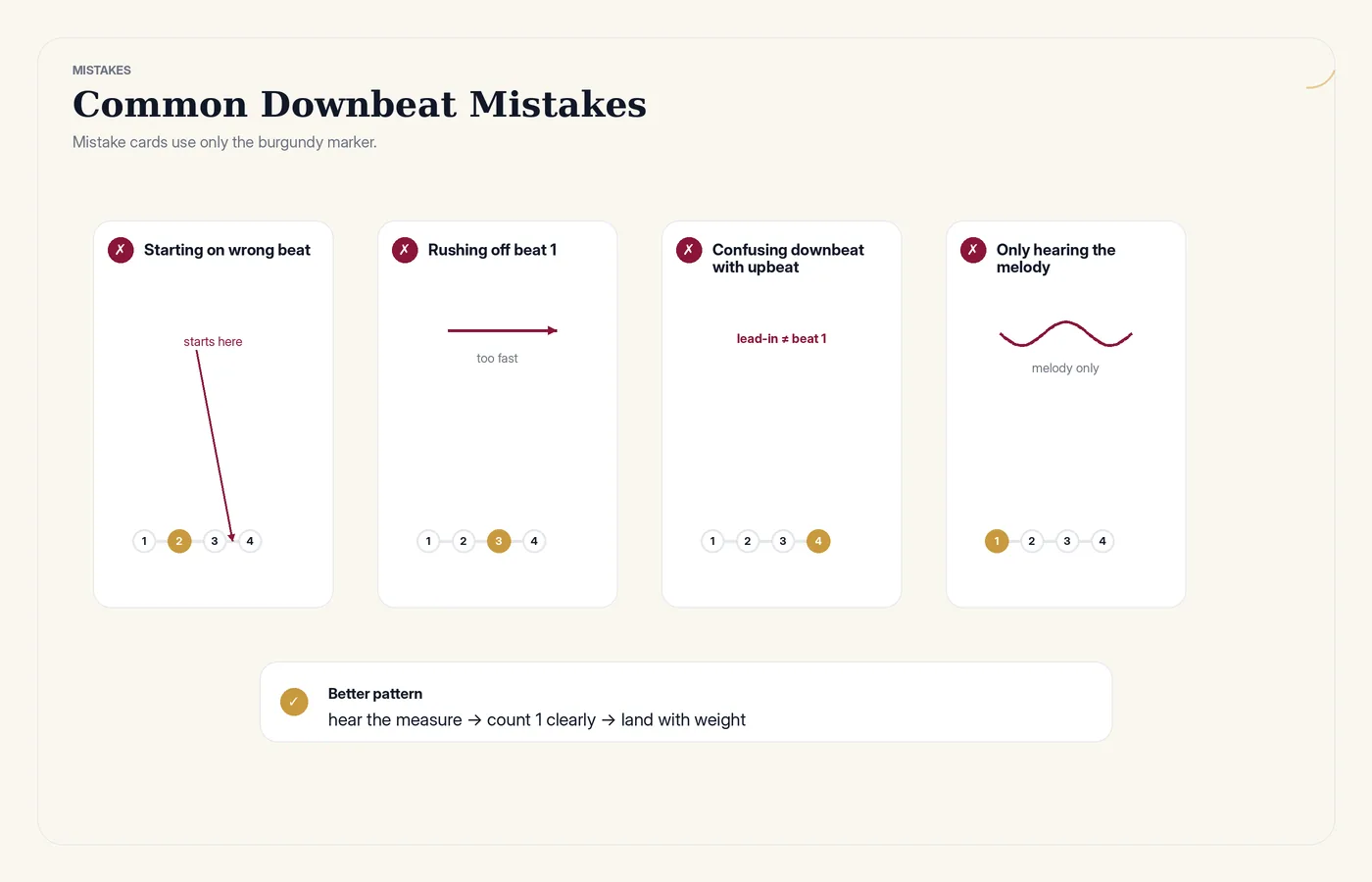
Starting on the wrong beat
Fix: Find “1” before you move. Clap along until the strong beat reliably lands on 1.
Rushing off the downbeat
Fix: Let beat 1 arrive fully and commit your weight before moving to 2.
Confusing downbeat and upbeat
Fix: The downbeat is the strong beat you land on; the upbeat is the softer beat that leads into it.
Only hearing the melody
Fix: Listen down to the bass and drums—the downbeat lives in the rhythm section, not the tune.
Practice hearing the downbeat
Train your ear with music you can dance to. Clap “1,” then move it into your feet:
- Clap only on 1. Play a Waltz and clap once per bar on the downbeat for a full song.
- Big step on 1. Walk to a 4/4 track with a bigger step on “1” and smaller steps on 2-3-4.
- Nod and count. Nod on every downbeat while counting 1-2-3-4 out loud until it is automatic.
-
Waltz (clear downbeat)
3/4 time. The strongest, clearest “1” in ballroom—perfect for finding the downbeat.
-
Rumba (drive to 1)
Slow 4/4. Feel the movement pull into the downbeat.
-
Count the music
Read the companion guide to counting ballroom music and finding beat 1.
-
BallroomPages Music (Telegram)
Mixed-style practice tracks. Beat-finding drills coming soon.
FAQ
Downbeat FAQ
What is a downbeat?
The downbeat is the first beat of a measure—the strongest pulse, usually carried by the bass drum. In dance it is counted as beat 1, and it is where most figures start and where the accent usually falls.
What is the difference between the downbeat and the upbeat?
The downbeat is the strong first beat of the measure that you land on. The upbeat is the weaker beat that immediately precedes it and leads into it—the “pickup.” In dance shorthand, downbeats are the odd beats (1, 3) and upbeats the even beats (2, 4).
How do I find the downbeat in a song?
Listen for the heaviest, loudest pulse—usually the bass drum—and notice where the melody restarts. Count 1-2-3-4; when the strong beat keeps landing on “1,” that is the downbeat.
Is the downbeat always beat 1?
Yes—by definition the downbeat is the first beat of the measure. In 3/4 time (Waltz) that is 1 of 1-2-3; in 4/4 it is 1 of 1-2-3-4. The first beat carries the strongest natural stress.
Do dancers always start on the downbeat?
Most basic figures start on the downbeat, which is why finding “1” is the first timing skill to learn. More advanced choreography may begin on other beats or use the upbeat as a preparation, but the downbeat remains the reference point.
Editorial
Sources and review notes
This glossary entry should be reviewed by a qualified ballroom instructor before launch. Downbeat and time-signature descriptions follow widely accepted conventions from music theory and ballroom syllabus materials; accent placement varies by song and arrangement.
This is dance terminology, not music-theory instruction. Ballroom Pages follows an editorial policy of education-first guidance. Questions? Contact us. Updated July 9, 2026.