
Glossary
Off-Beat in Ballroom Dance
Between every numbered beat is a little “and”—and that is where a lot of the fun in dancing hides. The off-beat is the weak part of the beat, the space where syncopation, quick steps, and rhythmic surprise live. Here is what the off-beat is, how it differs from the on-beat, how the “&” creates syncopation, and which dances make the most of it.
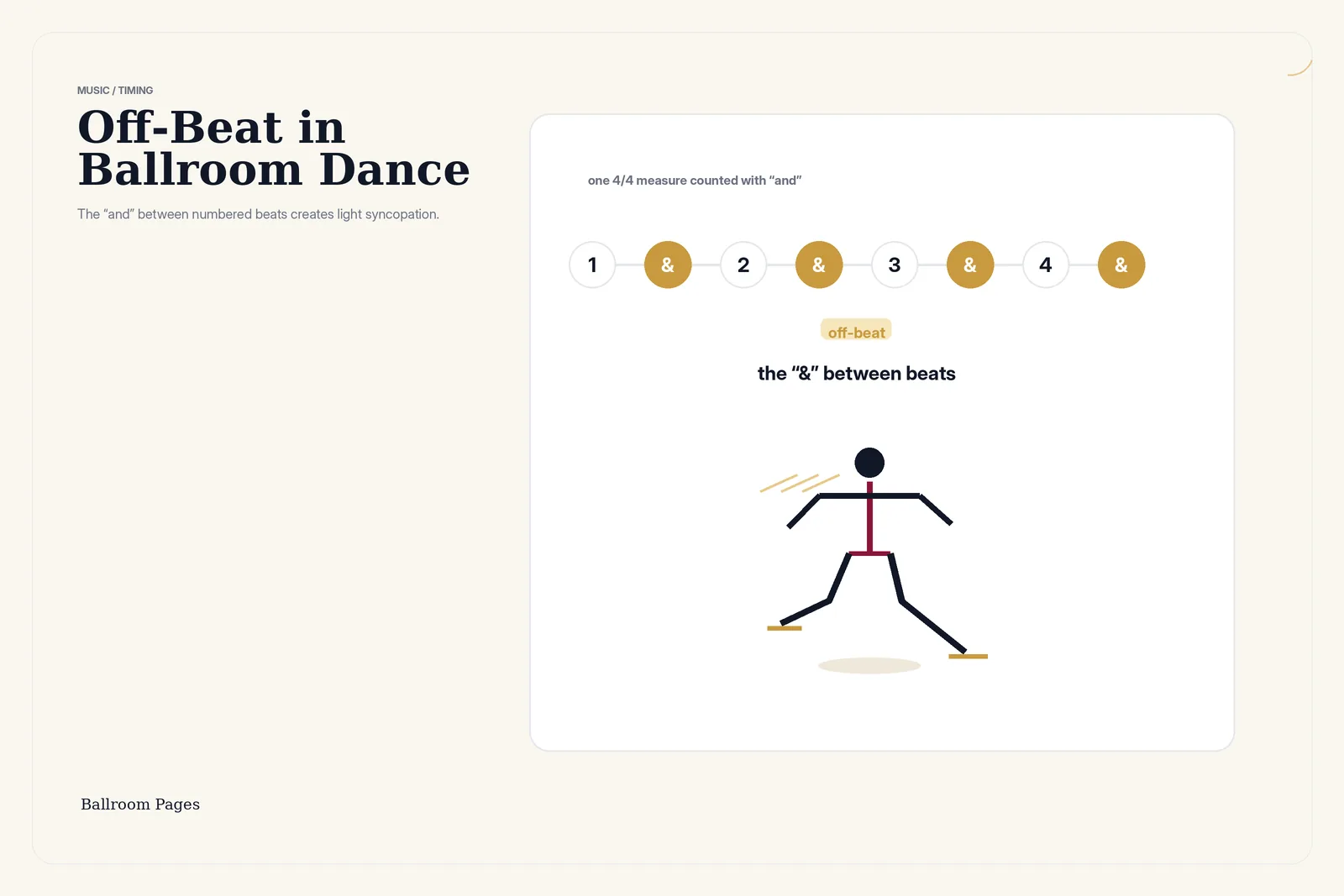
Definition of off-beat
Off-beat
- Pronunciation
- OFF-beet
- Skill category
- Music & timing
- Companion term
- Syncopation (accenting the off-beat)
- Related terms
- on-beat, downbeat, upbeat, beat, syncopation, count, accent
In music and dance, the off-beat is the weak part of the beat—the “&” between the numbered beats, or the weak beats of a measure. Accenting the off-beat creates syncopation, and dancing on the off-beat adds rhythmic contrast.
The on-beat is where the music expects you. The off-beat is where it surprises you.
What the off-beat means in music and dance
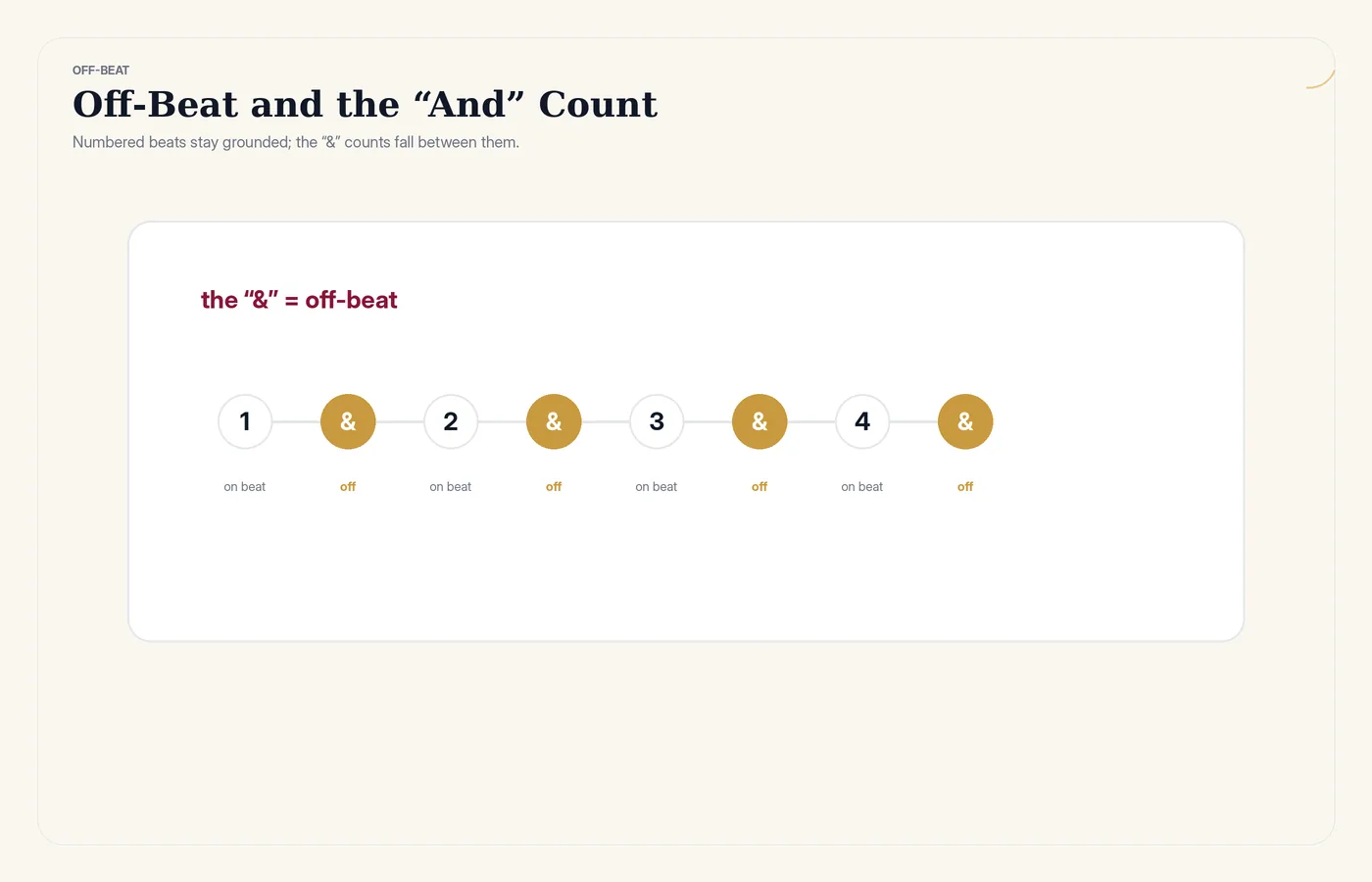
Every beat can be split in two: the strong front half, where the pulse lands, and the weak back half—the “and.” The off-beat is that weak part. When you count “1-and-2-and,” the numbers are on the beat and the “ands” are off the beat. More broadly, the off-beat can also mean the weak beats of a measure as opposed to the strong downbeat.
Landing on the off-beat feels different—lighter, quicker, a little unexpected. That is exactly why it is so useful: it is the source of rhythmic contrast, syncopation, and the little accents that make dancing feel alive rather than metronomic.
On-beat vs off-beat
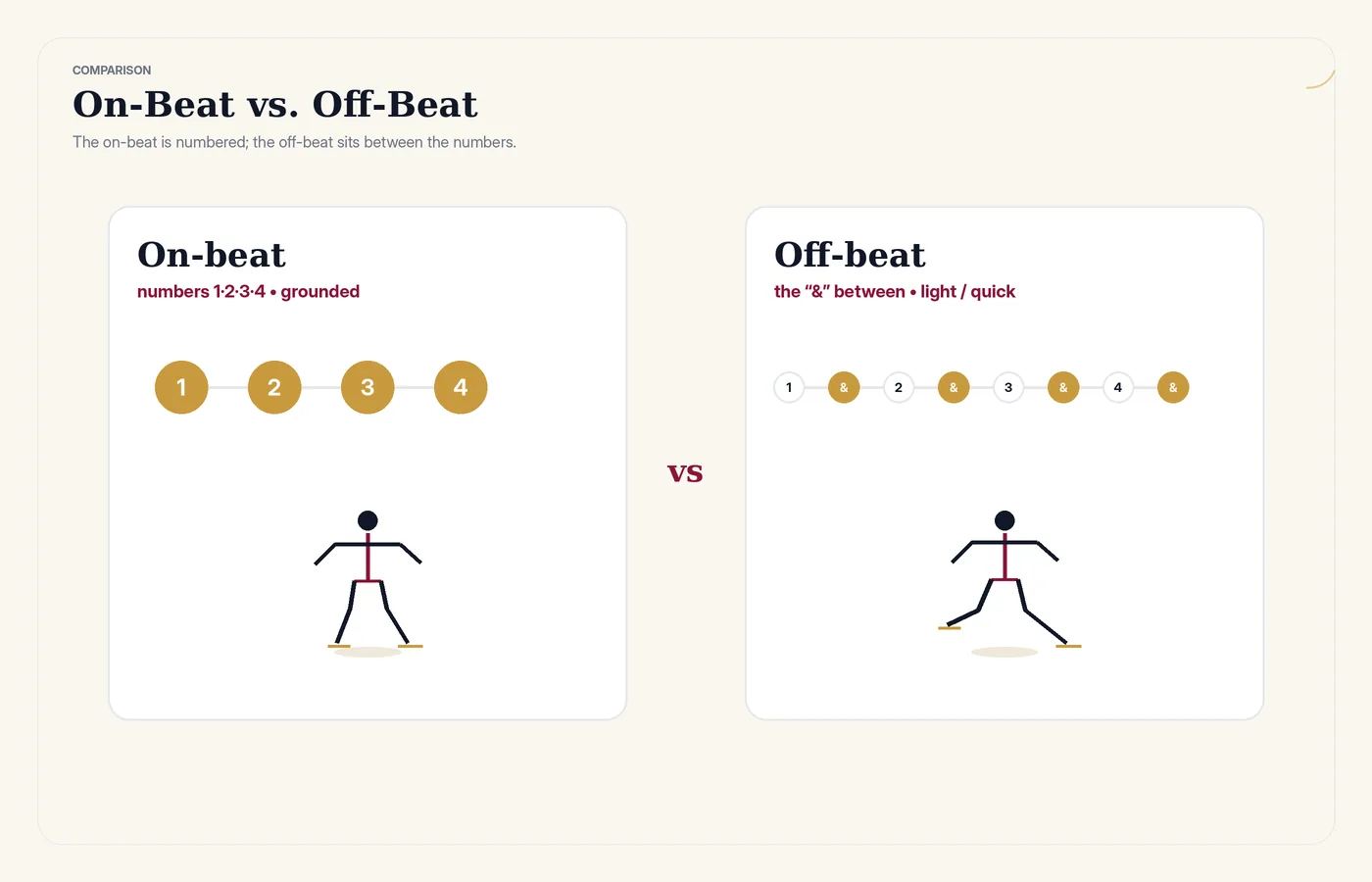
The clearest way to feel the off-beat is against its opposite, the on-beat.
| On-beat | Off-beat |
|---|---|
| The numbered beats: 1, 2, 3, 4 | The “&” between them (and the weak beats) |
| Where the strong pulse lands | Where the pulse does not land |
| Feels grounded and expected | Feels light, quick, surprising |
| Most basic steps | Syncopations and quick actions |
The “&” and syncopation
The off-beat is the home of syncopation—deliberately accenting a weak part of the beat instead of the strong one. When a step or an accent lands on the “and” rather than the number, the music feels like it leans forward or catches you by surprise.
Hearing the “and”
- Count it in. Say “1-and-2-and-3-and-4-and” evenly—the “ands” are the off-beats.
- Clap the ands. Clap only on the “ands” to feel the off-beat against the pulse.
- Notice the syncopation. When a song’s accent lands on an “and,” that is syncopation at work.
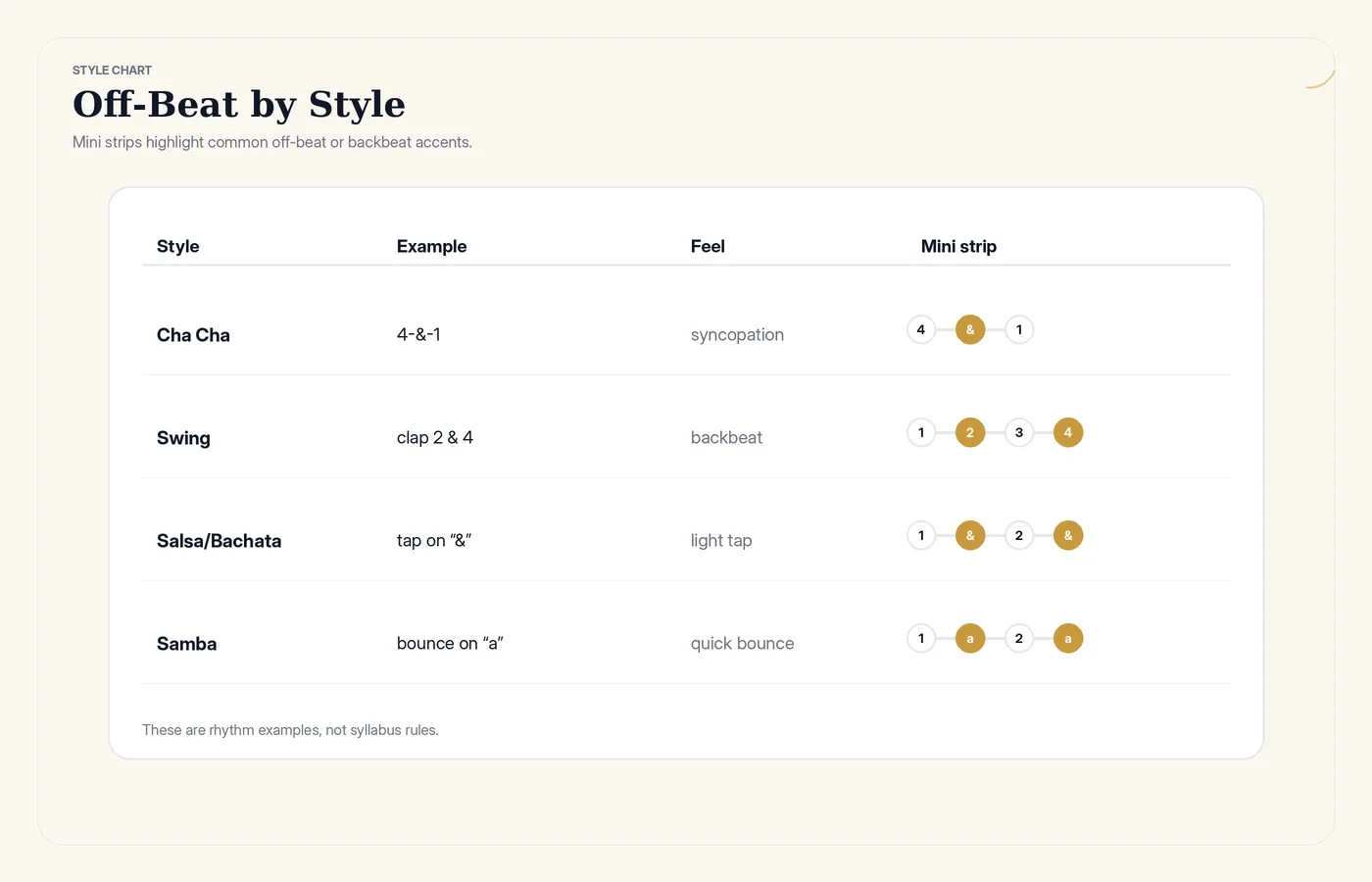
Off-beat by dance style
Off-beat, upbeat, and downbeat
These three music terms are easy to blur. Quick distinctions:
- Downbeat: the strong first beat of the measure (beat 1).
- Upbeat: the weak beat that leads into the downbeat; loosely, the even beats.
- Off-beat: the weak part of the beat—usually the “&” between the numbered beats.
In short: the downbeat is the strong beat, the upbeat is a whole weak beat, and the off-beat is the “and” in between. Get the beat solid first; the off-beat is a layer you add on top.
Common off-beat mistakes
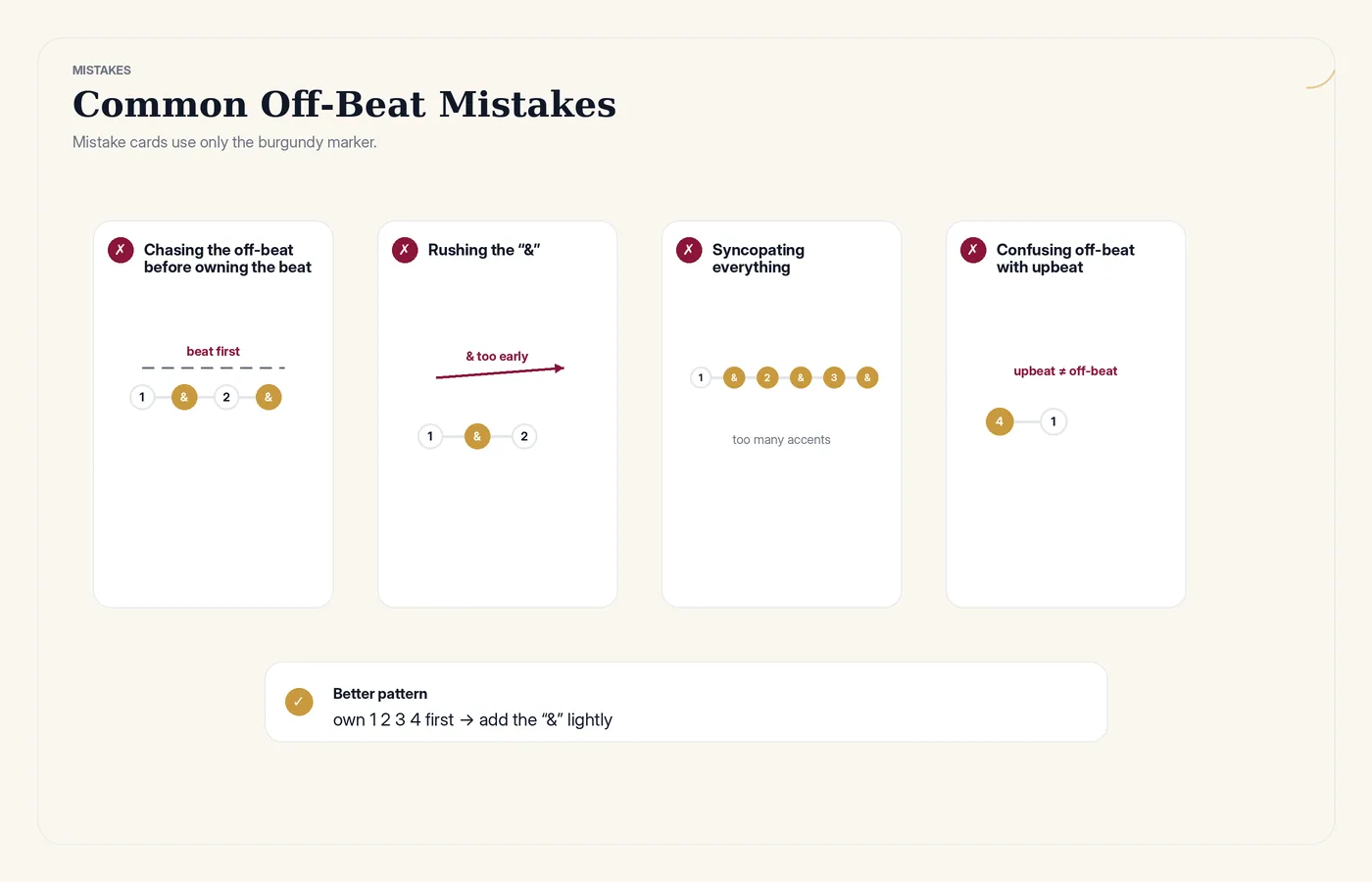
Chasing the off-beat before you own the beat
Fix: Lock in the on-beat first. You cannot dance the “and” reliably if you lose the number.
Rushing the “and”
Fix: The off-beat sits exactly halfway between beats. Keep the “ands” even, not early.
Syncopating everything
Fix: Off-beat accents work because they contrast the on-beat. Use them for effect, not constantly.
Confusing off-beat with upbeat
Fix: The off-beat is the “and” between beats; the upbeat is a whole weak beat leading into “1.”
Practice dancing off the beat
Build the off-beat on top of a solid beat, slowly:
- Count with ands. Over any track, count “1-and-2-and” evenly and clap only on the “ands.”
- Step, tap. Step on the beat, tap on the “and”—feel the two layers.
- Cha Cha timing. Practice the “4-and-1” of the Cha Cha to feel a real off-beat syncopation.
-
Cha Cha (4-and-1)
The classic off-beat syncopation. Feel the “and” between 4 and 1.
-
Swing (clap 2 & 4)
Lean into the weak beats with the classic off-beat clap.
-
Syncopation
Read the companion guide to accenting the off-beat.
-
BallroomPages Music (Telegram)
Mixed-style practice tracks. Syncopation drills coming soon.
FAQ
Off-beat FAQ
What is the off-beat in music?
The off-beat is the weak part of the beat—most often the “&” between the numbered beats (as in “1-and-2-and”), and sometimes the weak beats of a measure. Accenting it creates syncopation.
What is the difference between on-beat and off-beat?
The on-beat is where the strong pulse lands—the numbered beats 1, 2, 3, 4. The off-beat is where it does not—the “ands” between them. On-beat feels grounded; off-beat feels light and quick.
How do you dance on the off-beat?
First lock in the main beat, then place a step or accent on the “and” between beats. Counting “1-and-2-and” and clapping only on the “ands” is the fastest way to build the feel.
Is the off-beat the same as syncopation?
They are closely linked. The off-beat is the weak part of the beat; syncopation is what happens when you accent it, placing emphasis where the ear does not expect it.
Which dances use the off-beat most?
Cha Cha (the “4-and-1” syncopation), swing (triple steps and the 2-and-4 clap), and many Latin dances like Salsa and Samba lean heavily on off-beat rhythms.
Editorial
Sources and review notes
This glossary entry should be reviewed by a qualified ballroom instructor before launch. Off-beat and syncopation descriptions follow widely accepted conventions from music theory and ballroom practice; exact rhythm counts vary by dance and arrangement.
This is dance terminology, not music-theory instruction. Ballroom Pages follows an editorial policy of education-first guidance. Questions? Contact us. Updated July 9, 2026.