
Glossary
Beat in Ballroom Dance
A beat is the steady underlying pulse of music—the thing you tap your foot to. Here’s what a beat actually is, how it differs from count and tempo, and how to find the beat in any song.
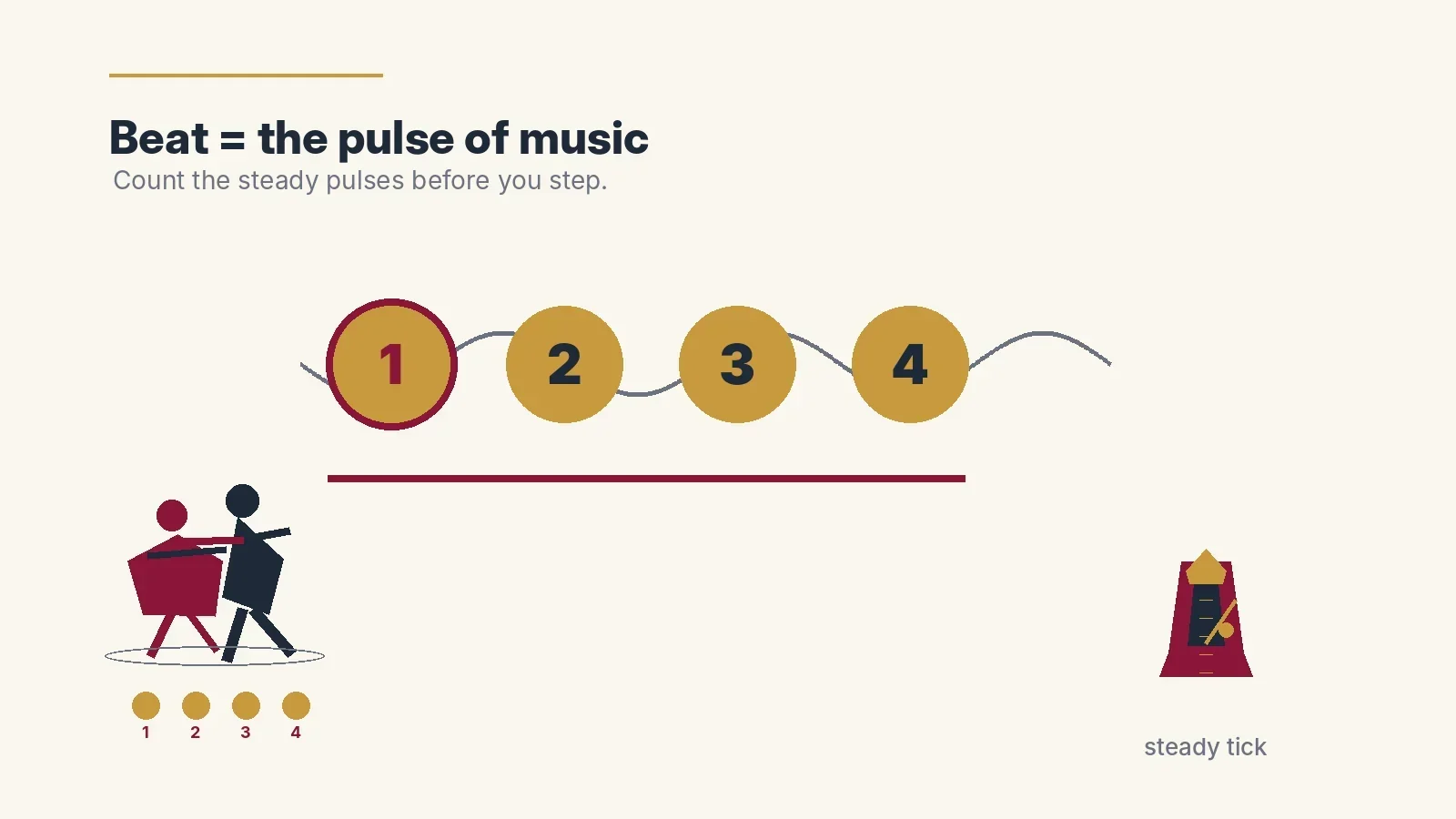
Definition of beat
Beat
- Pronunciation
- beet, rhymes with “feet”
- Skill category
- Music & timing
- Related terms
- count, tempo, measure, rhythm, downbeat, upbeat, off-beat
- Full guide
- How to Count Ballroom Dance Music
In ballroom dance, a beat is the steady underlying pulse of music—the regular pattern of strong points that keeps the song moving. When you tap your foot to a song, you’re tapping the beat. Beats are grouped into measures, and the dance count tells you which beats matter for each specific dance.
The beat is what makes a song danceable. The count is what makes it a Waltz, a Foxtrot, or a Rumba.
What a beat means in dance music
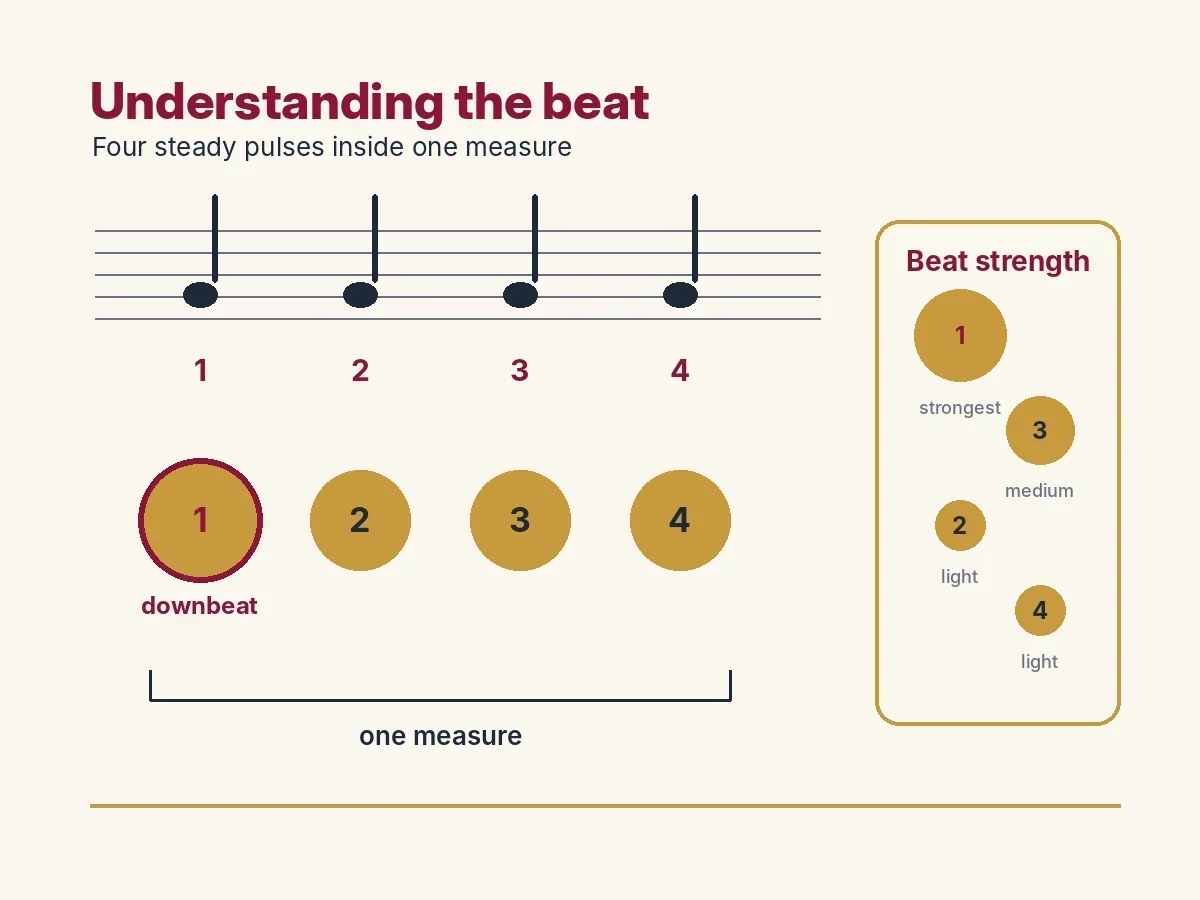
A beat is one of the regular, steady pulses that makes up the rhythm of a song. If you tap your foot to music, the steady pattern of taps is the beat. Music is built on beats the way text is built on syllables—they’re the basic units.
In ballroom dance, beats matter because they’re what your feet land on. A Waltz measure has three beats; a Foxtrot measure has four. Knowing where the beats are in a song is the first step toward dancing in time. Without that, no amount of step practice will look right.
Beats are usually evenly spaced. The space between them is determined by the song’s tempo—faster tempo, closer beats. But the beats themselves are always the steady reference points.
Beat vs count vs tempo
Beat, count, and tempo all describe the music, but each means something specific.
| Term | Plain-English meaning | How it relates to beat |
|---|---|---|
| Beat | The steady pulse of the music | The fundamental unit—everything else builds on this |
| Count | The spoken rhythm dancers use to organize steps | A count maps steps to specific beats (and sub-beats) |
| Tempo | How fast the beats happen (BPM) | Tempo measures how quickly beats occur in time |
Think of it this way: the beat is the heartbeat of the music, the tempo tells you how fast that heartbeat is, and the count is the dancer’s language for which heartbeats matter for the dance.
Strong vs weak beats (downbeat vs upbeat)
Not every beat in a measure is equally loud. The first beat—called the downbeat—is usually the strongest. Subsequent beats are weaker. In some dances, the second beat is also accented; in others, the second and fourth.
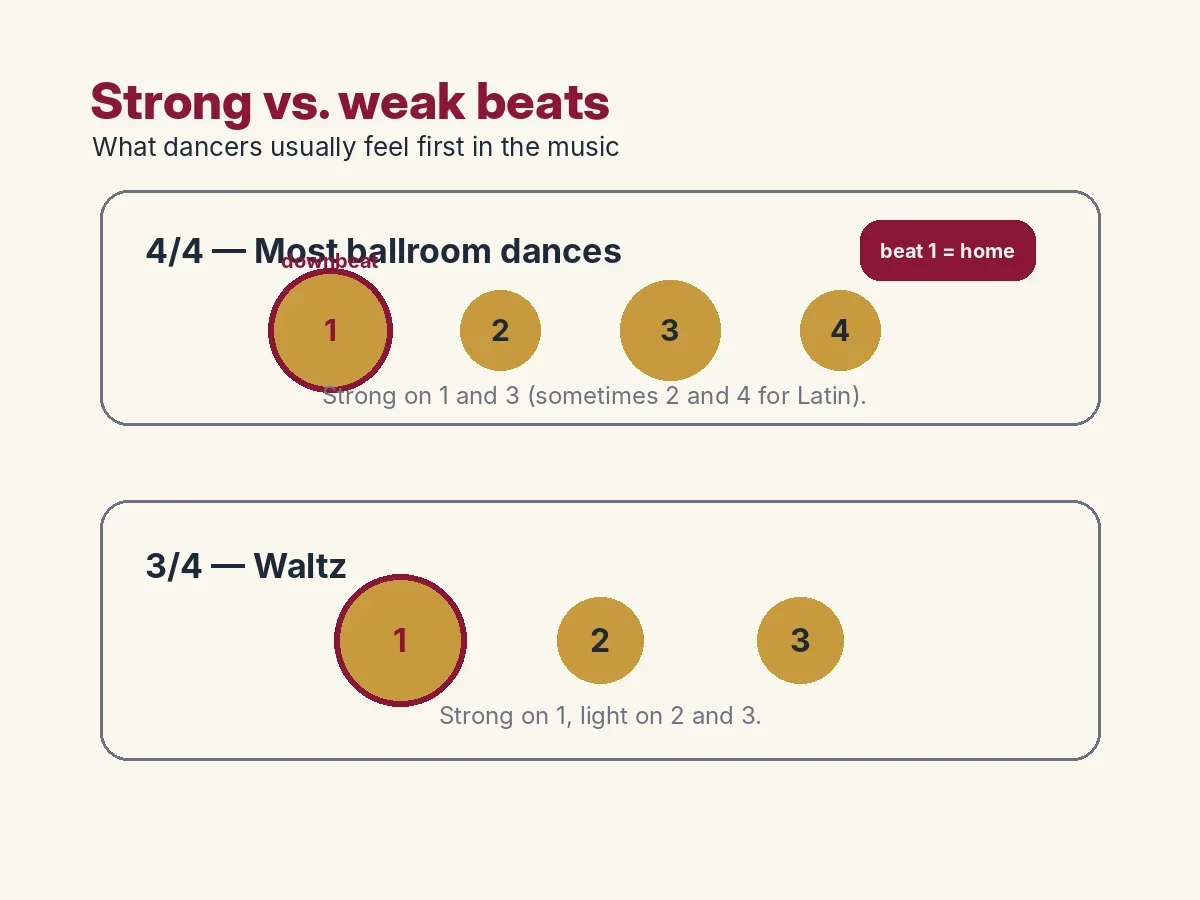
- Downbeat (beat 1): The strongest pulse. Usually marked by the bass drum or strongest instrumental hit.
- Backbeat (beats 2 and 4 in 4/4): Often accented by snare hits in pop, rock, and Latin music.
- Upbeat: The weaker beat that leads into a downbeat. The "and" between beats can also be considered upbeats.
- Off-beat: The exact midpoint between two beats—the "and" of every beat.
In ballroom, most dances start on beat 1 (the downbeat). A few—notably "On 2" Salsa—start on beat 2. Knowing where you start is the difference between dancing in time and dancing in counter-time.
How beats are grouped by dance time signature
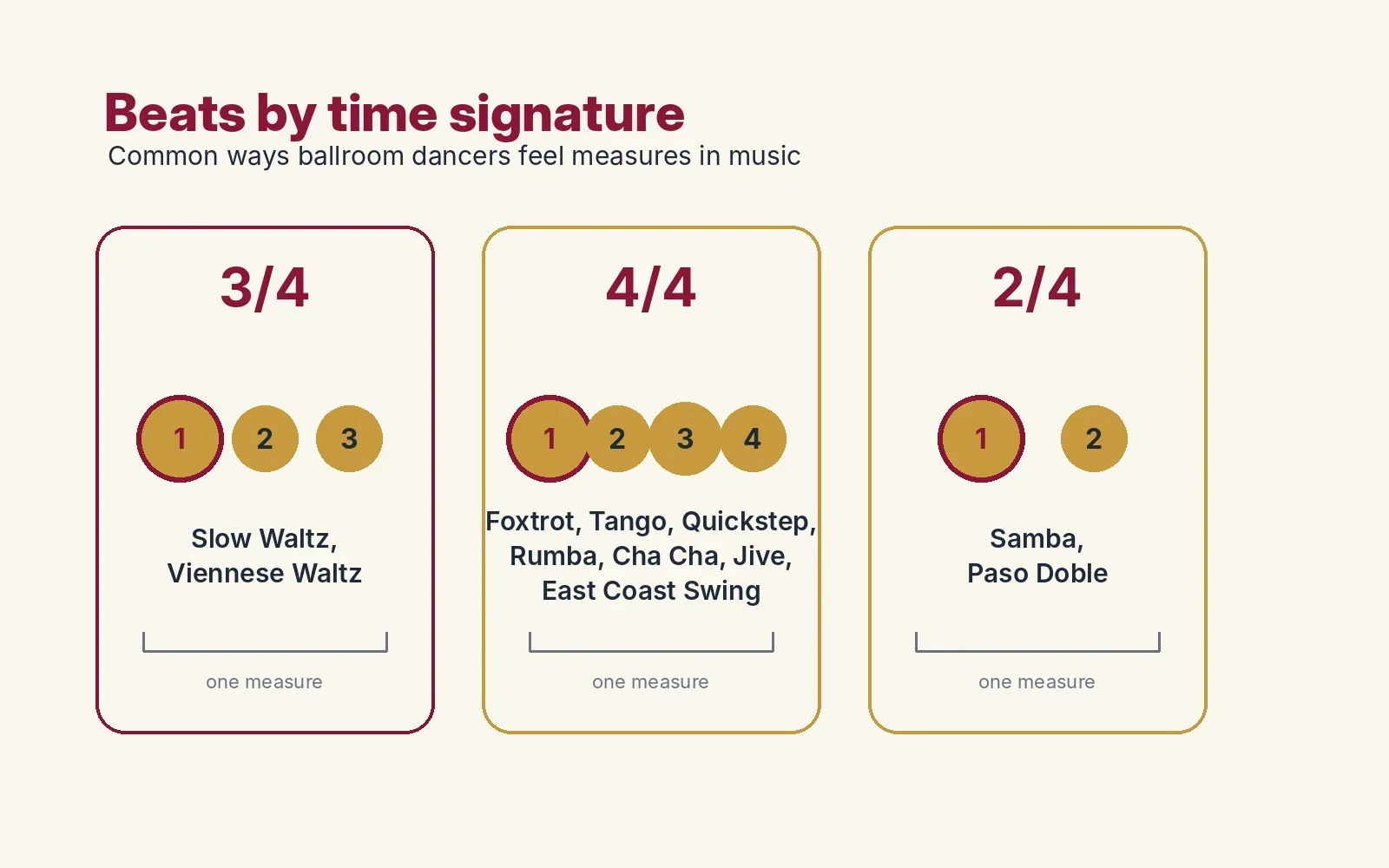
3/4 time: 3 beats per measure
The Waltz family. Each measure has three beats: ONE-two-three, ONE-two-three. The downbeat is strong; beats 2 and 3 are gentler. See Waltz and Viennese Waltz.
4/4 time: 4 beats per measure
Most ballroom dances. Each measure has four beats: ONE-two-three-four, ONE-two-three-four. The downbeat is strongest, the third beat is moderately strong, and beats 2 and 4 are weak. See Foxtrot, Rumba, Cha Cha, East Coast Swing, Salsa, and most others.
2/4 time: 2 beats per measure
A handful of Latin dances. Each measure has two beats: ONE-two, ONE-two. Often used in Samba, Paso Doble, and some Tango variants.
How to find the beat in a song
Finding the beat is a skill. Here’s how to build it:
- Listen for the bass drum. In most popular music, the bass drum lands on the downbeat. If you can hear "boom" pulses, those are usually beats.
- Tap your foot. Don’t analyze—just let your foot find a natural tapping rhythm. That’s the beat.
- Confirm it’s steady. Real beats are evenly spaced. If your tapping is uneven, you’re probably catching something else (rhythm, melody, syncopation).
- Count along. Once you’ve found the beat, try counting "1, 2, 3, 4" repeatedly. If it lines up with the music, you’ve got the beat.
- Find the “1”. The strongest beat—the one that feels like the start of a phrase—is your downbeat. That’s where most dances begin.
Common mistakes finding the beat
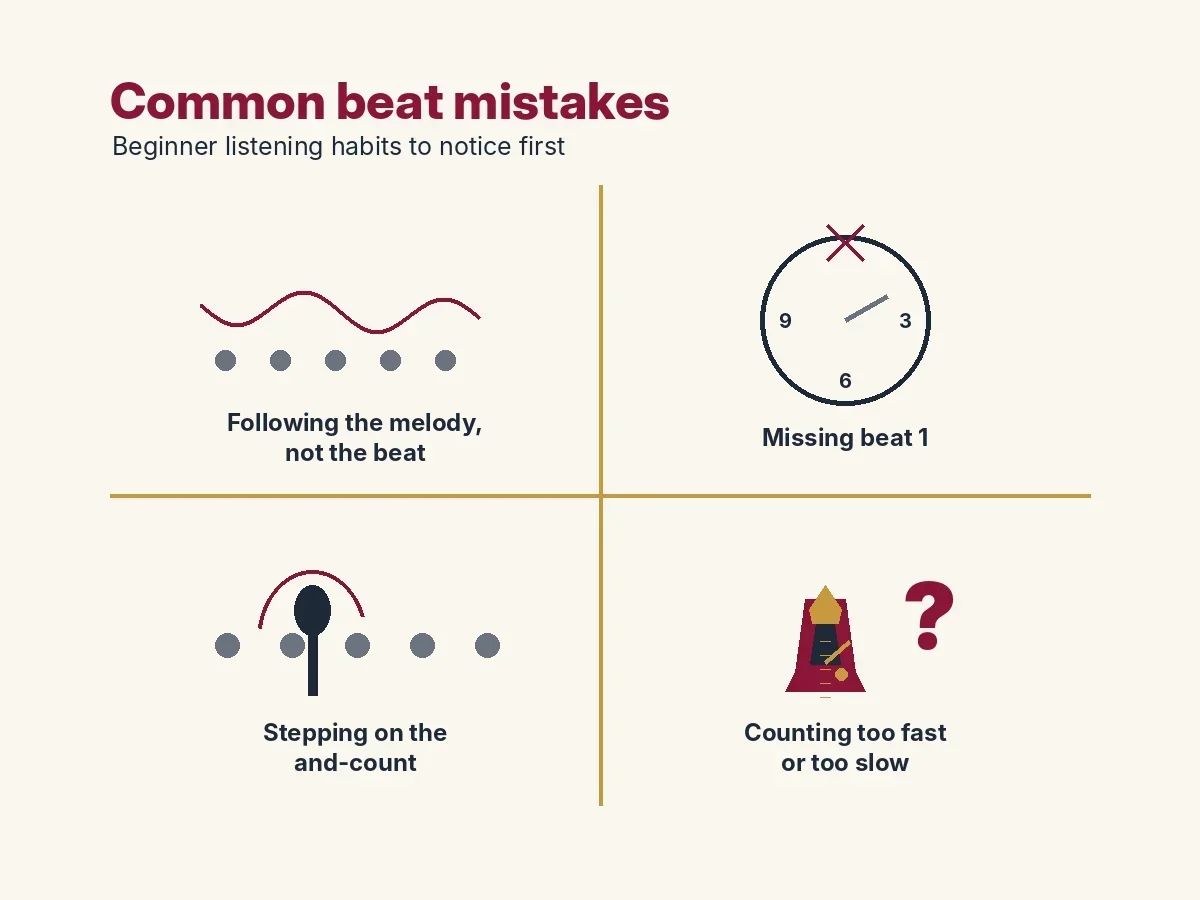
Tapping the melody instead of the pulse
Fix: Beats are steady. Melodies vary. If your tapping speeds up and slows down, you’re following melody, not beat.
Catching the half-time pulse
Fix: Some songs have a strong snare on every other beat that can fool you. Listen for the bass to find the actual beat rate.
Confusing syncopation for the beat
Fix: Syncopated notes land between beats. The steady underlying pulse is still there—listen for it underneath the syncopation.
Starting on beat 2 thinking it’s beat 1
Fix: The strongest beat—usually the bass drum—is your "1". If your "1" feels weak, you’re probably hearing beat 2 or 3.
Counting the “and”s as beats
Fix: The "and" between beats is a sub-beat, not a beat. If you’re counting twice as many pulses as feels natural, you’re counting "ands".
Looking for the beat in silence between phrases
Fix: Beats continue through quiet sections. If a song has a quiet bar, the beat is still there—keep counting in your head.
Practice hearing the beat
The fastest way to develop beat-finding is to listen to music in different styles and tap along—without dancing. Start with strong, clear beats (most pop and Latin music) before moving to subtler tracks (Slow Waltz, jazz Foxtrot).
-
Easy beats (start here)
Pop, dance, and Latin music with strong downbeats. Tap along until the pulse feels automatic.
-
Medium beats
Foxtrot and Cha Cha tracks. The beat is clear but the rhythm has more layers.
-
Subtler beats
Slow Waltz, ballad-style Foxtrot. Beat is gentler—you need to listen carefully.
-
BallroomPages Music (Telegram)
Mixed dance music for beat-finding practice across styles.
If you’re struggling to find the beat in a song, try listening with headphones. Bass and percussion come through more clearly, which makes the pulse easier to feel.
FAQ
Beat FAQ
What does beat mean in music?
A beat is the steady underlying pulse of music—the regular pattern of strong points that keeps the song moving. When you tap your foot to a song, you’re tapping the beat.
How is a beat different from a count?
A beat is the music’s pulse. A count is the dancer’s mapping of steps to those beats. A 4/4 song has 4 beats per measure, but a Foxtrot count might be "slow-slow-quick-quick"—the count doesn’t name every beat directly.
What is a downbeat?
The downbeat is the first beat of a measure—usually the strongest and most accented. Most ballroom dances start on the downbeat.
How do I find the beat in a song?
Listen for the bass drum or the steady underlying pulse—not the melody. Tap your foot to whatever feels naturally steady. Confirm by counting "1, 2, 3, 4" and seeing if it lines up.
Do all dances have the same beat structure?
No. Different dances use different time signatures: Waltz is 3/4 (three beats per measure), most others are 4/4 (four beats), and some Latin dances like Samba and Paso Doble use 2/4 (two beats).
What does "off-beat" mean?
The off-beat is the exact midpoint between two beats—the "and" between numbered counts. Some dance styles emphasize the off-beat for a syncopated feel.
Is beat the same as rhythm?
No. Beat is the steady pulse. Rhythm is the pattern of notes (long, short, accented, syncopated) on top of those beats. Two songs at the same beat rate can have very different rhythms.
Why can’t I find the beat in some songs?
Some music styles (jazz, ballads, ambient) deliberately obscure the beat. Songs with heavy syncopation or unusual production can also be hard to feel. For ballroom practice, start with pop and Latin tracks where the beat is clear.
Editorial
Sources and review notes
This glossary entry should be reviewed by a qualified ballroom instructor or music teacher before launch. Sources include standard music-theory references on beat and meter, NDCA and WDSF ballroom syllabus materials, and Dance Vision counting/timing resources.
This is dance terminology, not medical advice. Ballroom Pages follows an editorial policy of education-first guidance. Questions? Contact us. Updated May 26, 2026.