Glossary
Tempo in Ballroom Dance
Tempo is the speed of a song—how fast the beats go. In ballroom dance, tempo decides which dance fits which song. Here’s what tempo means, how BPM and MPM measure it, and the tempo ranges for Waltz, Foxtrot, Rumba, Cha Cha, and more.
Definition of tempo
Tempo
- Pronunciation
- tem-poh
- Skill category
- Music & timing
- Related terms
- BPM, MPM, beat, count, measure, rhythm, timing
- Full guide
- Ballroom Dance Tempo Chart
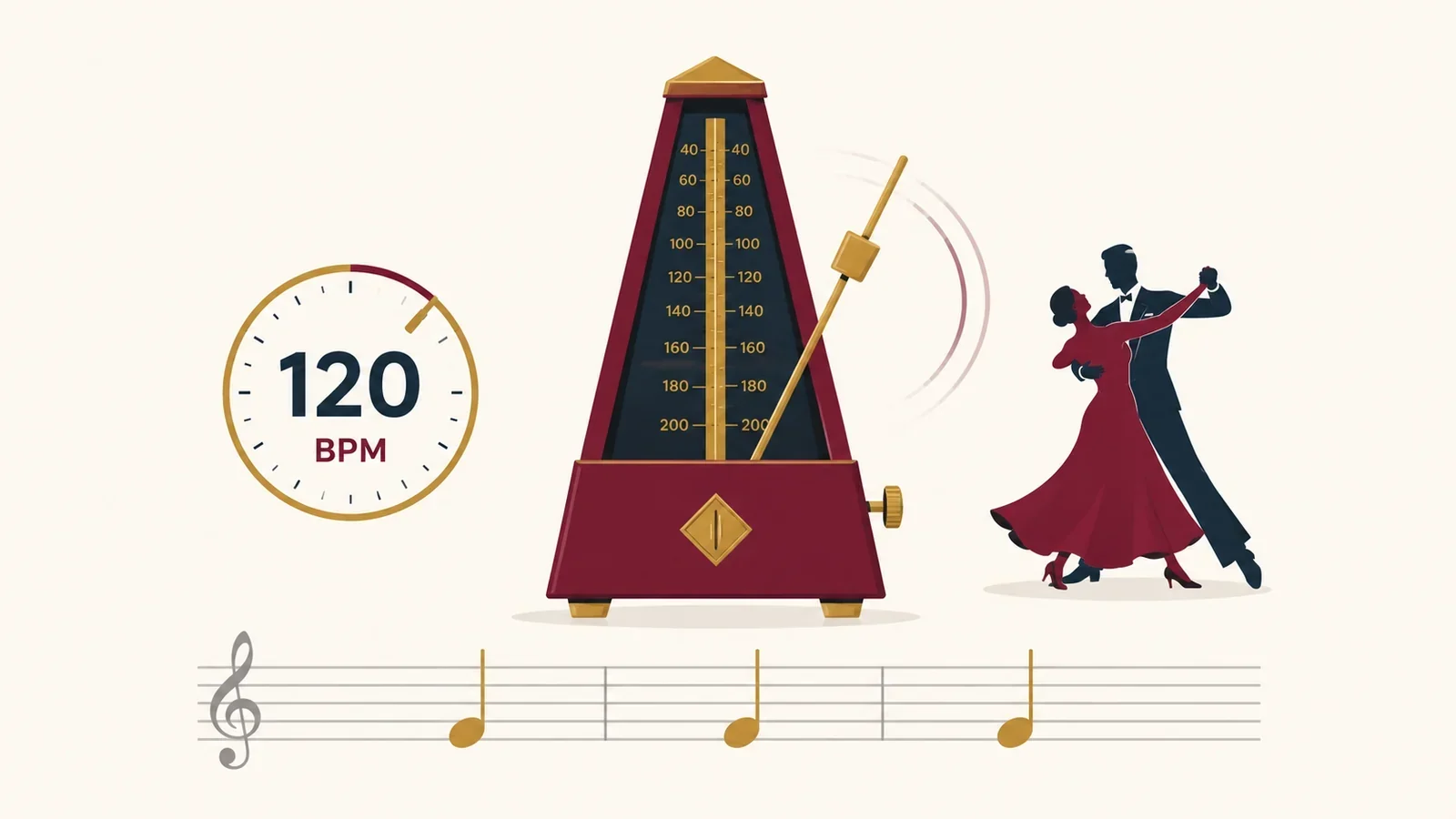
In ballroom dance, tempo is how fast the music moves—measured in beats per minute (BPM) or measures per minute (MPM). Tempo doesn’t change a dance’s count pattern, but it does decide which dance the music suits. A 28 MPM Slow Waltz feels totally different from a 60 MPM Viennese Waltz, even though the count is “1-2-3” in both.
Pick the right tempo and the dance feels easy. Pick the wrong tempo and even the right steps feel rushed or sluggish.
What tempo means in ballroom dance
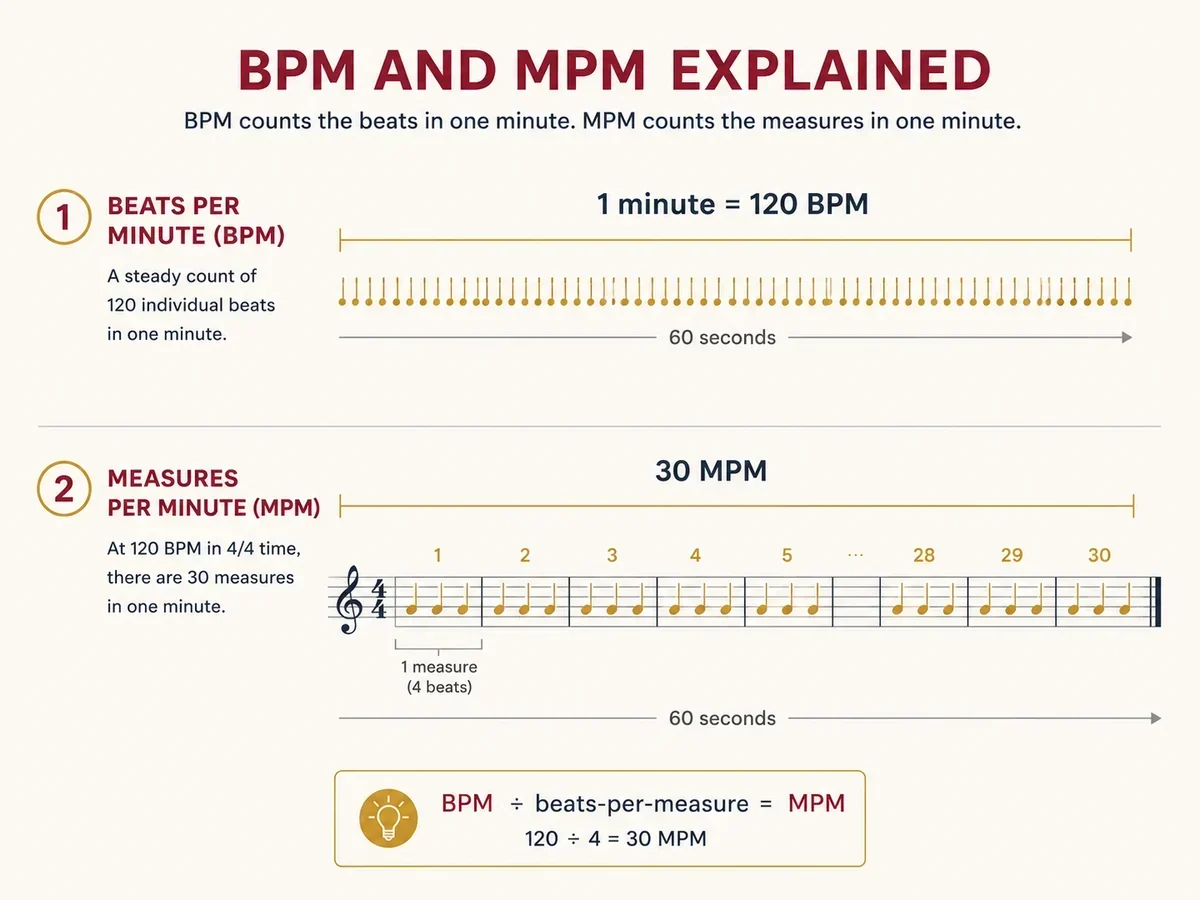
Tempo is how fast the music is moving. If you tap your foot along to a song, the number of taps you make in a minute is the tempo. A song at 120 BPM has 120 of those taps per minute; a song at 60 BPM has half as many.
Every ballroom dance has a tempo range where it feels comfortable. Slow Waltz lives around 84-90 BPM. Quickstep lives around 200 BPM. The same step pattern at the wrong tempo simply doesn’t work—at too-slow a tempo it feels lifeless; at too-fast a tempo it feels frantic.
Tempo also doesn’t change what dance the music is. A 100 BPM song might be a fast Foxtrot or a slow Cha Cha. The genre, time signature, and rhythm tell you which dance fits. Tempo just tells you how fast you’ll be dancing it.
Tempo vs BPM vs MPM
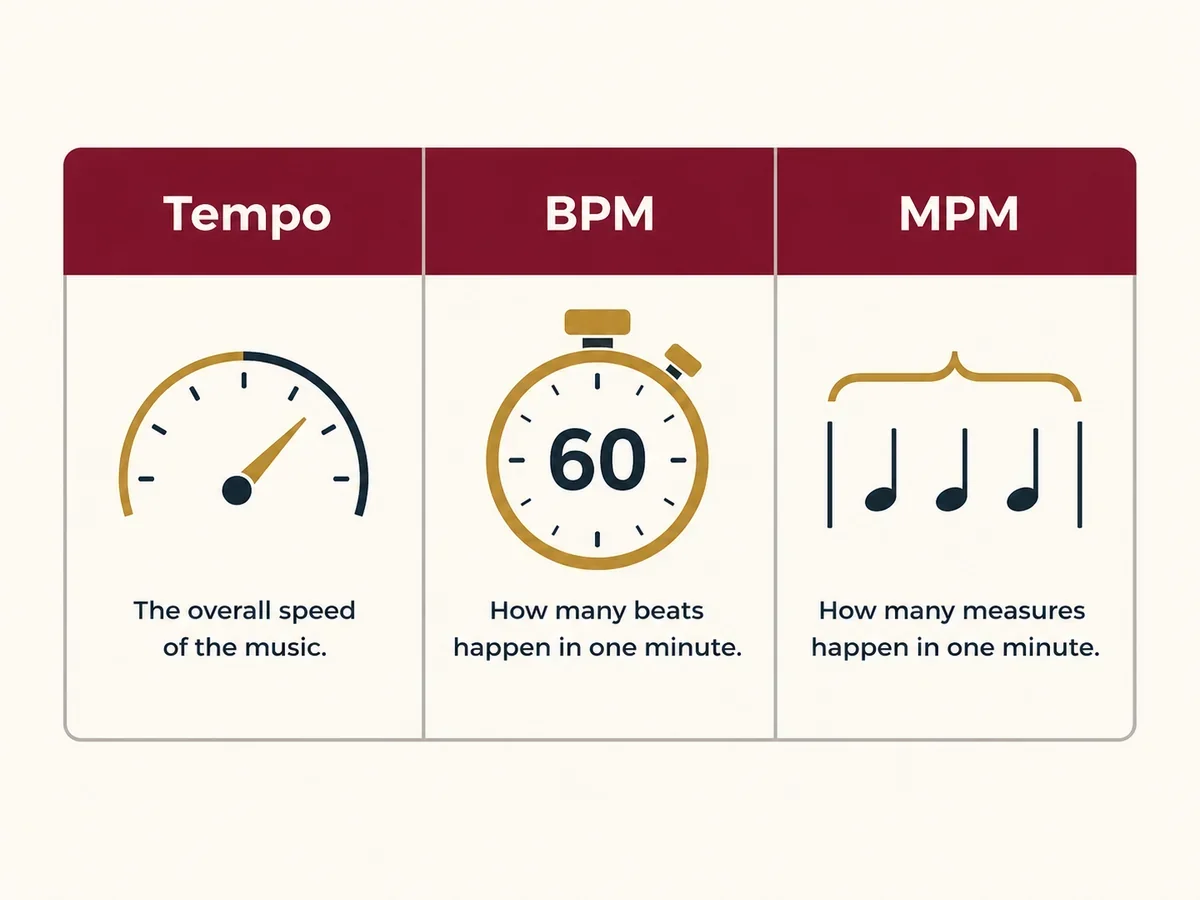
Three terms for closely related ideas. Easy to mix up.
| Term | Plain-English meaning | When you’ll see it |
|---|---|---|
| Tempo | The general concept of music speed | Used in instruction, song descriptions, casual conversation |
| BPM (beats per minute) | The number of musical beats counted in one minute | Used everywhere—Spotify, music apps, most ballroom resources |
| MPM (measures per minute) | The number of musical measures counted in one minute | Used for Waltz-family dances (3/4 time). 30 MPM = 90 BPM in 3/4. |
BPM is the safe default. If a music app says “120 BPM,” everyone knows what that means. MPM appears mostly in ballroom syllabus materials for Waltz and Viennese Waltz, where dancers count measures more than individual beats.
Why tempo matters
Right-tempo music feels easy to dance. Wrong-tempo music feels like a fight against the song. Choosing music in the dance’s range is one of the fastest wins for new ballroom dancers.
Tempo affects:
- How much time you have for each step.
- Whether you can stay on count without rushing.
- How big your steps can be (faster tempo = smaller steps).
- How much rise and fall, swing, or styling you can add.
- Whether the song feels like the right dance at all.
For wedding couples, tempo is often the single most important factor when picking a first-dance song. See the First Dance Songs by Dance Style guide for tempo-matched suggestions.
Tempo ranges by ballroom dance
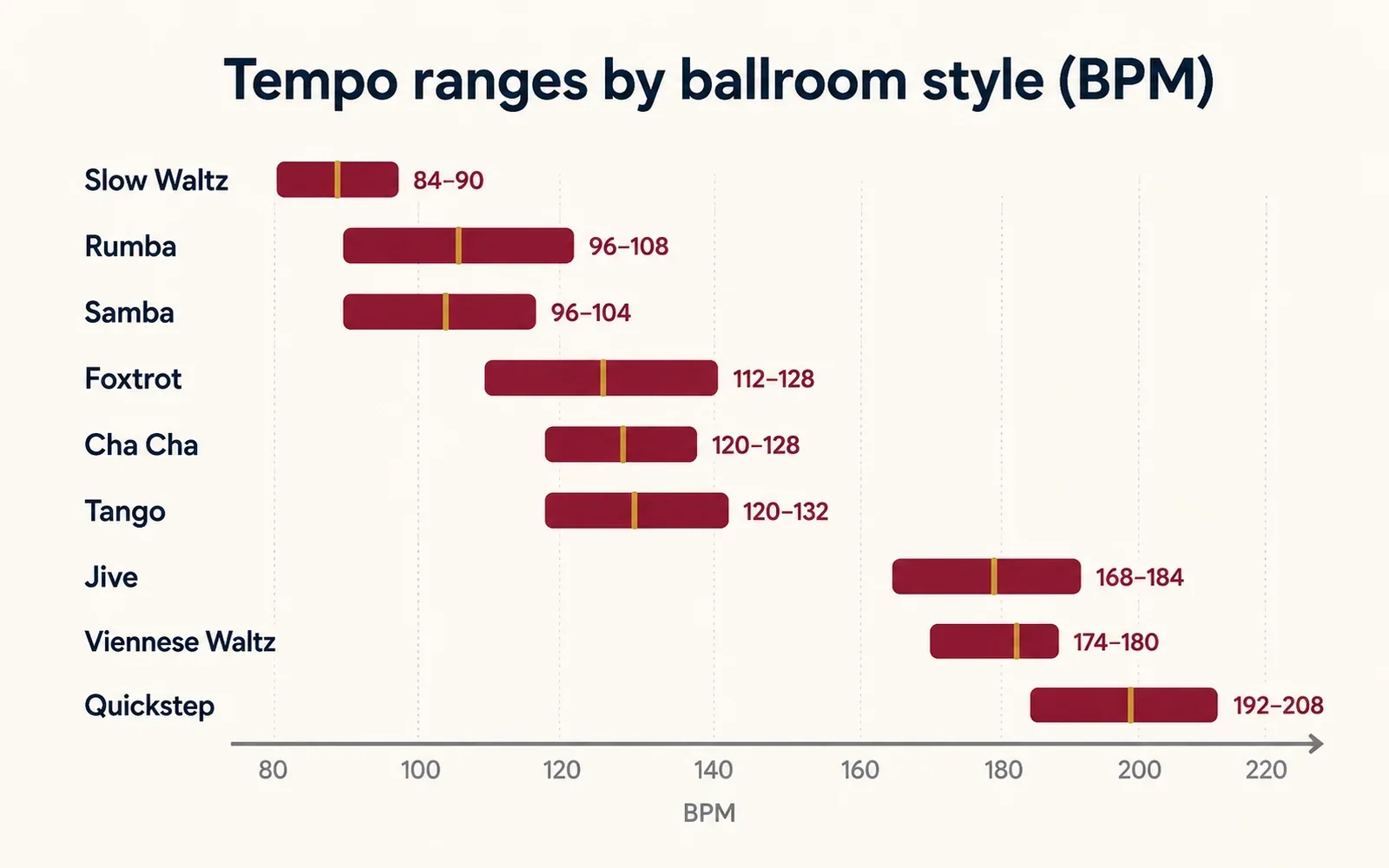
These ranges are widely accepted across NDCA, WDSF, ISTD, and major social-dance communities. Exact numbers vary slightly by syllabus and event.
Smooth and Standard dances
- Slow Waltz: 84-90 BPM (28-30 MPM, 3/4)
- Foxtrot: 112-128 BPM (4/4)
- Ballroom Tango: 120-132 BPM (2/4 or 4/4)
- Viennese Waltz: 174-180 BPM (58-60 MPM, 3/4)
- Quickstep: 192-208 BPM (4/4)
Rhythm and Latin dances
- Rumba: 96-108 BPM (4/4); American Rumba ~120 BPM
- Cha Cha: 120-128 BPM (4/4)
- Samba: 96-104 BPM (2/4)
- Jive: 168-184 BPM (4/4)
- Paso Doble: ~120 BPM (2/4)
- Bolero: 96-104 BPM (4/4)
- Mambo: ~188-204 BPM
Swing and Social dances
- East Coast Swing: 136-160 BPM (4/4)
- West Coast Swing: 88-128 BPM (4/4)
- Salsa: 160-220 BPM (4/4)
- Bachata: 108-152 BPM (4/4)
- Merengue: 120-160 BPM (2/4 or 4/4)
- Nightclub Two Step: 60-80 BPM (4/4)
- Hustle: 110-130 BPM (4/4)
- Country Two Step: 168-200 BPM (4/4)
- Lindy Hop: 120-200 BPM (4/4)
For a sortable reference with practice notes, see the full Ballroom Dance Tempo Chart.
Common tempo mistakes
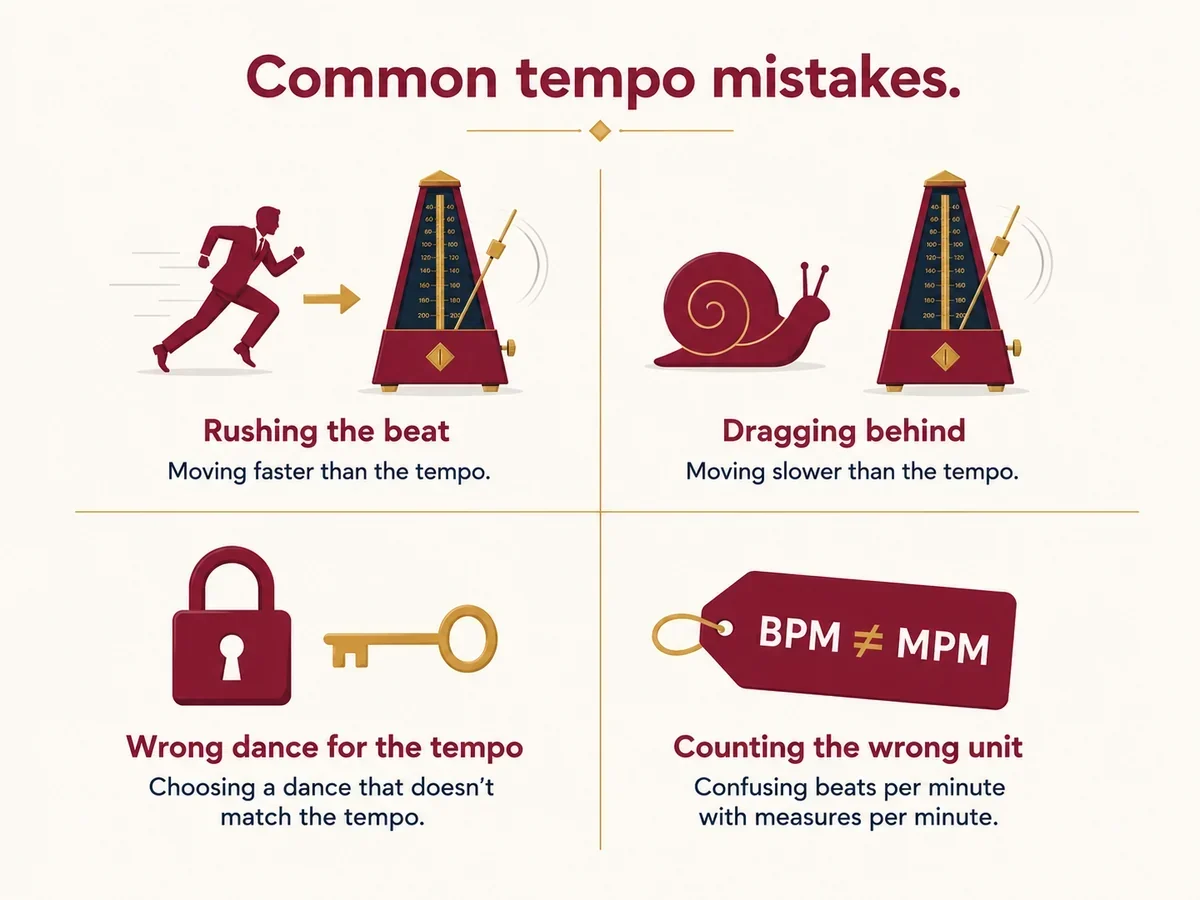
Picking music outside the dance’s range
Fix: Check the BPM before adding a song to your practice playlist. Stay within the listed range for the dance.
Mistaking half-time for the real tempo
Fix: Tap the strongest steady pulse—not every drum hit. Many songs have a snare on every other beat that can fool you into counting half the actual tempo.
Double-timing slow songs to make them “work”
Fix: Double-time changes the dance feel completely. If the song is slow, pick a slow dance for it rather than dancing twice as fast.
Practicing only at competition tempo
Fix: Beginners should start at the slow end of the range. Get the steps clean before adding speed.
Ignoring tempo when choosing a wedding first-dance song
Fix: Confirm the BPM matches your chosen dance before locking in the song. Many beautiful songs are too slow or too fast for the dance you have in mind.
Assuming a song’s genre tells you its tempo
Fix: Two Foxtrot-genre songs can have very different BPMs. Always check the actual tempo, not just the genre label.
Treating MPM and BPM as the same number
Fix: In 3/4 time, 30 MPM = 90 BPM (each measure has 3 beats). Don’t convert between them without doing the math.
Practice with the right tempo
Two practical tools: a BPM-tagged playlist and a metronome. Most music apps show BPM either in the song info or via a third-party tool. A metronome lets you practice at exact tempos without the song.
For beginners, the workflow is: pick a target tempo at the slow end of the dance’s range, practice the basic step until it feels comfortable, then bump the tempo up by 5-10 BPM and repeat. By the time you’re at the middle of the range, the dance feels natural at speed.
-
Slow Waltz (84-90 BPM)
Easiest tempo entry point for Standard work. Practice 3/4 timing without rush.
-
Foxtrot (112-128 BPM)
Smooth mid-tempo 4/4. Good for practicing slow-quick-quick timing.
-
Rumba (96-108 BPM)
Slow Latin 4/4. Best for practicing weight transfer and Cuban motion.
-
BallroomPages Music (Telegram)
Mixed-tempo practice tracks. More dance-specific BPM playlists rolling out.
If you’re unsure what tempo a song is, search “[song name] BPM” in your music app or use a tap-tempo tool. Many DJ and dance apps will show BPM directly.
FAQ
Tempo FAQ
What does tempo mean in ballroom dance?
Tempo is how fast the music is moving, measured in beats per minute (BPM) or measures per minute (MPM). Each ballroom dance has a recommended tempo range that makes it feel comfortable to dance.
What is BPM?
BPM stands for beats per minute—the number of musical beats counted in one minute. A 120 BPM song has twice as many beats per minute as a 60 BPM song.
What is MPM?
MPM stands for measures per minute—the number of musical measures counted in one minute. MPM is most often used for Waltz and Viennese Waltz, since dancers in those styles count measures rather than individual beats. 30 MPM in 3/4 time equals 90 BPM.
How do I find a song’s BPM?
Most music apps show BPM in the song info. You can also search “[song name] BPM” or use a tap-tempo tool that calculates BPM from how fast you tap along.
What’s a good tempo for a Waltz first dance?
Slow Waltz is danced at 84-90 BPM (28-30 MPM). For wedding first dances, the slow end of the range (84-87 BPM) is generally easier for couples to manage on the day.
Can I dance the same dance at different tempos?
Yes, but it changes the feel significantly. Most dances have an accepted range; staying inside it keeps the dance recognizable. Going outside the range usually means the dance doesn’t work properly.
Is faster tempo always harder?
Usually yes for beginners. Faster tempo means less time per step, so technique has to be tighter. Slow tempos can actually be harder in different ways—they expose timing and balance issues that fast tempo hides.
What’s the difference between tempo and rhythm?
Tempo is the speed; rhythm is the pattern of long, short, and accented notes within that speed. Two songs at the same BPM can have very different rhythms.
Editorial
Sources and review notes
This glossary entry should be reviewed by a qualified ballroom instructor before launch. Tempo ranges follow widely accepted conventions from NDCA, WDSF, ISTD, and Arthur Murray syllabus materials, plus Dance Vision and other standard references. Exact ranges vary slightly by syllabus and competition body—match your instructor’s convention within a single learning context.
This is dance terminology, not medical advice. Ballroom Pages follows an editorial policy of education-first guidance. Questions? Contact us. Updated May 26, 2026.