Glossary
Phrase in Ballroom Dance
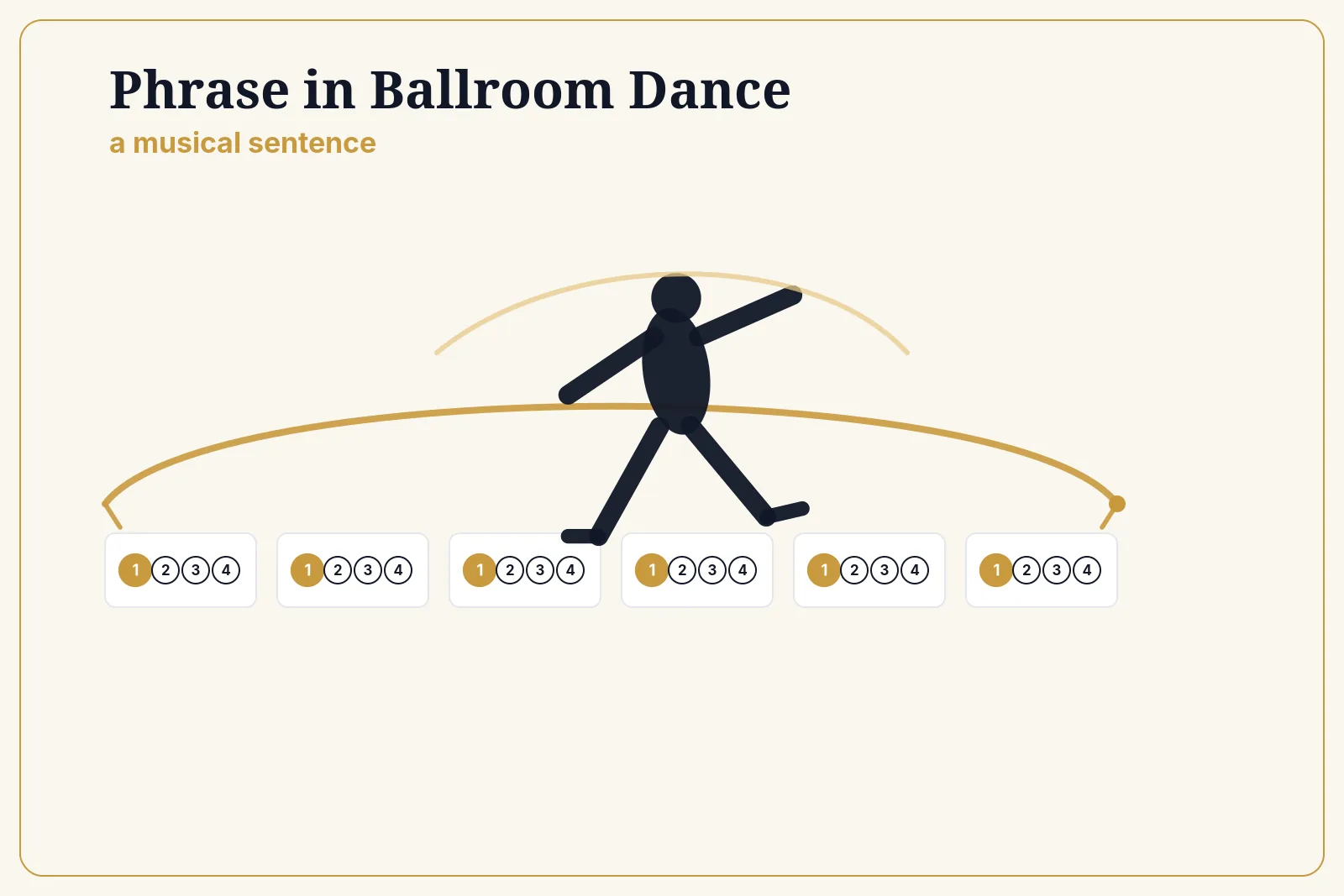
Music speaks in sentences. A phrase is one of them—a short musical thought that rises, travels, and lands, usually over eight or more counts. Dancers who hear phrases stop dancing near the music and start dancing inside it: figures begin where sentences begin, and big moves land where the music lands. Here is what a phrase is, how the famous 8-count fits in, and how to phrase your dancing.
Definition of phrase
Phrase
- Also heard as
- Phrasing, the 8-count, “the top of the music”
- Skill category
- Music & timing
- Companion term
- Measure (what phrases are built from)
- Related terms
- beat, count, downbeat, musicality, rhythm, timing
In music, a phrase is a short musical sentence built from measures. In dance counting, the everyday unit is the 8-count (two measures of 4/4), and larger phrases of 16 or 32 beats shape where melodies begin and end. Dancers “phrase” their dancing by starting figures at the top of a phrase.
Beats are letters, measures are words, phrases are sentences. Dance the sentences.
What a phrase is in music and dance
Zoom out from the beat and the measure and you hear music’s real architecture: short sentences that begin, develop, and resolve. Each one is a phrase. Hum any melody you know and notice where you would naturally breathe—those breaths are phrase boundaries. Songs are built by stacking phrases into verses and choruses, which is why music feels like it “starts again” every so often.
For dancers, phrases answer a question the beat can’t: when should I begin? Any beat 1 is technically correct, but a figure launched at the top of a phrase rides the music’s whole sentence—the movement builds as the melody builds and settles as it settles. That is the difference between dancing that is merely on time and dancing that looks composed.
The 8-count: the dancer’s everyday phrase
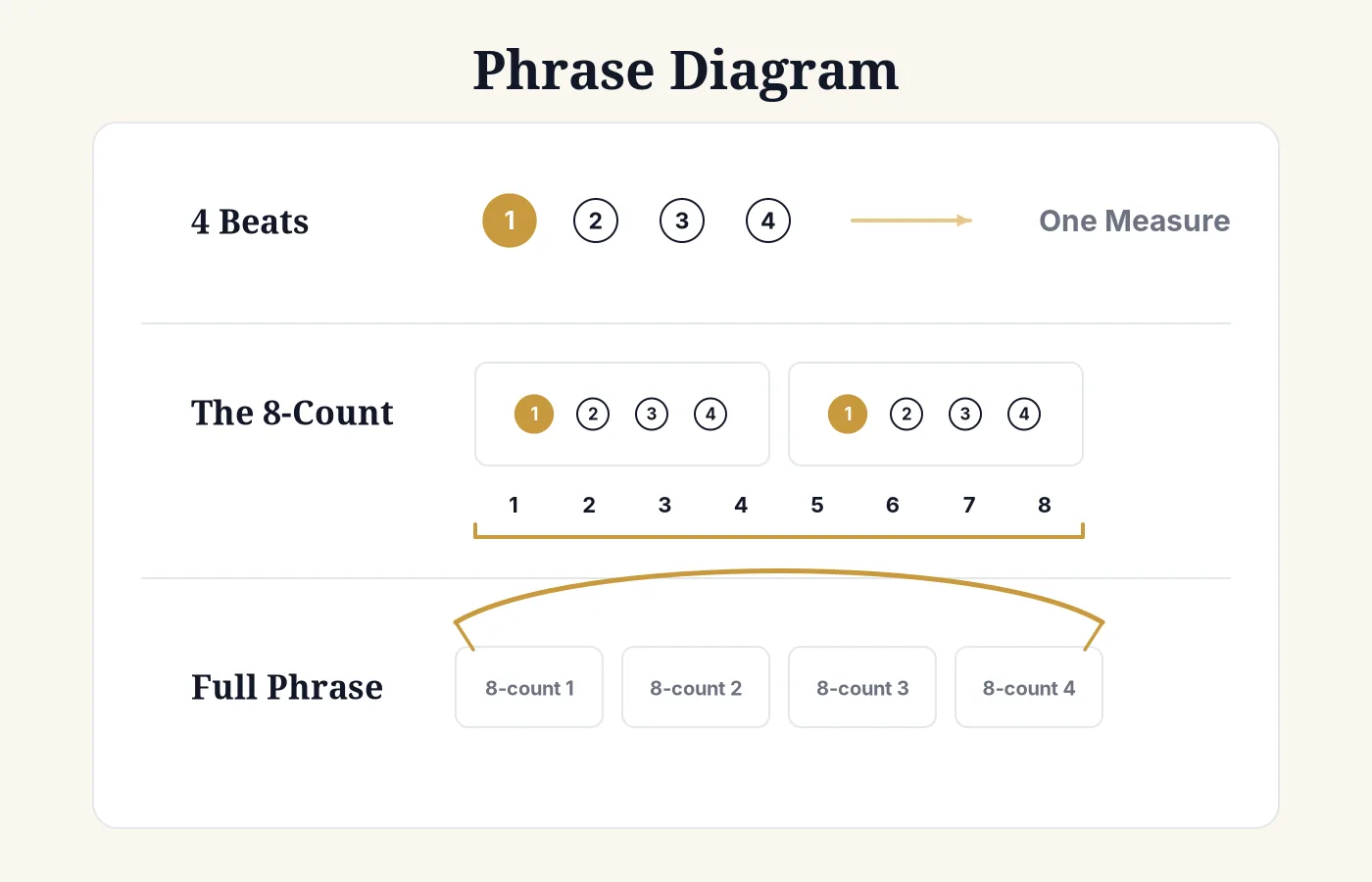
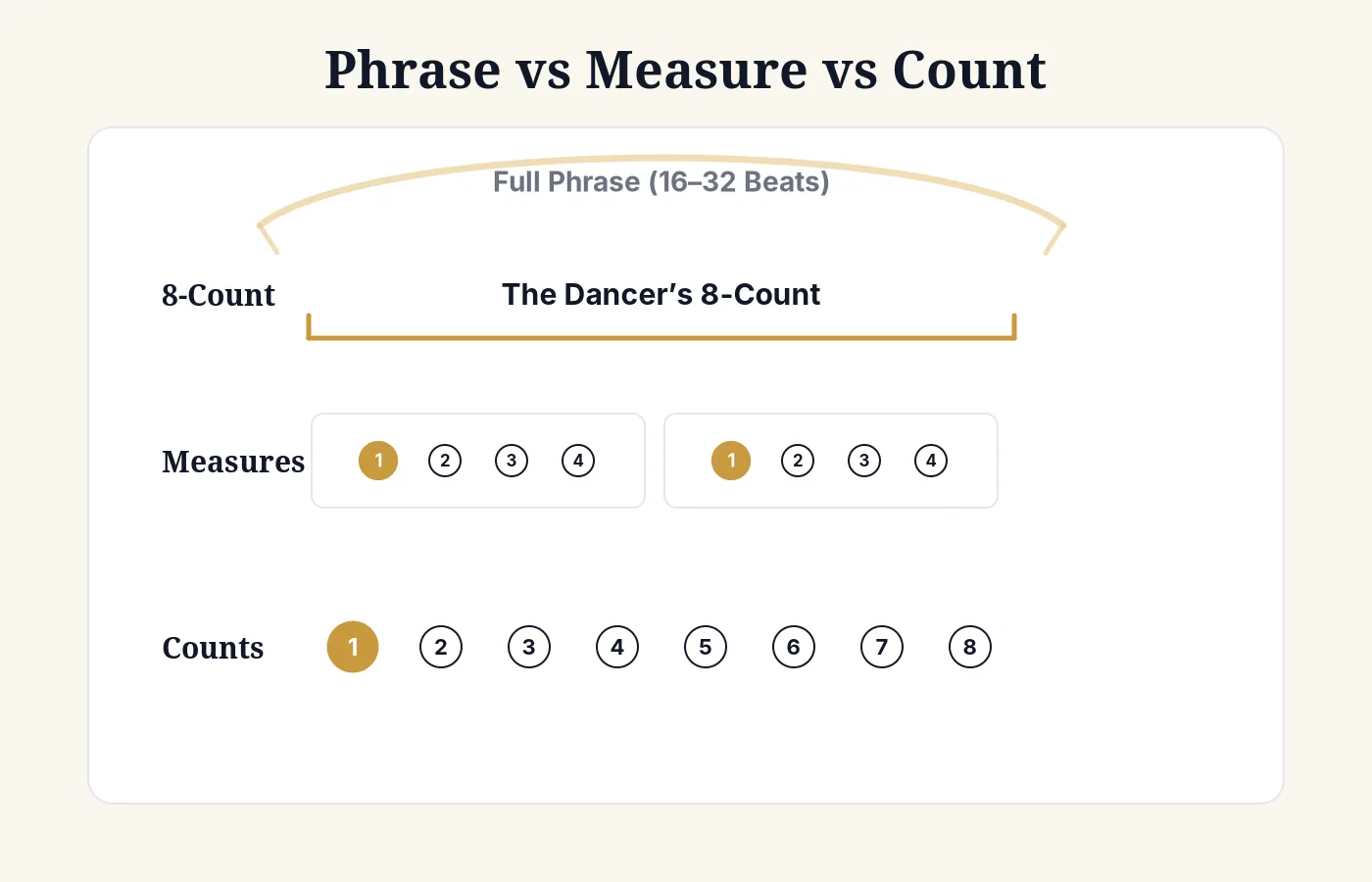
Musicians count measures; social dancers count eights. The famous 8-count is simply two measures of 4/4 counted straight through: 1-2-3-4-5-6-7-8. It exists because most dance figures and most pop-music ideas are two measures long—so the eight is the most practical chunk to think in.
| Unit | Size | Who counts it |
|---|---|---|
| Beat | 1 count | Everyone |
| Measure | 4 beats | Musicians (“bar”) |
| 8-count | 2 measures | Dancers |
| Full phrase | Commonly 16 or 32 beats | Choreographers & DJs |
In Waltz the same idea applies with sixes: dancers often count two measures of 3/4 as “1-2-3, 4-5-6,” and Waltz phrases are commonly four or eight measures long.
Mini phrases and major phrases
Phrases nest inside each other like paragraphs hold sentences. A mini phrase (one 8-count, or two bars) is a single musical idea. A major phrase stacks two or four of those—16 or 32 beats—and usually matches a full line of melody. Sections of a song (verse, chorus, bridge) are built from major phrases, and the “top of the music” a teacher waits for before starting choreography is the top of a major phrase.
You don’t need to label them precisely to use them. What matters is feeling the two levels: the small “idea” that repeats, and the bigger arc that starts fresh when the melody does.
Phrasing: dancing to the phrase
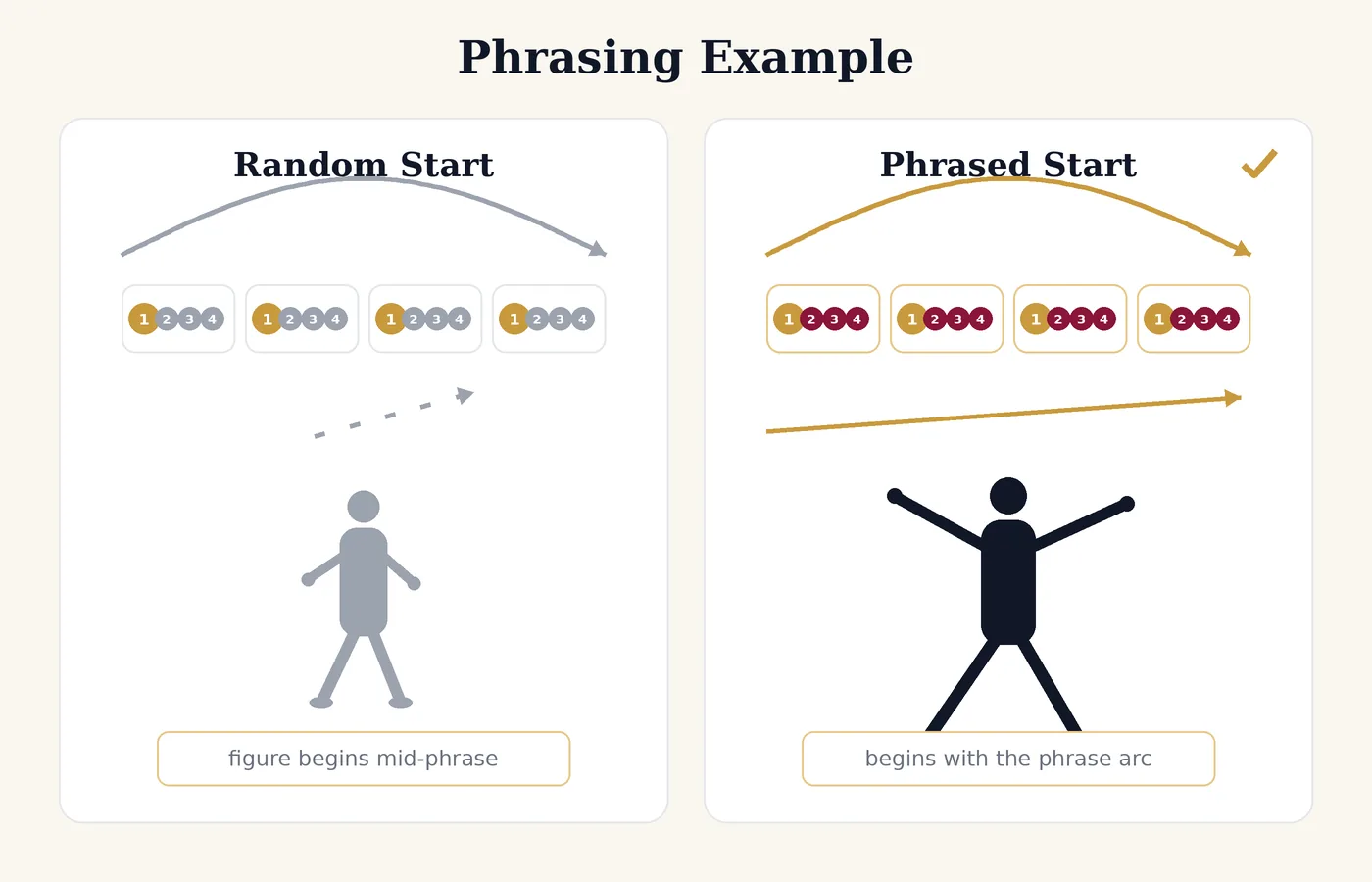
“Phrasing” is the verb: matching your dancing to the music’s sentences. In practice it means three habits:
Phrasing habits
- Start at the top. Begin your first figure where a phrase begins—wait a measure or two if you must; the music will “come around.”
- Save the fireworks. Place your biggest figure where a major phrase lands (often into a chorus)—the music will appear to cue it.
- Breathe at the boundaries. Let simpler steps live at phrase ends so the next sentence can start clean.
Leaders carry most of the phrasing responsibility in social dancing, but followers who hear phrases styling their movement to them is a hallmark of advanced dancing. It is the most learnable piece of musicality.
How to hear a phrase
Finding the sentences
- Follow the melody’s breath. Where the singer or lead instrument pauses, a phrase just ended.
- Count eights, not beats. Count 8-counts and notice how verses and choruses take a neat number of them.
- Listen for the turnaround. Drums often fill, lift, or crash right before a new phrase begins.
- Feel the restart. When the music seems to take a fresh breath and begin again—that’s the top.
Build the underlying skills with how to count ballroom dance music.
Common phrase mistakes
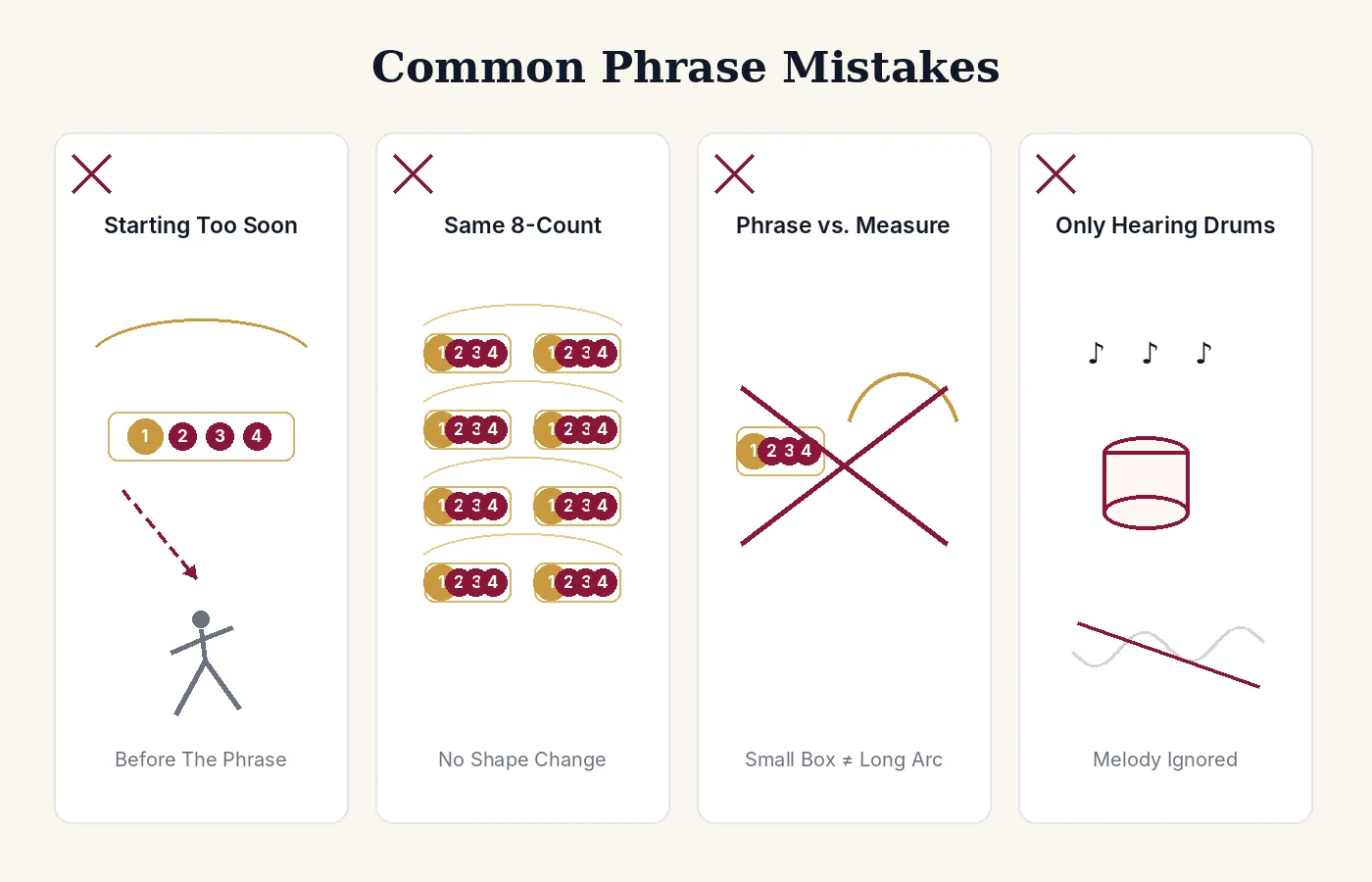
Starting the moment you hit the floor
Fix: Wait for the top of a phrase. A measure of patience makes the whole dance sit inside the music.
Treating every 8-count as identical
Fix: Eights group into bigger arcs. Notice which eight starts the sentence and which one ends it—then dance them differently.
Confusing the phrase with the measure
Fix: The measure is the 3–4 beat box; the phrase is the sentence made of several boxes. The 8-count sits in between: two measures.
Only hearing the drums
Fix: Phrases live in the melody. Follow the tune’s breathing, not just the beat, to find where sentences start.
Practice hearing phrases
Phrase-hearing is mostly mindful listening—no partner needed:
- Raise a hand at the top. Play a song and lift your hand every time a new phrase starts. Check yourself against the chorus—it always starts on one.
- Count the eights in a verse. Most verses are 2 or 4 eights. Predict the chorus’s arrival before it happens.
- Phrase one figure. Dance a single figure repeatedly, restarting only at phrase tops—feel how different it sits.
-
Waltz (long, clear phrases)
Classic songwriting with audible sentence structure—ideal phrase training.
-
Rumba (feel the arcs)
Slow 4/4 with strong vocal melodies—easy to follow the breathing.
-
Count the music
The companion guide to counting beats, measures, and phrases.
-
BallroomPages Music (Telegram)
Mixed-style practice tracks. Phrase drills coming soon.
FAQ
Phrase FAQ
What is a phrase in music?
A phrase is a short musical sentence—a complete idea that begins, develops, and resolves, built from several measures. Melodies breathe at phrase boundaries, and songs stack phrases into verses and choruses.
How many counts are in a phrase?
The dancer’s everyday unit is the 8-count (two measures of 4/4). Full musical phrases are commonly 16 or 32 beats—two or four 8-counts—though song sections vary.
What is phrasing in dance?
Phrasing means matching your dancing to the music’s sentences: starting figures at the top of a phrase, placing big moves where a phrase lands, and letting simpler steps live at the boundaries. It is the most learnable part of musicality.
What is the difference between a phrase and a measure?
A measure is the small repeating box of 3–4 beats set by the time signature. A phrase is the sentence built from several measures. The dancer’s 8-count sits in between: exactly two measures of 4/4.
Do I need to hear phrases to social dance?
You can dance on time without them—but phrases are what make dancing look intentional. Social dancers who start figures at phrase tops appear to predict the music. It’s a listening skill anyone can build in a few focused sessions.
Editorial
Sources and review notes
This glossary entry should be reviewed by a qualified ballroom instructor before launch. Phrase-length descriptions follow common popular-music and ballroom conventions; actual phrase lengths vary by song, genre, and arrangement.
This is dance terminology, not music-theory instruction. Ballroom Pages follows an editorial policy of education-first guidance. Questions? Contact us. Updated July 9, 2026.