
Glossary
Musicality in Ballroom Dance
Two dancers do the same figure to the same song. One looks correct; the other looks like the music is coming out of their body. The difference is musicality—the skill of expressing what you hear: the timing, the accents, the phrases, the character. And despite its reputation, it is not a gift some people are born with. It is a stack of learnable skills, and you already have the first one. Here is the whole picture.
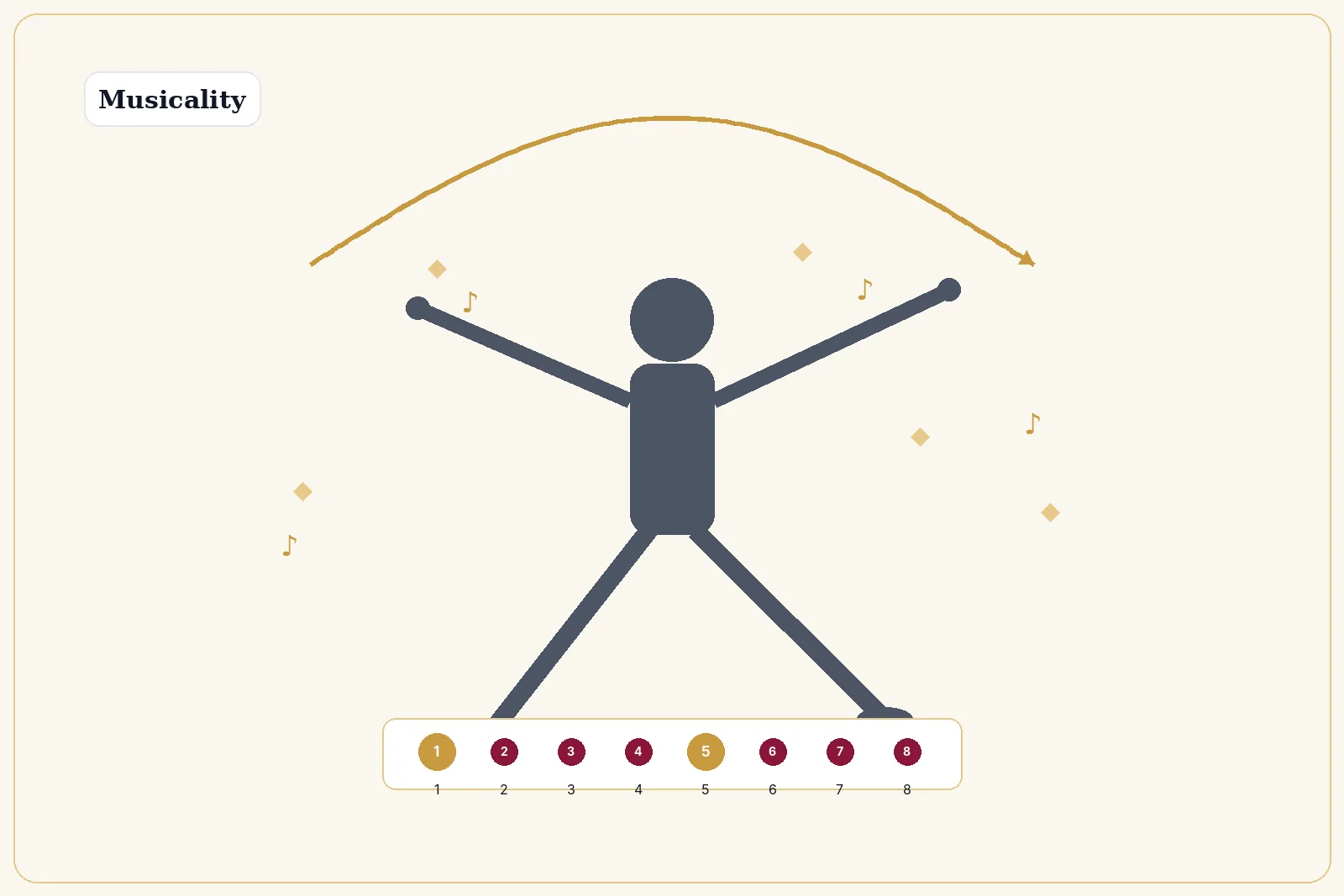
Definition of musicality
Musicality
- Pronunciation
- myoo-zih-KAL-ih-tee
- Skill category
- Music & timing (capstone skill)
- Companion term
- Timing (its foundation)
- Related terms
- accent, phrase, rhythm, syncopation, tempo
In dance, musicality is the skill of expressing the music with your body: dancing on time, marking the accents, following the phrases, and matching the character of the song. It is built from learnable layers—not an inborn talent.
Timing keeps you with the music. Musicality makes you part of it.
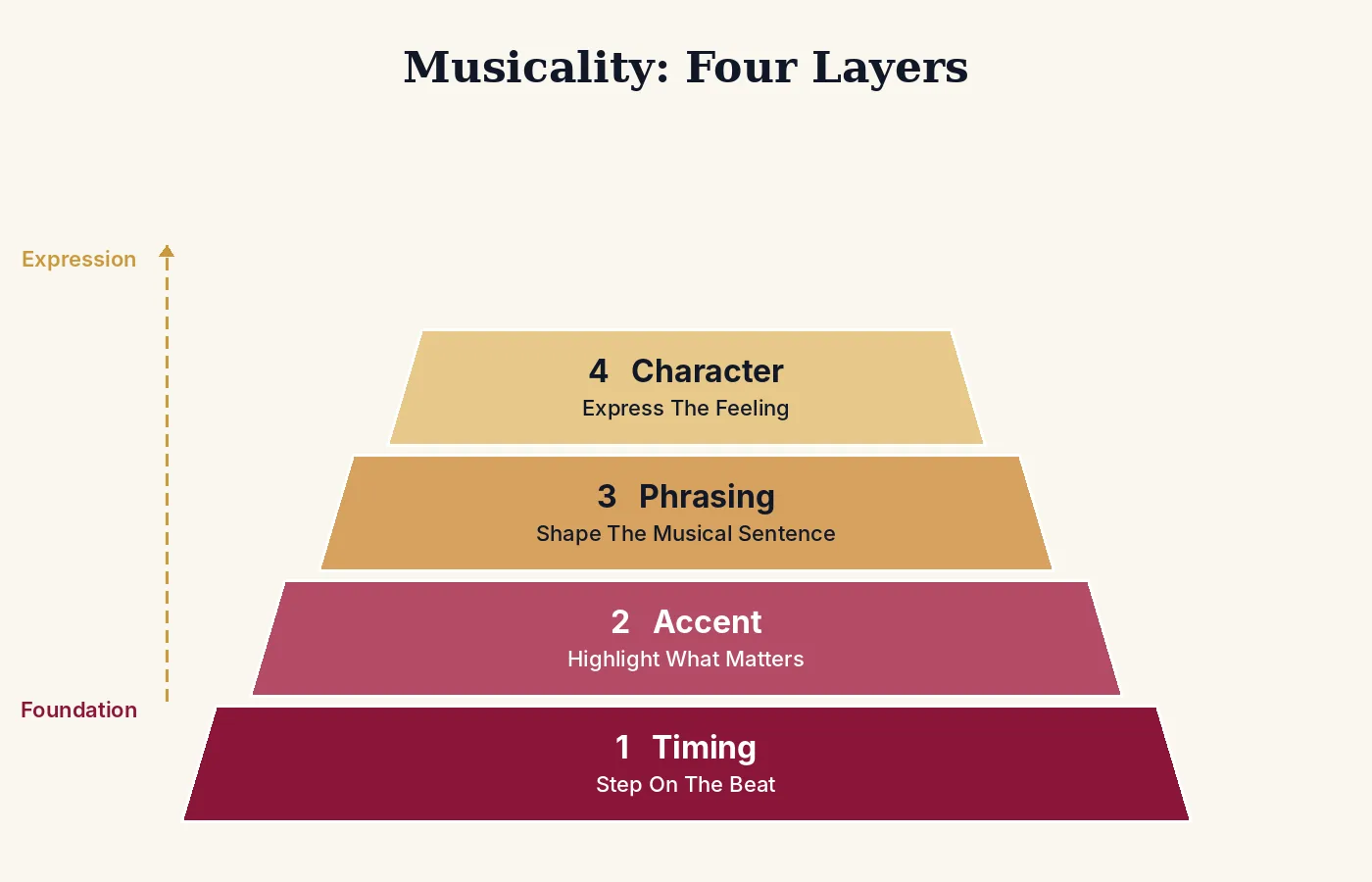
What musicality means in dance
Musicality is the umbrella word for everything a dancer does with the music beyond simply keeping time. It covers when you move (timing and phrasing), how strongly you move (matching the music’s accents and dynamics), and the flavor of the movement (smooth for a lyrical Rumba, staccato for a driving Tango—even when the steps are identical).
Judges score it, social partners feel it, and audiences see it instantly, even if they can’t name it. A musical dancer seems to predict the song: the big figure arrives exactly when the chorus lifts, the pause lands exactly on the break. None of that is magic—it is hearing the music’s structure and making choices about it, which is why it can be taught.
The four layers of musicality
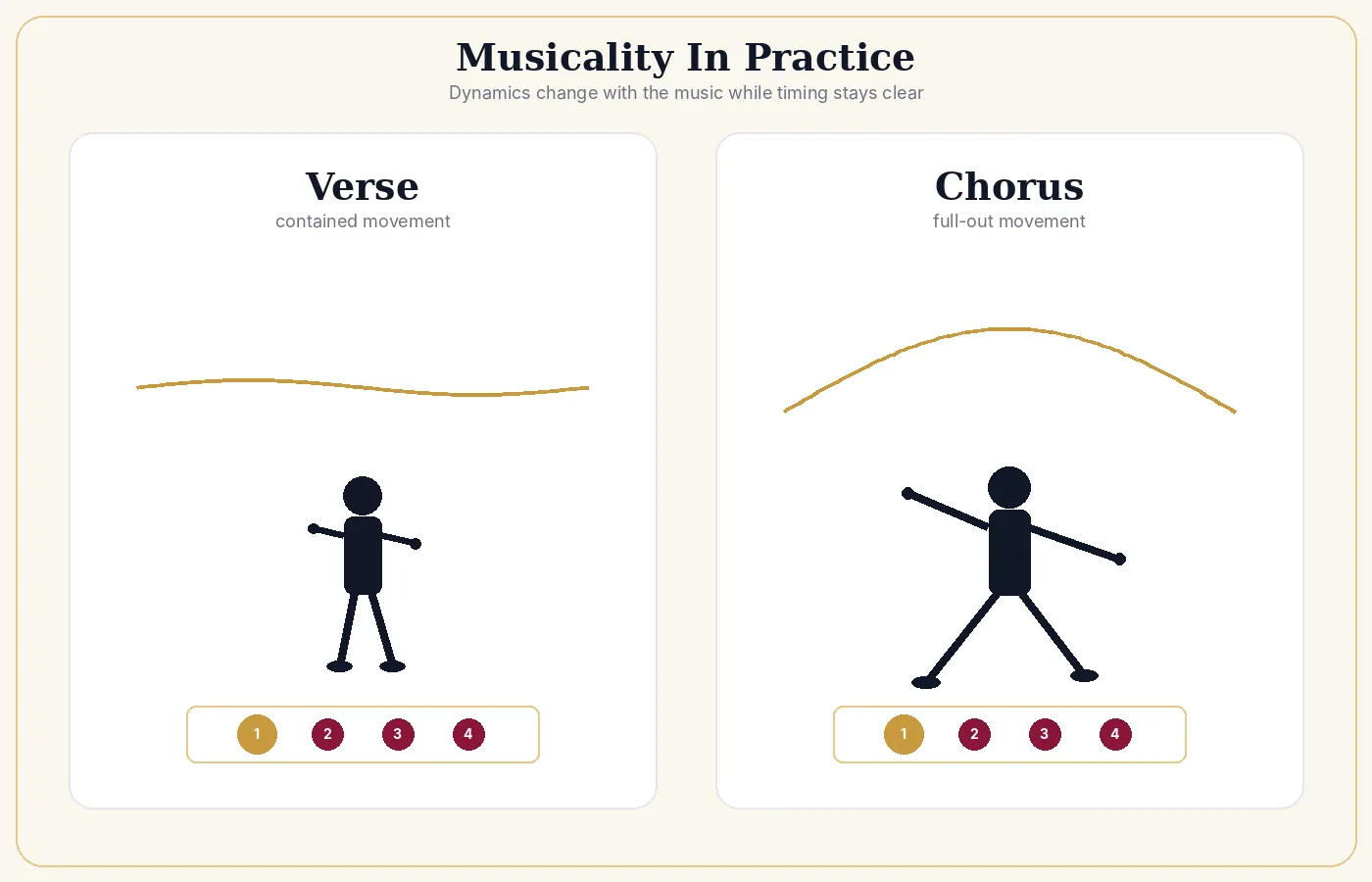
Think of musicality as a stack. Each layer depends on the one below it, and each one is practiced separately:
The stack, bottom to top
- 1. Timing. Step on the beat, in the right rhythm for the dance. This is the non-negotiable foundation—see timing and beat.
- 2. Accent. Make strong beats look strong: land the downbeat, mark the accents, let weak beats stay soft.
- 3. Phrasing. Start figures at the top of a phrase and land the big moments where the music lands.
- 4. Character. Match the song’s personality—sharp or smooth, playful or dramatic—and even play against it deliberately with syncopation.
A useful self-diagnosis: dancers who feel “unmusical” are almost always missing layer 1 or 2, not some mysterious layer 5. Fix the timing, then the accents, and the upper layers become available.
Musicality vs timing
The two get used interchangeably, but they are different sizes:
| Timing | Musicality |
|---|---|
| Stepping on the correct beats | Expressing everything the music is doing |
| Right or wrong—you’re on it or you’re not | A spectrum of choices and interpretation |
| Can be counted and drilled directly | Built in layers on top of timing |
| Makes dancing correct | Makes dancing expressive |
The order matters: no amount of styling rescues dancing that is off time, and even perfect timing looks mechanical without the layers above it. Build up, in order.
“I’m just not musical” — yes, you are
If you can tell a lullaby from a march, notice when a chorus arrives, or feel that a song is “building,” you already perceive everything musicality requires—you just haven’t connected it to your body yet. Research on rhythm perception consistently finds that beat-keeping improves with practice at any age; the dancers who look “naturally musical” almost always grew up listening, singing, or playing—which is to say, practicing.
The practical consequence: treat musicality like footwork, not like a personality trait. Isolate one layer, drill it with music you love, and stack the next one when it’s stable. The practice section below gives you the drills in order.
Common musicality mistakes
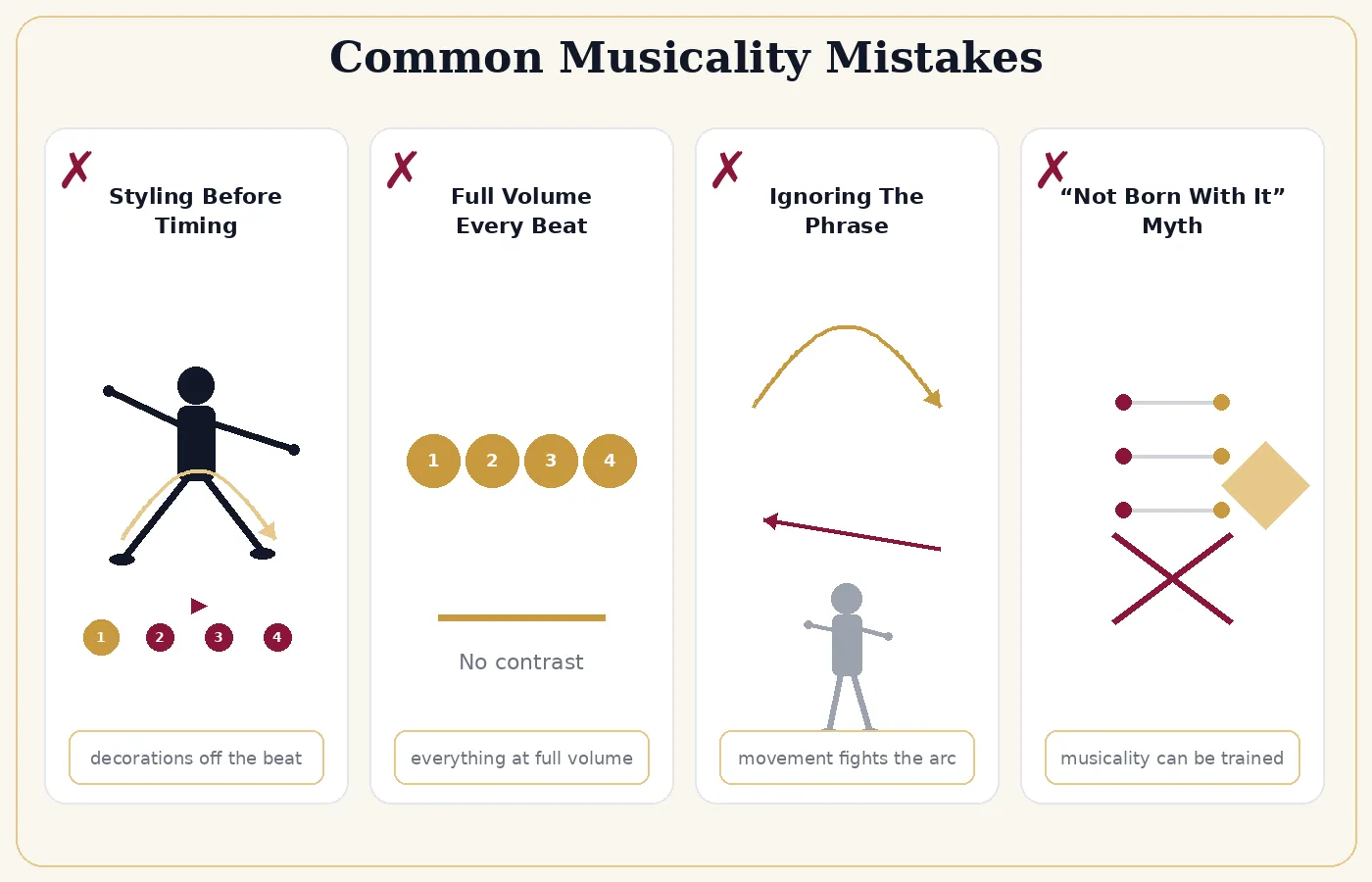
Adding styling before the timing is solid
Fix: Styling on shaky timing reads as noise. Lock layer 1 first—then decoration becomes expression.
Dancing everything at full volume
Fix: If every step is big, nothing is. Save size and sharpness for the accents and the phrase peaks.
Ignoring the phrase
Fix: Starting anywhere makes correct steps look random. Begin at the top of the phrase and the same steps look choreographed.
Believing it can’t be learned
Fix: Musicality is a stack of skills, each drillable. “Unmusical” almost always means “hasn’t drilled layers 1–2 yet.”
Practice musicality, layer by layer
One layer at a time, with music you genuinely like:
- Layer 1 — walk the beat. Walk to music stepping exactly on the beat for a full song. Boring on purpose; this is the foundation.
- Layer 2 — accent one beat. Same walk, but make beat 1 visibly bigger and let 2-3-4 stay small.
- Layer 3 — restart on the phrase. Dance a basic figure, restarting only at phrase tops. Feel the music “agree” with you.
- Layer 4 — two characters. Dance the same figure to a sharp Tango and a smooth Rumba, changing nothing but the quality of movement.
-
Rumba (character: smooth)
Slow, lyrical 4/4—practice legato movement and phrase-following.
-
Tango (character: sharp)
Staccato and grounded—the perfect contrast drill for layer 4.
-
Count the music
The companion guide to beats, measures, and phrases—layers 1 and 3.
-
BallroomPages Music (Telegram)
Mixed-style practice tracks. Musicality drills coming soon.
FAQ
Musicality FAQ
What is musicality in dance?
Musicality is the skill of expressing the music with your body: dancing on time, marking the accents, following the phrases, and matching the character of the song. It is what makes the same steps look correct on one dancer and alive on another.
Can musicality be learned, or are you born with it?
It can absolutely be learned. Musicality breaks into four drillable layers—timing, accent, phrasing, character—and beat perception improves with practice at any age. Dancers who seem “naturally” musical usually just started practicing (through music, singing, or listening) earlier.
What is the difference between musicality and timing?
Timing is stepping on the correct beats—it is right or wrong. Musicality is the full expression built on top of timing: accents, phrasing, and character. Timing makes dancing correct; musicality makes it expressive.
How do I improve my musicality?
One layer at a time: walk the beat until timing is automatic, then exaggerate beat 1 to learn accents, then restart figures only at phrase tops, then dance the same figure to songs with opposite characters. Ten focused minutes a day beats an occasional marathon.
Do judges score musicality in competitions?
Yes—timing and musical expression are core judging criteria in ballroom competition. Off-time dancing is heavily penalized at every level, and at higher levels musical interpretation is a major separator between couples with similar technique.
Editorial
Sources and review notes
This glossary entry should be reviewed by a qualified ballroom instructor before launch. The four-layer framing is an educational simplification; syllabi and coaches divide musical skills differently, and judging criteria vary by organization.
This is dance terminology, not music-theory instruction. Ballroom Pages follows an editorial policy of education-first guidance. Questions? Contact us. Updated July 9, 2026.