Glossary
Measure in Ballroom Dance
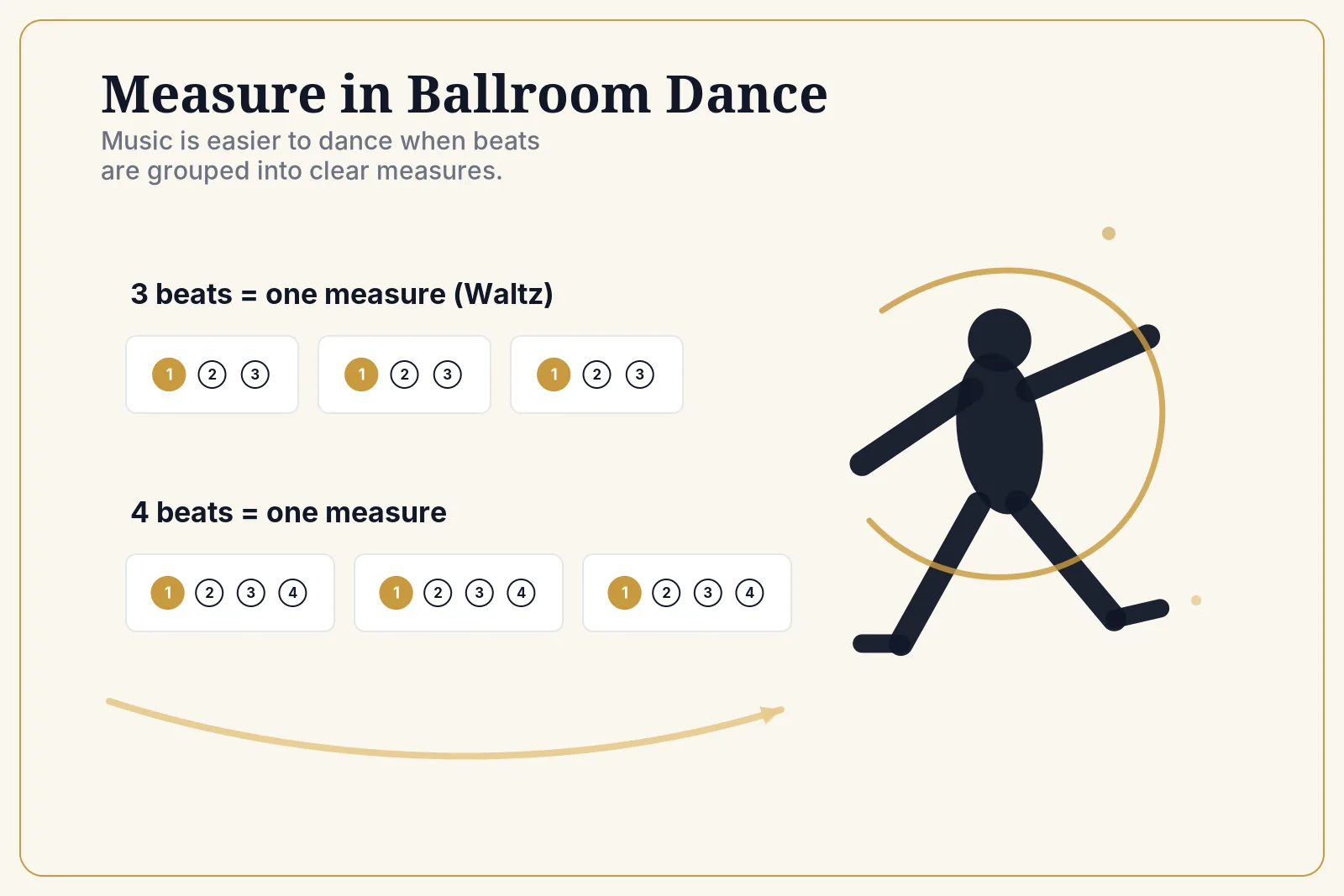
Music doesn’t arrive as one long stream of beats—it comes in small, repeating boxes. Each box is a measure: three beats in a Waltz, four in almost everything else. Once you can hear the boxes, counting, timing, and even choreography suddenly make sense. Here is what a measure is, how it differs from a bar and a phrase, and how to hear one in any song.
Definition of measure
Measure
- Also called
- Bar (same thing)
- Skill category
- Music & timing
- Companion term
- Beat (what measures are made of)
- Related terms
- beat, count, downbeat, phrase, tempo, timing
In music, a measure (also called a bar) is a small group of beats set by the time signature—three beats per measure in a Waltz, four in most other ballroom dances. Each measure starts with the downbeat, and dancers count measures to stay with the music.
If beats are the letters of music, measures are the words.
What a measure is in music and dance
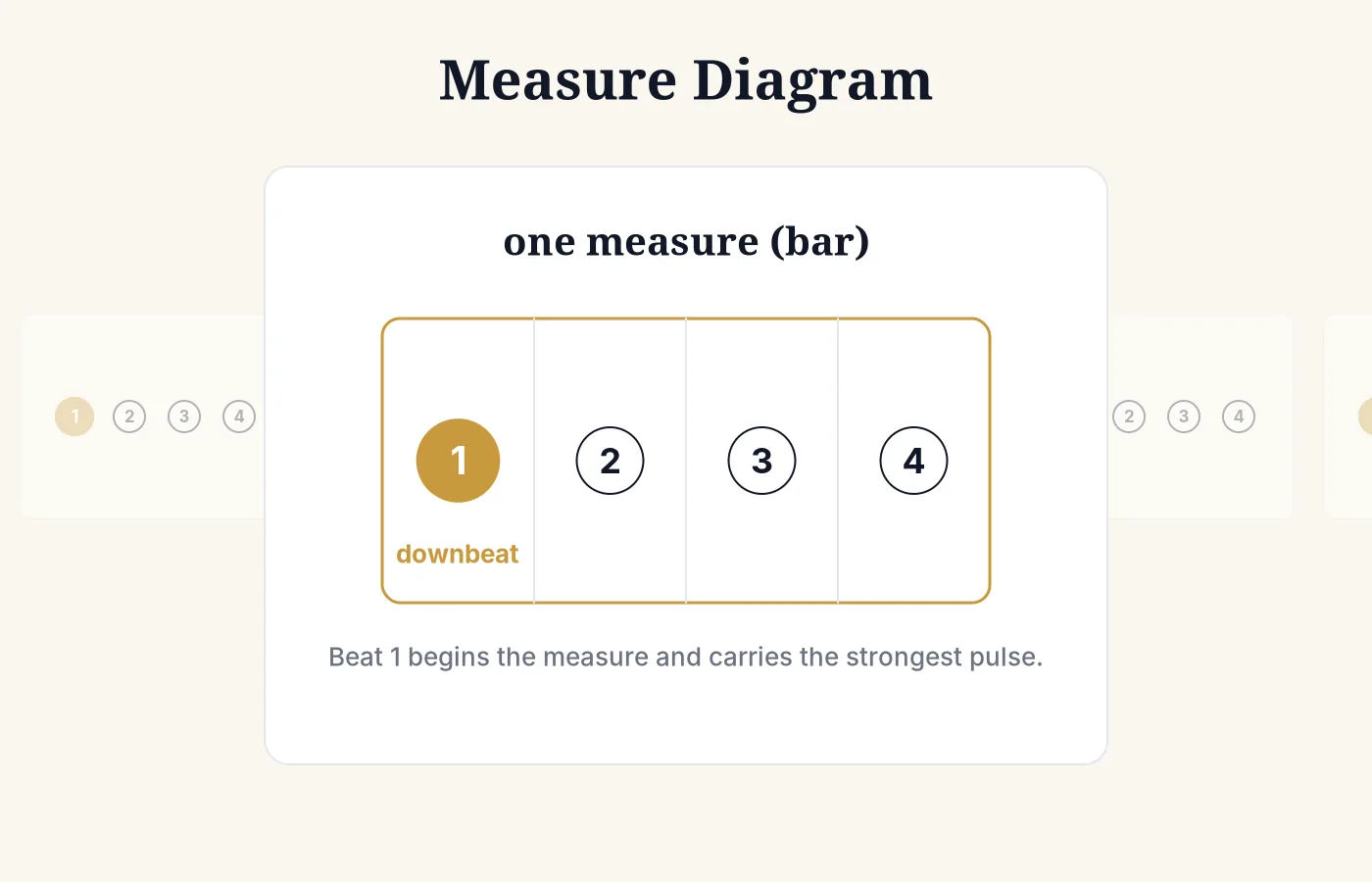
Every song has a steady pulse—the beat. A measure is how those beats get organized: the time signature declares how many beats belong in each group, and the music repeats that group over and over. In 3/4 time (Waltz), each measure holds three beats; in 4/4 time (most other ballroom dances), each holds four. The first beat of every measure is the downbeat, the strongest pulse.
For dancers, measures are the practical unit of music. Basic figures are built to fit them—a Waltz box step takes exactly two measures, one for each half. When a teacher says “we’ll take it from the top of the bar,” they mean the start of a measure. Learning to feel where measures begin is the step between hearing the beat and actually counting the music.
Measure vs bar: same thing, two names
This trips up almost every beginner at some point, so let’s settle it: a measure and a bar are the same thing. “Measure” is the common American term; “bar” is preferred in British English and much of the ballroom world (many syllabi write “1 bar of music”). The name “bar” comes from the vertical bar lines that divide measures in written music.
| Unit | What it is | Typical size |
|---|---|---|
| Beat | One pulse of the music | The smallest unit dancers count |
| Measure (bar) | A group of beats set by the time signature | 3 beats (Waltz) or 4 beats (most dances) |
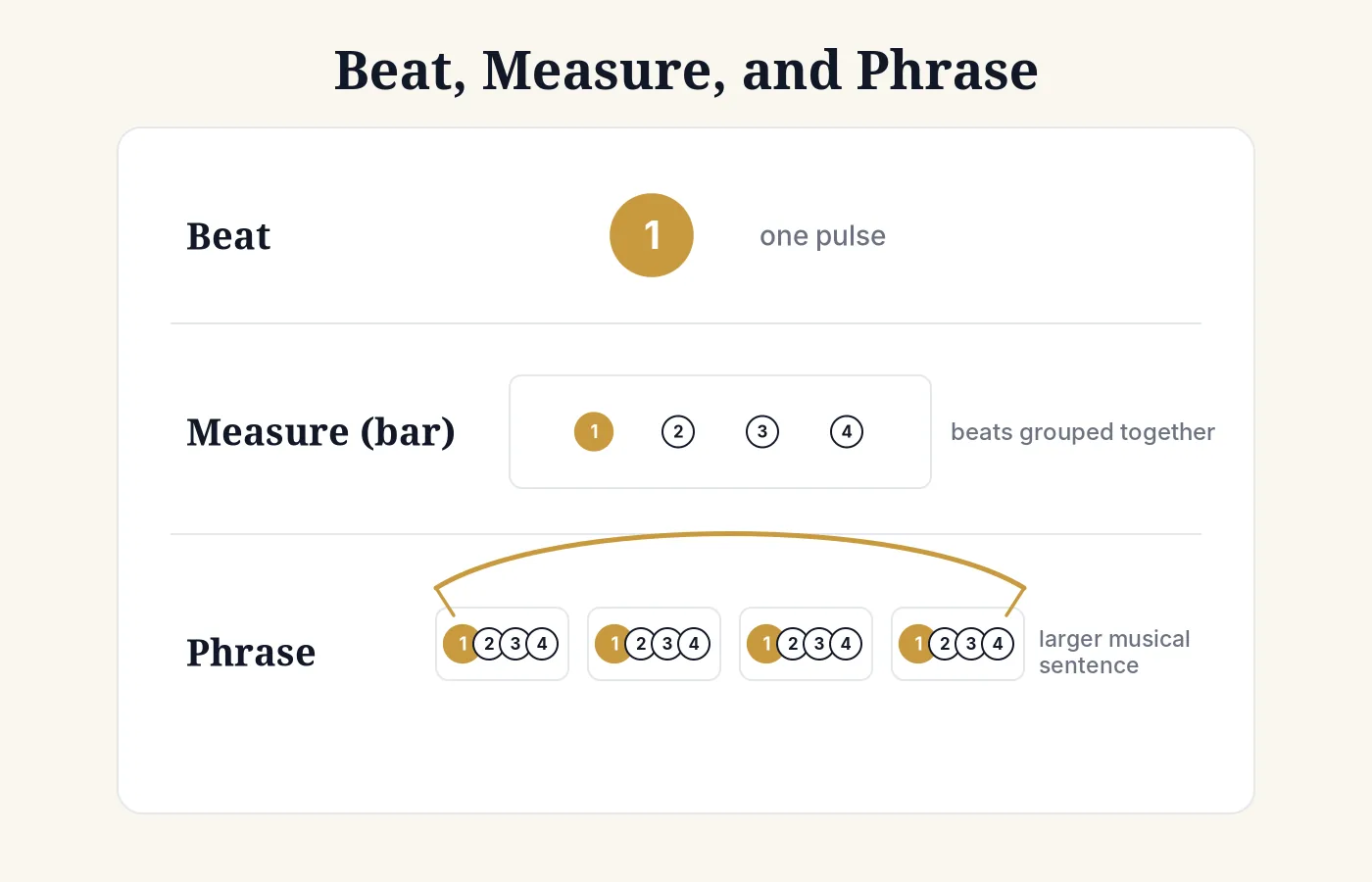
| Phrase | A musical sentence made of measures | Commonly 2 measures of 4/4 = the dancer’s “8-count” |
Measures by dance style
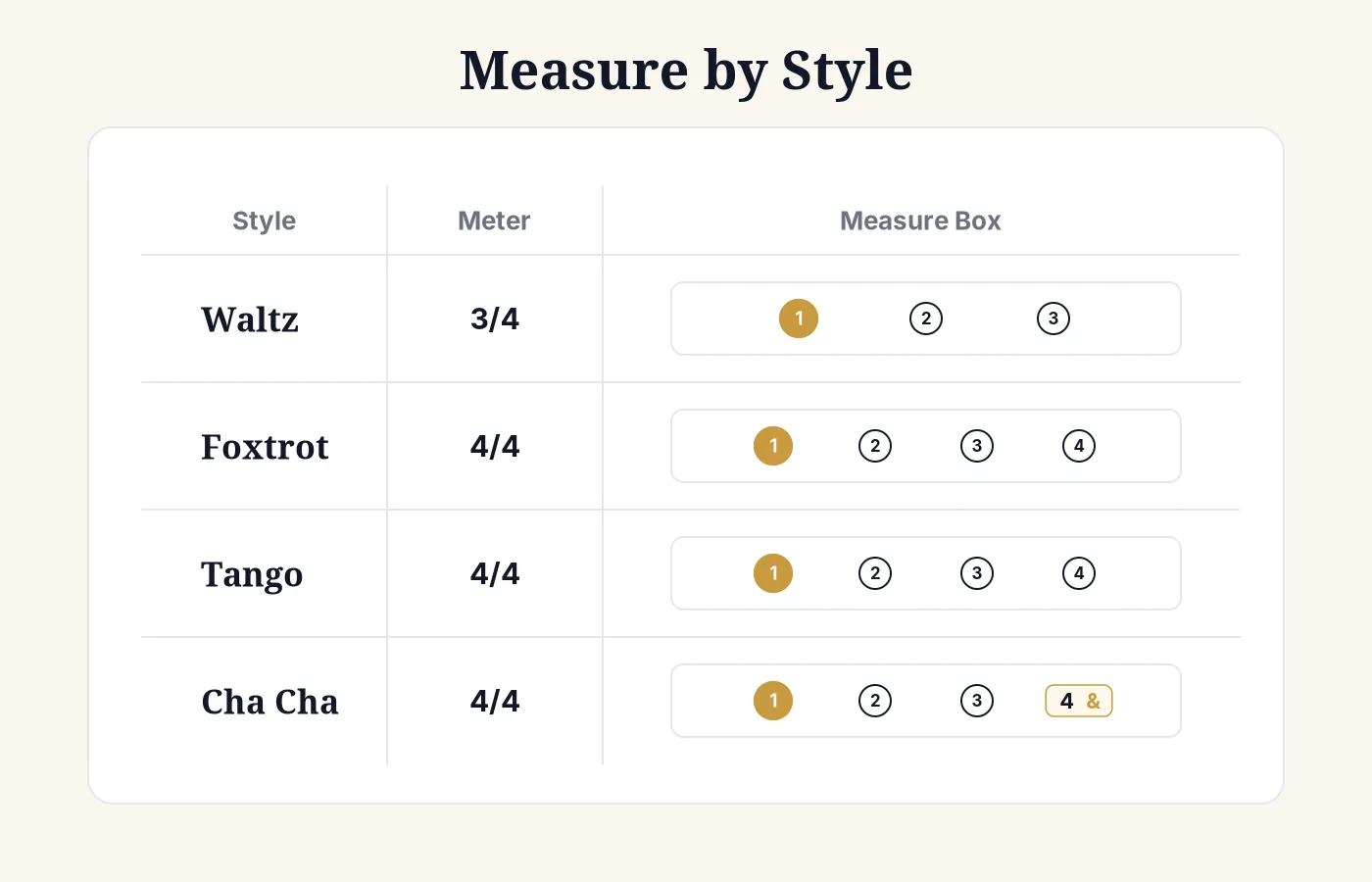
Measures build phrases
Measures don’t just repeat—they stack into bigger shapes. Two measures of 4/4 make the “8-count” most dancers count in; several 8-counts make a musical phrase, the sentence-length chunk that melodies live in. Choreographers and good social dancers start new figures at the top of a phrase, which is why some dancing looks “wired into” the song. Learn measures first; phrases are the next floor up, and musicality is the view from the top.
How to hear a measure
Finding the boxes
- Find the downbeat first. The heaviest pulse—usually the bass drum—marks the start of each measure.
- Count until it comes back. Count 1-2-3 or 1-2-3-4 from the strong beat; when the weight returns, a new measure has started.
- Feel the size. If counting to 3 keeps landing you on the strong beat, it’s a Waltz; if 4 does, it’s a 4/4 dance.
- Check with the melody. Melodies tend to start and breathe at measure boundaries.
For the full walkthrough, see how to count ballroom dance music.
Common measure mistakes
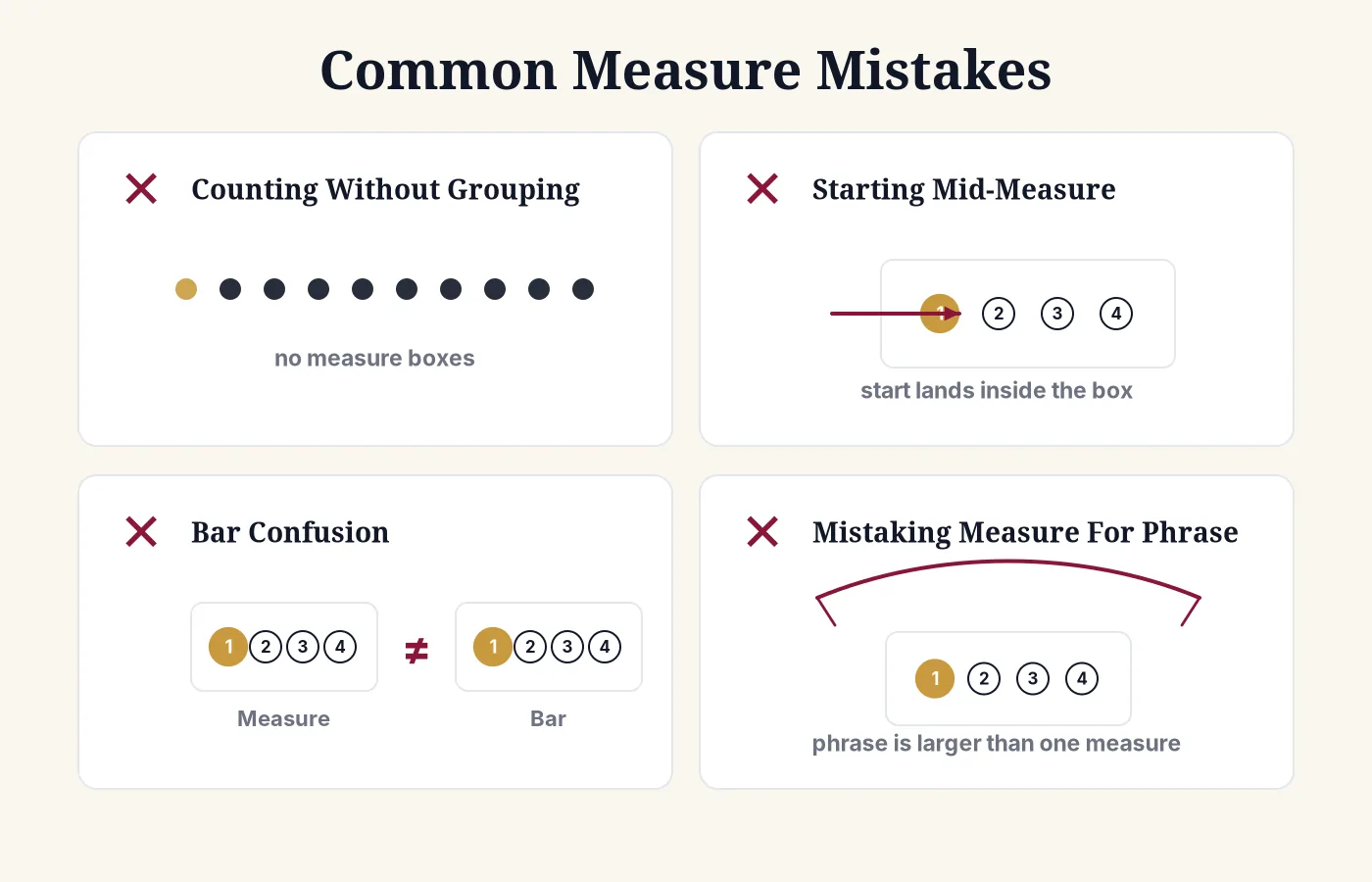
Counting beats without grouping them
Fix: Endless “1-2-3-4-5-6-7…” drifts. Restart at 1 on every downbeat so each measure is its own box.
Starting a figure mid-measure
Fix: Wait for the downbeat. Figures are built to start at the top of the measure—joining mid-box is why a step can feel “off” even at the right speed.
Thinking measure and bar are different things
Fix: They’re synonyms. If a syllabus says “this figure takes 2 bars,” that’s 2 measures.
Confusing the measure with the phrase
Fix: The measure is the small box (3–4 beats); the phrase is the sentence built from several boxes. Dancers’ “8-count” = two measures of 4/4.
Practice hearing measures
Measure-hearing is beat-hearing plus grouping. Train it with music you love:
- Clap the downbeat only. One clap per measure for a whole song—Waltz makes this easiest.
- Count boxes out loud. “1-2-3, 2-2-3, 3-2-3…”—numbering each measure as you go.
- Box-step check. Dance a Waltz box: each half should consume exactly one measure.
-
Waltz (3 beats per box)
The clearest measures in ballroom—perfect for hearing the 1-2-3 group.
-
Rumba (4 beats per box)
Slow 4/4—plenty of time to feel each measure arrive.
-
Count the music
The companion guide to counting beats, measures, and phrases.
-
BallroomPages Music (Telegram)
Mixed-style practice tracks. Measure drills coming soon.
FAQ
Measure FAQ
What is a measure in music?
A measure is a small group of beats set by the time signature—three beats in 3/4 time (Waltz), four in 4/4 time (most other ballroom dances). Music repeats this group continuously, and each measure begins with the downbeat, the strongest beat.
Is a measure the same as a bar?
Yes. “Measure” and “bar” are two names for the same unit—measure is the common American term, bar the British one (from the bar lines in written music). Ballroom syllabi often use “bar.”
How many beats are in a measure?
It depends on the time signature: 3/4 time has three beats per measure (Waltz, Viennese Waltz), and 4/4 time has four (Foxtrot, Tango, Rumba, Cha Cha, and most other ballroom dances).
What is the difference between a measure and a phrase?
A measure is the small repeating group of 3–4 beats; a phrase is a longer musical sentence built from several measures. The “8-count” dancers use equals two measures of 4/4, and full phrases are usually made of two or four 8-counts.
Why do measures matter for dancing?
Because figures are built to fit them. A Waltz box takes two measures, most basics start on beat 1 of a measure, and syllabi describe figures in bars. Dancers who feel measures start figures in the right place without counting frantically.
Editorial
Sources and review notes
This glossary entry should be reviewed by a qualified ballroom instructor before launch. Measure and time-signature descriptions follow standard music-theory conventions and ballroom syllabus materials; Tango’s written time signature varies by source and arrangement.
This is dance terminology, not music-theory instruction. Ballroom Pages follows an editorial policy of education-first guidance. Questions? Contact us. Updated July 9, 2026.