
Glossary
Upbeat in Ballroom Dance
Every strong “one” is set up by the beat just before it—the upbeat. It is the quiet lead-in that lets a dancer prepare, breathe, and arrive on the downbeat with intention. Beginners often ignore it; good dancers use it. Here is what the upbeat is, how it pairs with the downbeat, why it matters for preparation, and how it relates to the off-beat.
Definition of upbeat
Upbeat
- Pronunciation
- UP-beet
- Skill category
- Music & timing
- Companion term
- Downbeat (the beat it leads into)
- Related terms
- downbeat, beat, off-beat, count, accent, timing, preparation
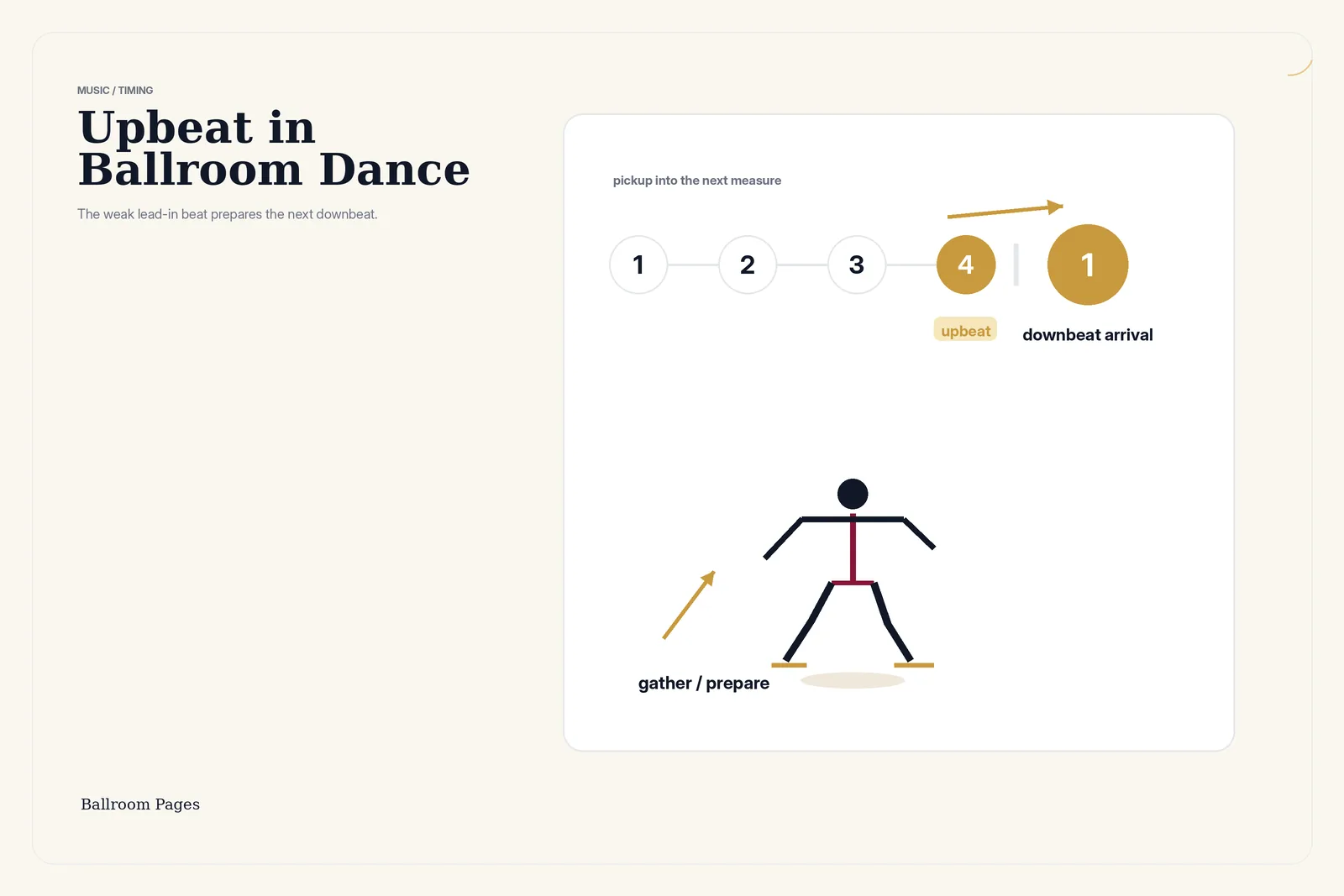
In music and dance, the upbeat is the weak beat that immediately precedes and anticipates the downbeat—the “pickup” that leads into beat 1. In dance, the even beats (2, 4) are often called upbeats, and dancers use the upbeat to prepare the next movement.
The downbeat is the arrival. The upbeat is the wind-up that makes the arrival land.
What the upbeat means in music and dance
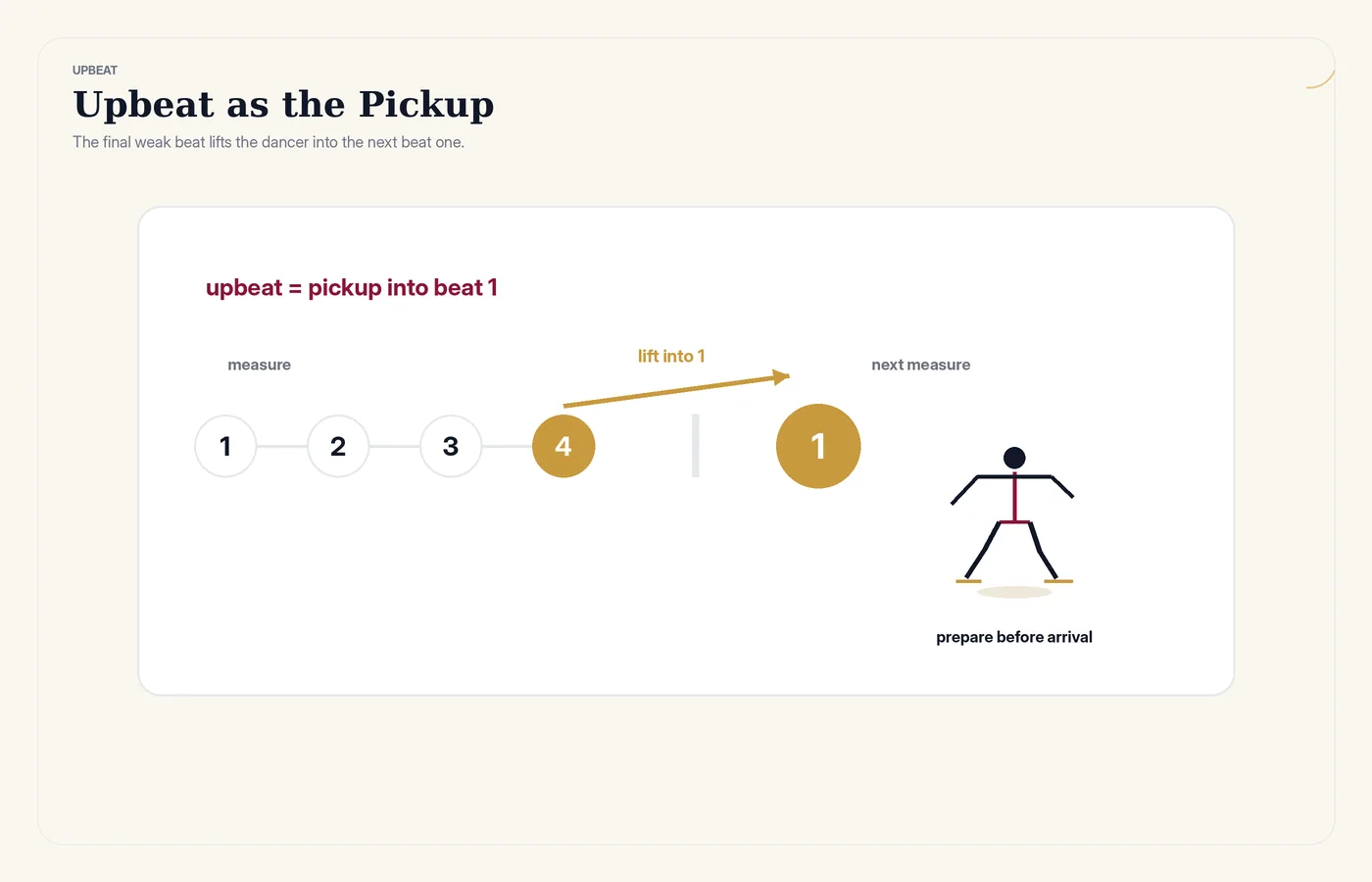
In its strictest sense, the upbeat is the final, weak beat of a measure that leads into the next measure’s downbeat. The name comes from conducting: the baton lifts up on this beat to prepare the downward stroke on beat 1. It is the musical equivalent of taking a breath before speaking.
For dancers, the upbeat is the moment of preparation. Where the downbeat is arrival and commitment, the upbeat is the gathering of energy just before. Learning to feel it—rather than rushing straight from one downbeat to the next—is what gives dancing a sense of ease and anticipation instead of a hurried, mechanical feel.
Upbeat vs downbeat
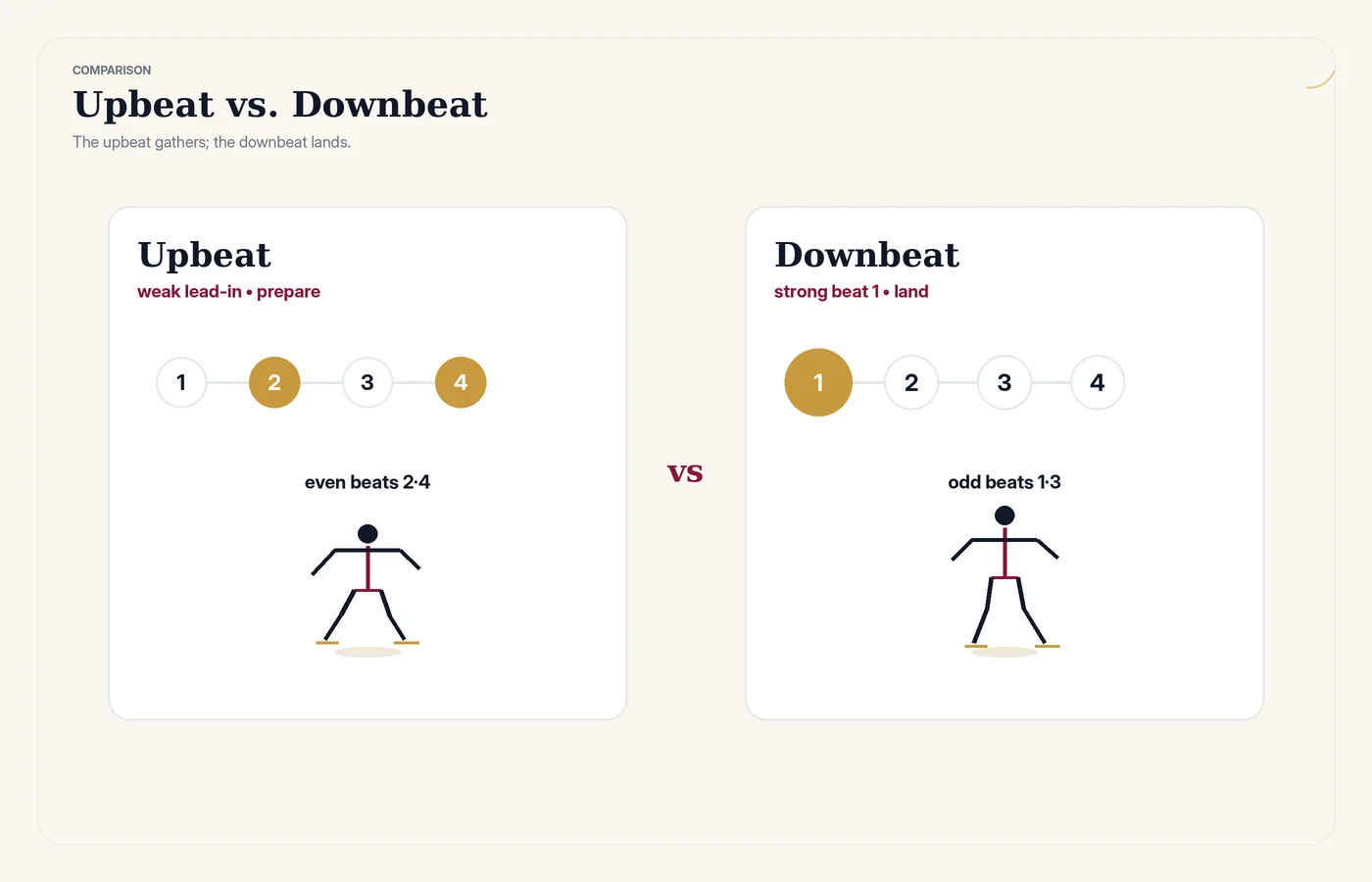
They are a matched pair: the weak lead-in and the strong arrival.
| Upbeat | Downbeat |
|---|---|
| The weak beat leading into the measure | The strong first beat of the measure |
| The “pickup” before “1” | Counted as “1” |
| Where you prepare | Where you land weight |
| Even beats: 2, 4, 6, 8 | Odd beats: 1, 3, 5, 7 |
The upbeat as preparation
This is where the upbeat earns its keep in dancing. Good movement is not a chain of equal, hurried steps—it breathes. The upbeat is the breath:
Using the upbeat
- Gather. Let the upbeat be a small preparation—a soften of the knees or a gathering of the body.
- Anticipate. Feel where the downbeat is coming and aim your energy toward it.
- Arrive. Commit fully to the downbeat, so the preparation pays off in a clean landing.
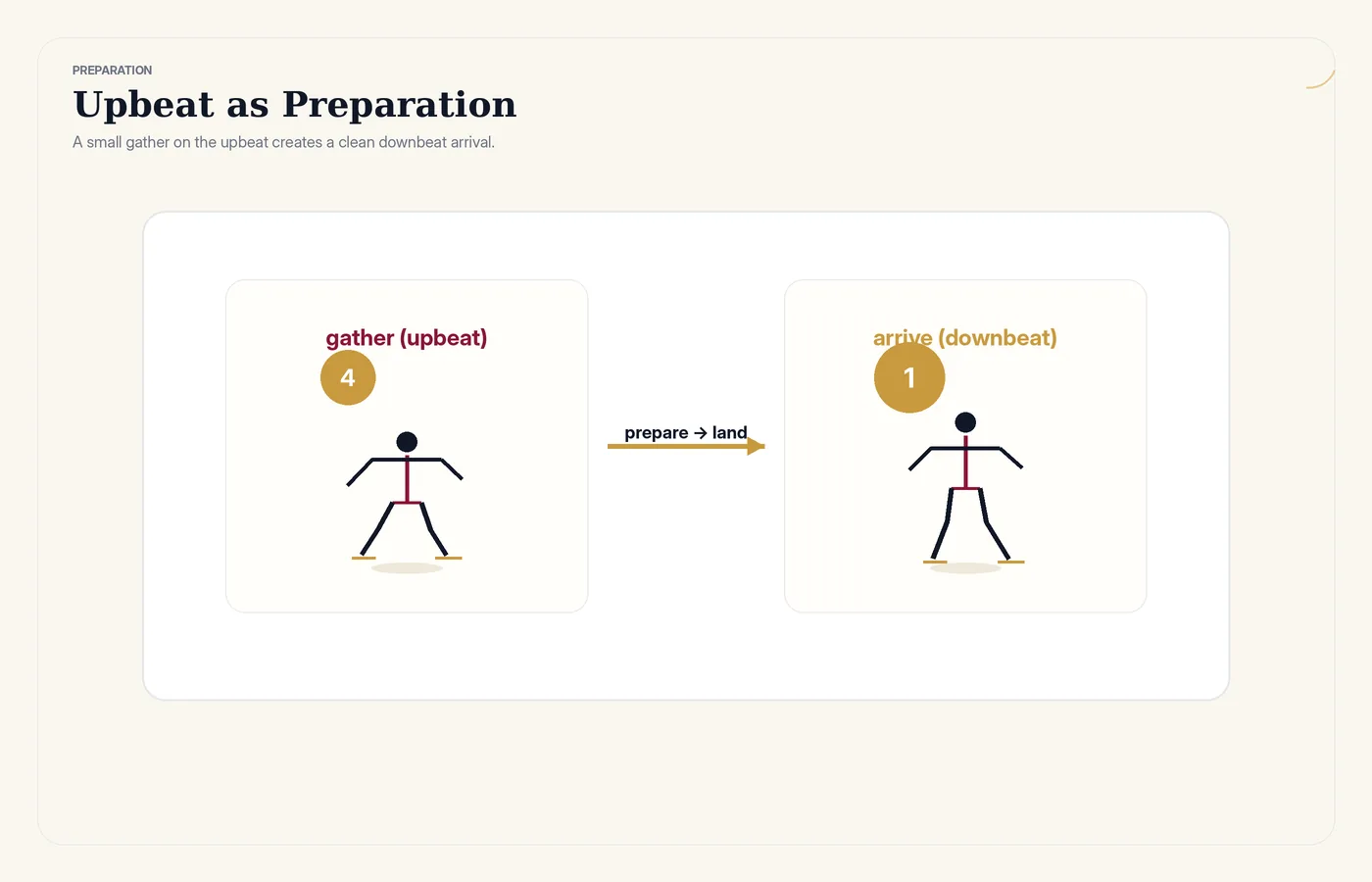
Ignore the upbeat and dancing feels rushed and flat. Use it and every downbeat has a sense of intention behind it.
The even beats
In everyday dance talk, teachers often use “downbeats” for the odd beats (1, 3, 5, 7) and “upbeats” for the even beats (2, 4, 6, 8). This is a simplification of the strict musical meaning, but it is useful: it gives dancers a quick way to talk about the strong-weak alternation they feel. In this shorthand, clapping on 2 and 4 is “clapping on the upbeats.” For the underlying pulse itself, see beat and count.
Upbeat vs off-beat
These two terms overlap and are often used loosely, which causes confusion. Here is the clean distinction:
- Upbeat: strictly, the weak beat that leads into the downbeat; loosely, the even beats (2, 4).
- Off-beat: the weak part of the beat—the “&” between the numbered beats, where syncopation lives.
So all upbeats are “off” the strong downbeat, but the off-beat usually refers specifically to the “&” subdivisions between beats. When in doubt: upbeat = a whole weak beat; off-beat = the “and” in between.
Common upbeat mistakes
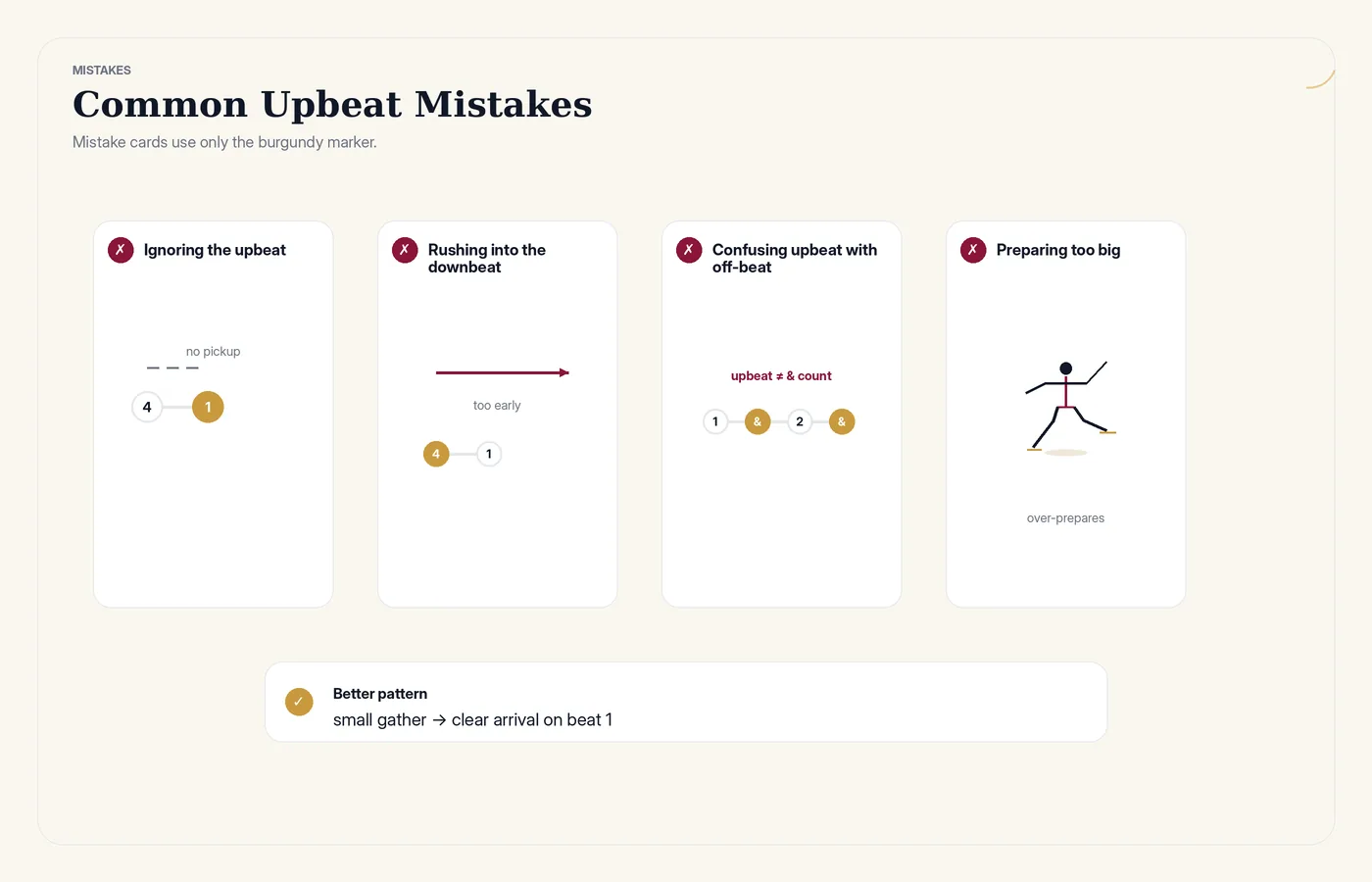
Ignoring the upbeat entirely
Fix: Treat the beat before “1” as a preparation, not dead time. It is what makes the downbeat land.
Rushing into the downbeat
Fix: Let the upbeat breathe. Arriving early robs the downbeat of its weight.
Confusing upbeat and off-beat
Fix: The upbeat is a whole weak beat; the off-beat is the “&” between beats.
Preparing too big
Fix: The upbeat is a small gather, not a separate move. Keep it subtle so the downbeat stays the event.
Practice feeling the upbeat
Train the strong-weak alternation with music you can move to:
- Clap 2 and 4. Over a 4/4 track, clap only on the even beats to feel the upbeats against the downbeats.
- Breathe the prep. Softly gather on the upbeat, then commit weight on the downbeat, over and over.
- Down-up walking. Say “down” on 1 and “up” on the beat before the next 1 as you walk.
-
Waltz (down-up feel)
3/4 time. Feel the lift toward each new “1” on the beat before it.
-
Swing (clap 2 & 4)
The classic upbeat clap. Great for feeling the even beats.
-
Count the music
Read the companion guide to counting ballroom music.
-
BallroomPages Music (Telegram)
Mixed-style practice tracks. Timing drills coming soon.
FAQ
Upbeat FAQ
What is an upbeat in music?
The upbeat is the weak beat that immediately precedes and leads into the downbeat—the “pickup” before beat 1. The name comes from conducting, where the baton lifts up to prepare the downward stroke on the downbeat.
What is the difference between the upbeat and the downbeat?
The downbeat is the strong first beat of the measure that you land on. The upbeat is the weaker beat that leads into it, used to prepare. In dance shorthand, downbeats are the odd beats (1, 3) and upbeats the even beats (2, 4).
Is the upbeat the same as the off-beat?
They overlap but are not identical. The upbeat is a whole weak beat (often the even beats). The off-beat usually refers to the “&” subdivisions between the numbered beats, where syncopation happens.
Why does the upbeat matter for dancing?
The upbeat is your preparation. Using it to gather and anticipate gives movement a sense of breath and intention, so each downbeat lands cleanly instead of feeling rushed or mechanical.
What does “clap on 2 and 4” mean?
It means clapping on the even beats—the upbeats—rather than the strong 1 and 3. It is common in swing and jazz, and it trains you to feel the weak beats against the downbeats.
Editorial
Sources and review notes
This glossary entry should be reviewed by a qualified ballroom instructor before launch. Upbeat and downbeat descriptions follow widely accepted conventions from music theory and ballroom practice; the strict (pickup) and colloquial (even beats) meanings both appear in common use and are noted above.
This is dance terminology, not music-theory instruction. Ballroom Pages follows an editorial policy of education-first guidance. Questions? Contact us. Updated July 9, 2026.