
Glossary
Accent in Ballroom Dance
Music is not a flat row of identical beats. Some beats are louder, heavier, or more important than others—those are accents. Learning to hear the accent and show it in your body is what separates dancing that looks musical from dancing that just keeps time. Here’s what a musical accent is, the different kinds, how each ballroom style uses them, and how to actually dance them.
Definition of accent
Accent
- Pronunciation
- AK-sent
- Skill category
- Music & timing
- Companion term
- Beat (the pulse an accent lands on)
- Related terms
- beat, downbeat, count, tempo, rhythm, timing, syncopation, musicality
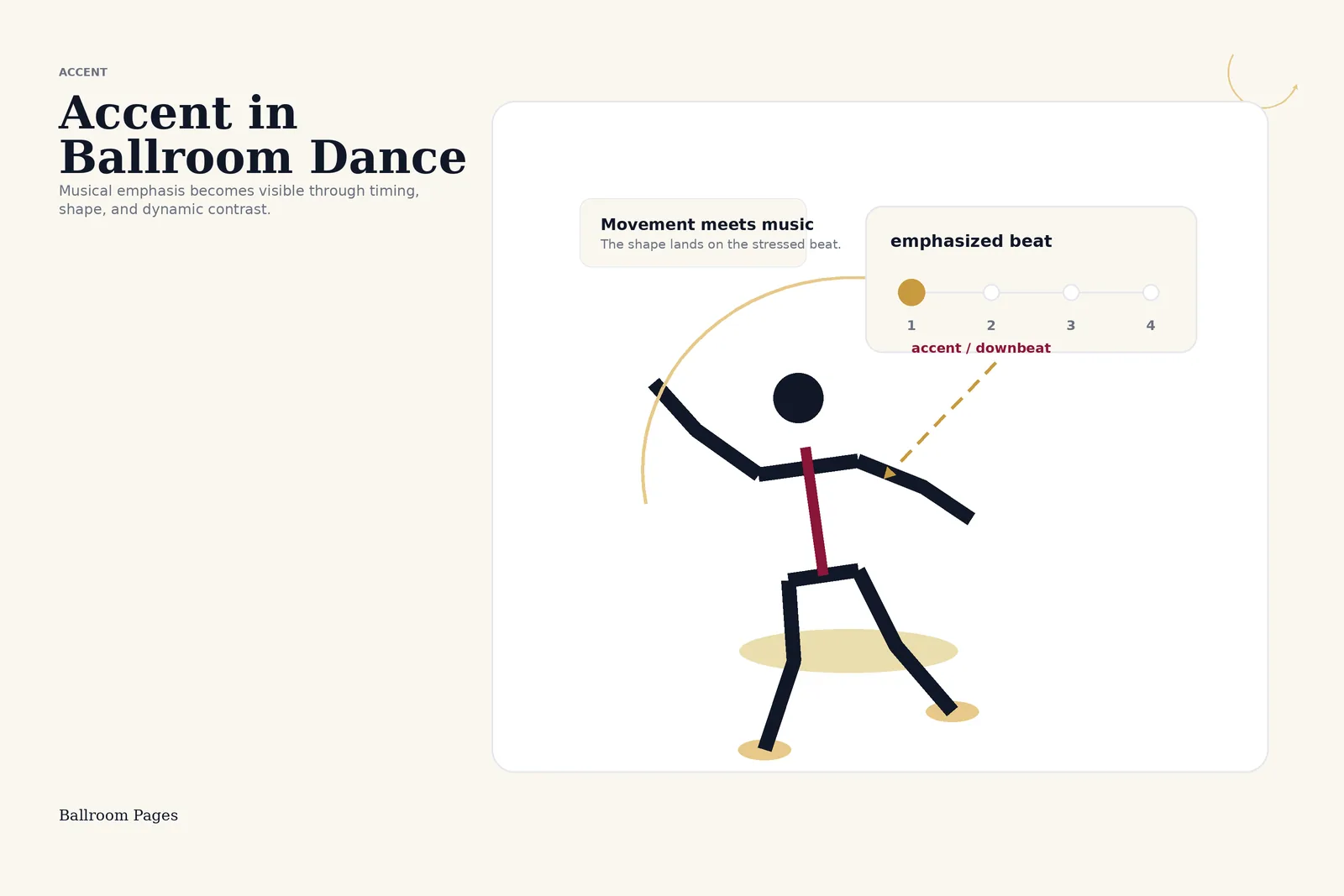
In ballroom dance, an accent is a beat that is emphasized more strongly than the beats around it—most often the first beat of a measure, the downbeat. Dancers hit an accent by starting a new movement, changing speed, changing the size of a step, or adding styling on that beat.
The music tells you where the accent is. Your job is to show it in your body.
What a musical accent means in ballroom dance
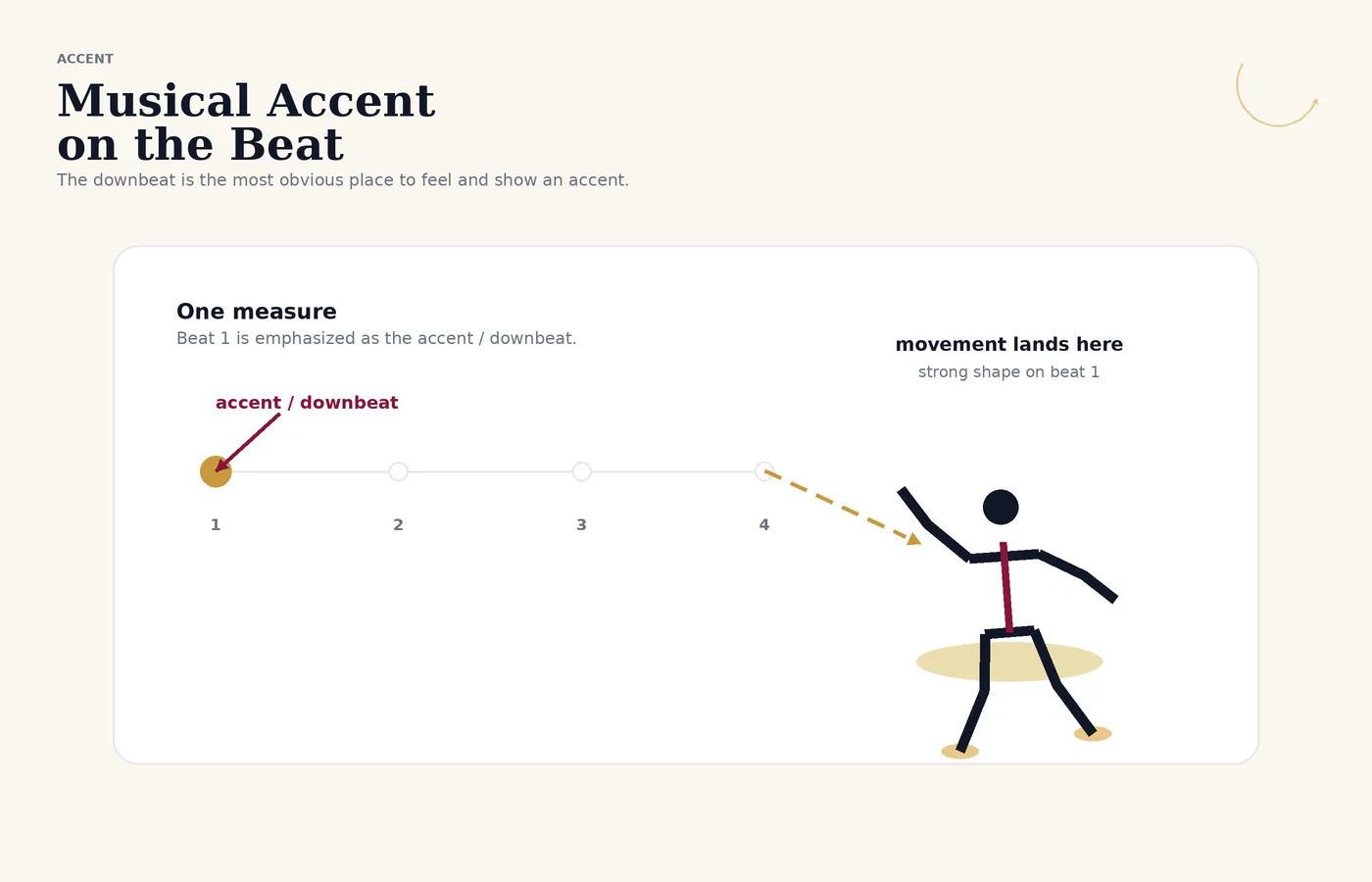
An accent is emphasis. In a bar of music, one or two beats are stressed more than the rest—played louder, hit harder, or landed on by the melody—and the ear naturally leans on them. That stressed beat is the accent.
In most ballroom music the strongest accent falls on the first beat of the measure, which musicians call the downbeat. It is the beat you would clap on, the beat that tells you where a bar begins, and the beat most figures are timed to start from. Some dances add secondary accents on other beats, and some songs place surprise accents off the beat for effect.
Hearing the accent is a listening skill. Dancing the accent is a movement skill. A dancer who can do both looks connected to the music instead of just marching through counts—this is the heart of what teachers call timing and musicality.
Types of accents
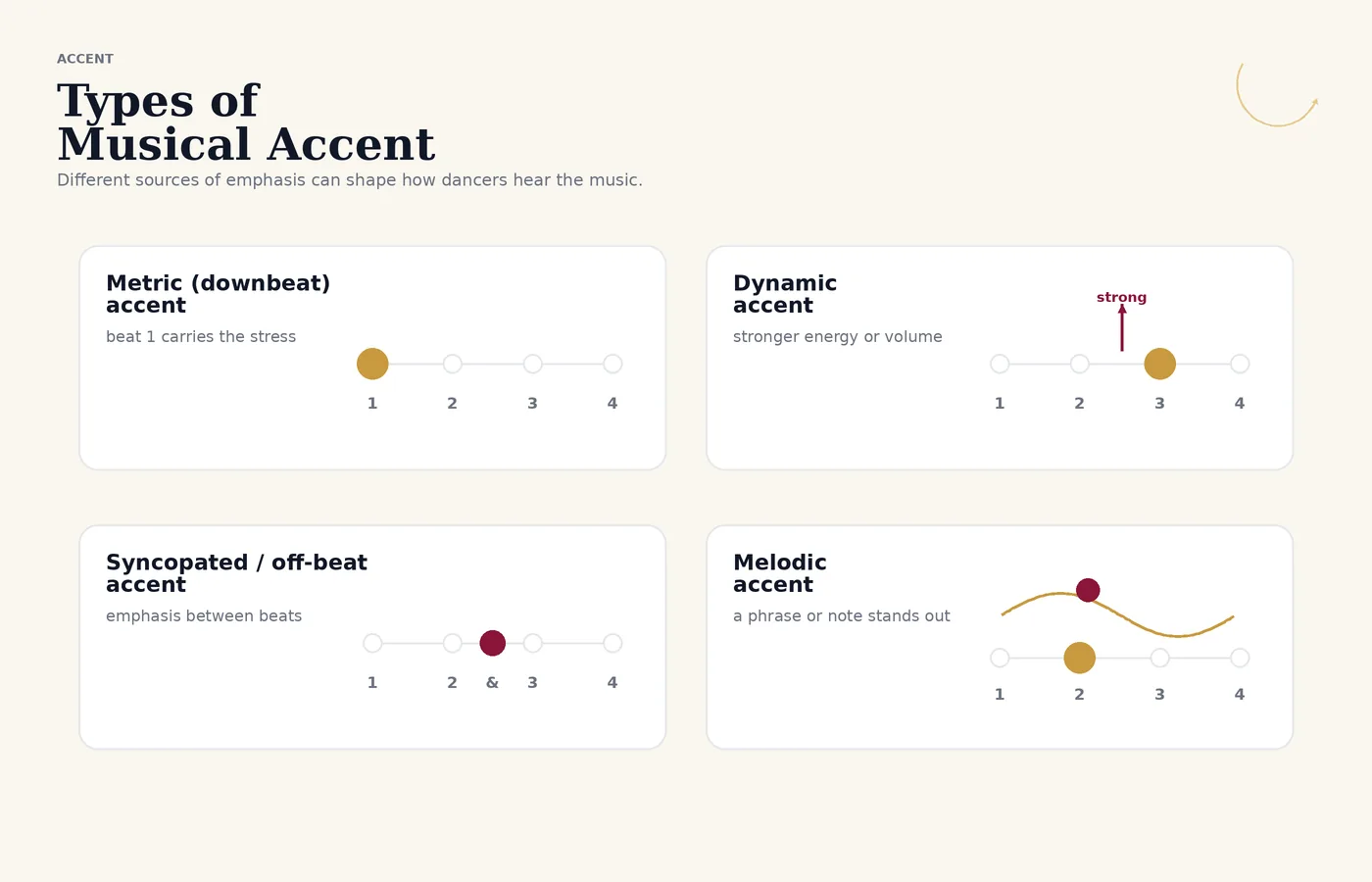
Not every accent is the loud downbeat. Four kinds show up in ballroom music:
| Accent type | What it is | Where you hear it |
|---|---|---|
| Metric (downbeat) | The regular stress on beat 1 of every measure | Waltz “1,” the boom of a bass drum, the accordion in Tango |
| Dynamic | A beat played suddenly louder than its neighbors | A brass hit or cymbal crash inside a phrase |
| Syncopated / off-beat | Emphasis on a weak beat or the “&” between beats | The “and” count in Cha Cha and swing music |
| Melodic | A note the tune leans on, even if it is not the loudest | The held note that starts a Rumba phrase |
For beginners, the metric accent on beat 1 is the one that matters. Master hitting “1” before you chase the subtler accents.
How dancers express an accent
Hearing the accent is only half the job. You have to show it. There are five common ways to dance an accent, and good dancers mix them:
- Start a new movement on it. Begin a figure exactly on the accented beat so the movement and the music launch together.
- Change speed. Arrive early and hold, or delay and go quickly, so your timing plays against a steady beat.
- Change size. Take a bigger step or a stronger action on the accent and smaller ones around it.
- Pause or hold. Stopping on an accent can be more powerful than moving—the stillness marks the beat.
- Add styling. A head turn, an arm line, or a sharpening of the body on the accent shows it without a step.
The one-bar accent drill
- Listen: find beat 1 of the bar and clap only on “1.”
- Grow it: make your clap bigger on “1” than a normal clap.
- Move it: replace the clap with a bigger step on “1,” smaller steps on the rest.
- Show it: add a small body accent (a lift or a sharpen) exactly on “1.”
Accent by dance style
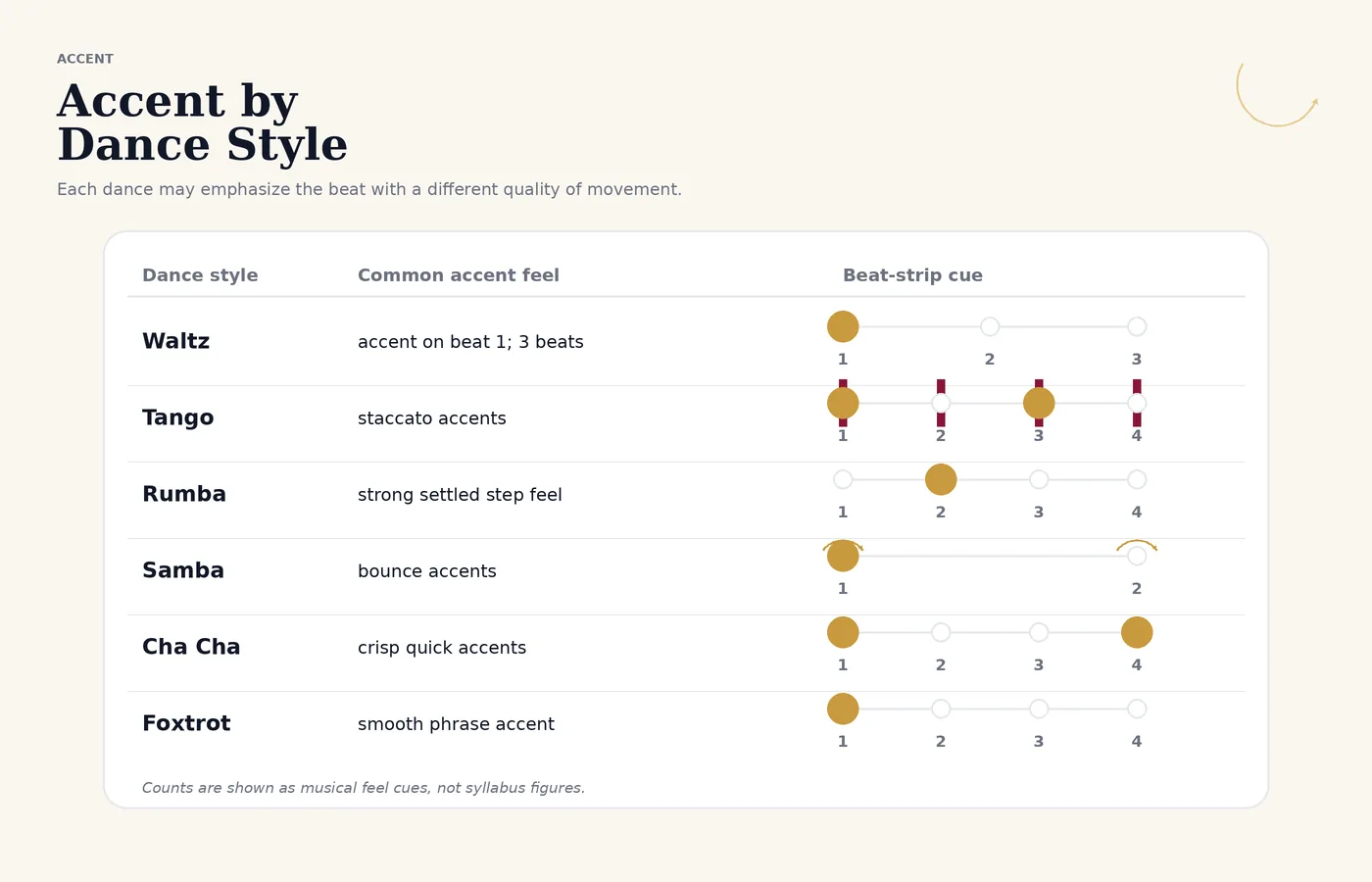
Where the accent falls and how you show it changes from dance to dance.
| Dance | Time signature | Where the accent sits |
|---|---|---|
| Waltz | 3/4 | Strong accent on beat 1, then two lighter beats (1-2-3) |
| Tango | 2/4 or 4/4 | Sharp, staccato accents—danced with sudden, marked movement |
| Rumba | 4/4 | Movement drives into beat 1; the step on “1” is the accent |
| Samba | 2/4 | A bounce accent tied to the “a” of the Samba rhythm |
| Cha Cha | 4/4 | Accent felt on the syncopated “cha-cha-cha” (4-and-1) |
| Foxtrot | 4/4 | Smooth, with gentle accents on beats 1 and 3 |
Time signatures and accent placement vary by arrangement. Use these as a starting map, then let the specific song guide you. For a deeper look at how beats are grouped, see how to count ballroom dance music.
Accent vs beat, downbeat, and syncopation
These four terms are close cousins and easy to blur. Quick distinctions:
- Beat: the steady pulse of the music. Every beat is a beat, accented or not.
- Downbeat: the first beat of the measure—usually the strongest, most-accented beat.
- Accent: any beat given extra emphasis. The downbeat is the most common accent, but not the only one.
- Syncopation: deliberately accenting a weak beat or an off-beat, against the expected pattern.
Put simply: the beat is the pulse, the downbeat is beat 1, an accent is any emphasized beat, and syncopation is an accent placed where you do not expect it.
Common accent mistakes
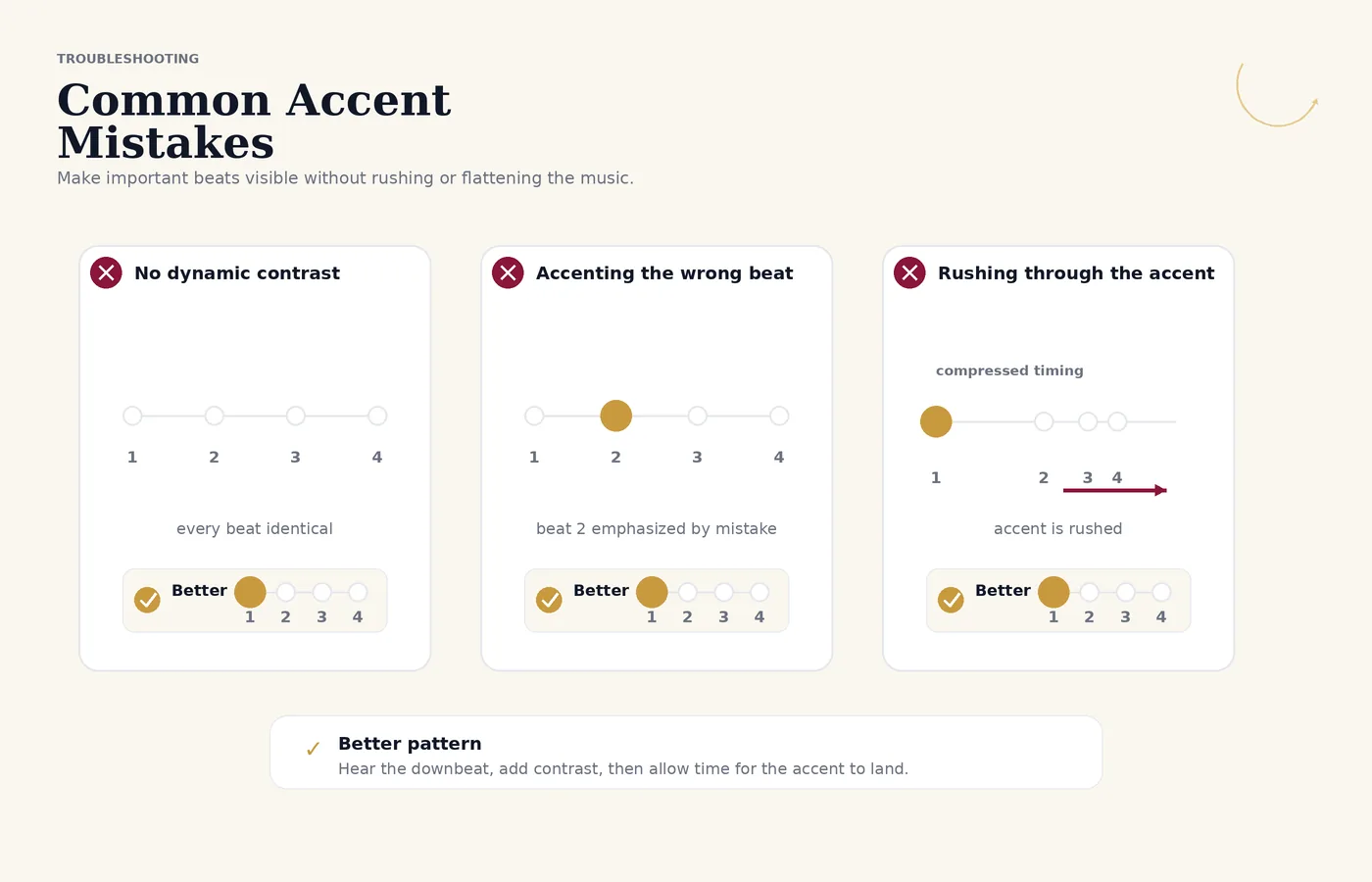
Dancing every beat the same size
Fix: If every step is equal, nothing reads as musical. Make the accented beat bigger or stronger and let the others recede.
Accenting the wrong beat
Fix: Find beat 1 first. Clap along until you are certain where the bar starts, then place your emphasis there.
Rushing through the accent
Fix: An accent often needs a fraction more time, not less. Let the strong beat breathe instead of hurrying off it.
Only ever hitting beat 1
Fix: Once beat 1 is solid, listen for the song’s own accents—a brass hit, a break—and dance those too.
Forcing an accent the music does not have
Fix: Accents come from the song. Dance what is actually there rather than imposing emphasis on a smooth passage.
Practice hearing the accent
Train your ear with music you can dance to. Start slow, clap the accent, then move it:
- Clap the downbeat. Play a Waltz and clap only on “1” for a full song. When you never miss, you own the metric accent.
- Big-small walking. Walk to any 4/4 track: a big step on “1,” smaller steps on 2-3-4. Feel the accent in your body, not just your ear.
- Name the hits. Listen to a Tango and say “hit” out loud on every sharp accent. You are building the map you will later dance.
-
Waltz (accent on 1)
3/4 time. The clearest metric accent in ballroom—perfect for finding beat 1.
-
Rumba (drive to 1)
Slow 4/4. Feel the movement pull into the accented step on beat 1.
-
Tango (staccato accents)
Sharp and marked. Practice matching your body to sudden accents.
-
BallroomPages Music (Telegram)
Mixed-style practice tracks. Accent-spotting drills coming soon.
If you can find and clap beat 1 of any song within a few bars, you already have the single most useful accent skill in ballroom. Everything else is built on that.
FAQ
Accent FAQ
What is an accent in music?
An accent is a beat that is emphasized more strongly than the beats around it—played louder, hit harder, or landed on by the melody. In ballroom music the strongest accent is usually the first beat of the measure, the downbeat.
What does it mean to dance the accent?
It means showing the emphasized beat in your movement—by starting a step on it, taking a bigger step, changing speed, pausing, or adding styling on that beat. Dancing the accent makes your movement look connected to the music.
Which beat is accented in a waltz?
Beat 1. A Waltz is in 3/4 time with a strong accent on the first beat, followed by two lighter beats (1-2-3). That accent on “1” is why the Waltz feels like it lifts and falls in threes.
What is the difference between an accent and the downbeat?
The downbeat is a specific beat—the first beat of the measure. An accent is any emphasized beat. The downbeat is the most common accent, but songs can accent other beats too, including weak or off-beats (that is syncopation).
How do you hit musical accents when dancing?
First hear the accent by clapping along until you can find beat 1 reliably. Then show it: start a figure on the accent, make that step bigger, change speed, hold, or add a body accent. Start with the downbeat and add subtler accents as your ear develops.
Why do my movements look out of sync with the music?
Usually because every step is the same size and lands on an unaccented beat. Find beat 1, put your strongest movement there, and let the other steps be smaller. Contrast between accented and unaccented beats is what reads as musical.
Editorial
Sources and review notes
This glossary entry should be reviewed by a qualified ballroom instructor before launch. Accent and time-signature descriptions follow widely accepted conventions from ballroom music theory and syllabus materials; specific accent placement varies by song and arrangement. When in doubt, dance what the individual track gives you.
This is dance terminology, not music-theory instruction. Ballroom Pages follows an editorial policy of education-first guidance. Questions? Contact us. Updated July 9, 2026.