
Glossary
Posture in Ballroom Dance
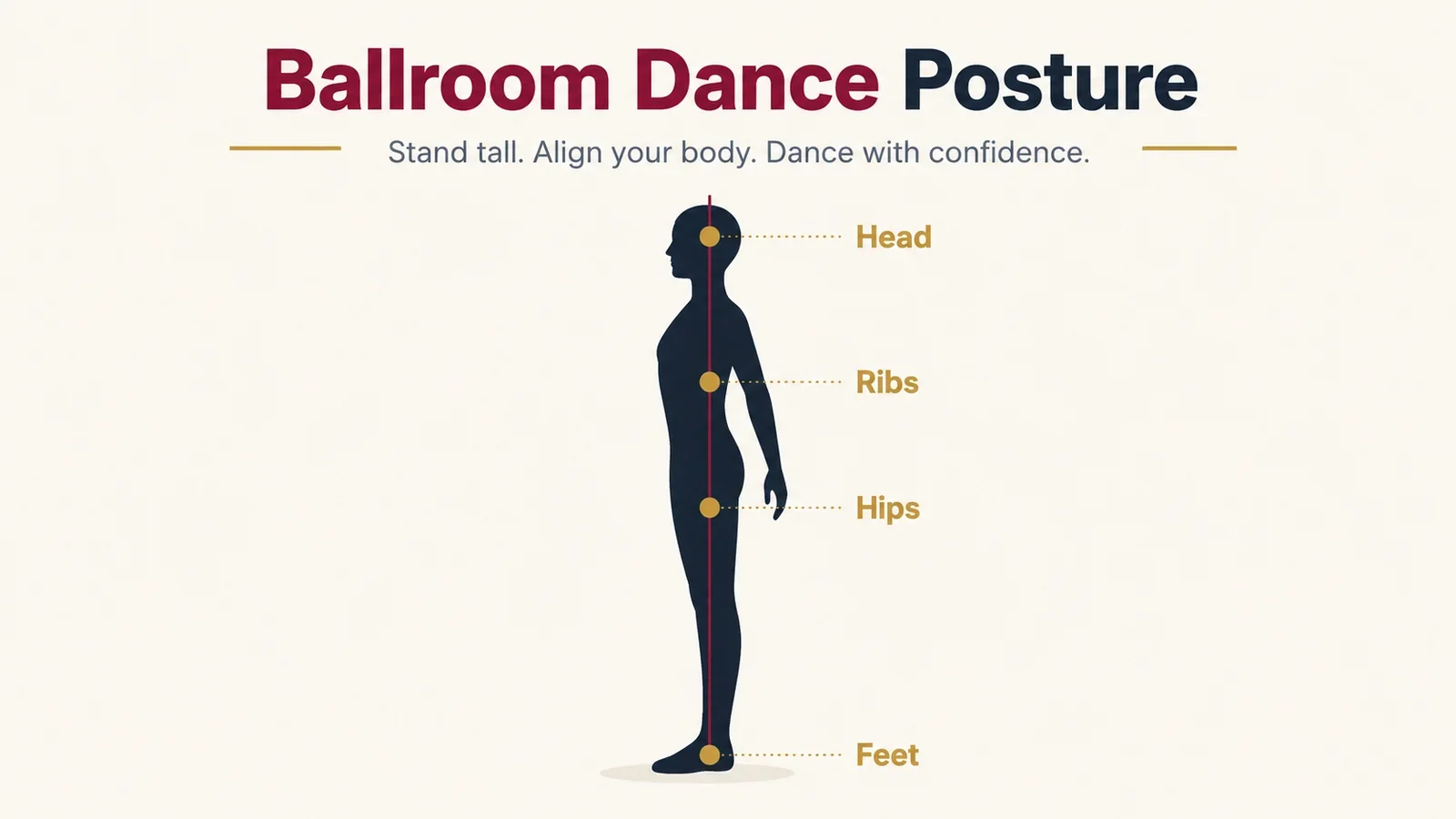
Posture is how the whole body stacks vertically—head over ribs over hips over feet. It’s the foundation that frame sits on top of, the thing that makes balance possible, and the difference between dancing that looks polished and dancing that looks slumped. Here’s what posture really means in ballroom, how it differs from frame, and how to build it.
Definition of posture
Posture
- Pronunciation
- pos-cher
- Skill category
- Technique & body
- Companion term
- Frame (upper body shape)
- Related terms
- frame, balance, alignment, line, head position, sway
In ballroom dance, posture is the vertical alignment of the body—head, ribs, hips, and feet stacked over each other for balance, partnership, and visual line. Posture is the foundation that frame sits on top of. Get posture right and frame becomes easier; get posture wrong and no amount of frame work will fix the dance.
Posture is full-body vertical. Frame is upper-body shape. Both are required.
What posture means in ballroom dance
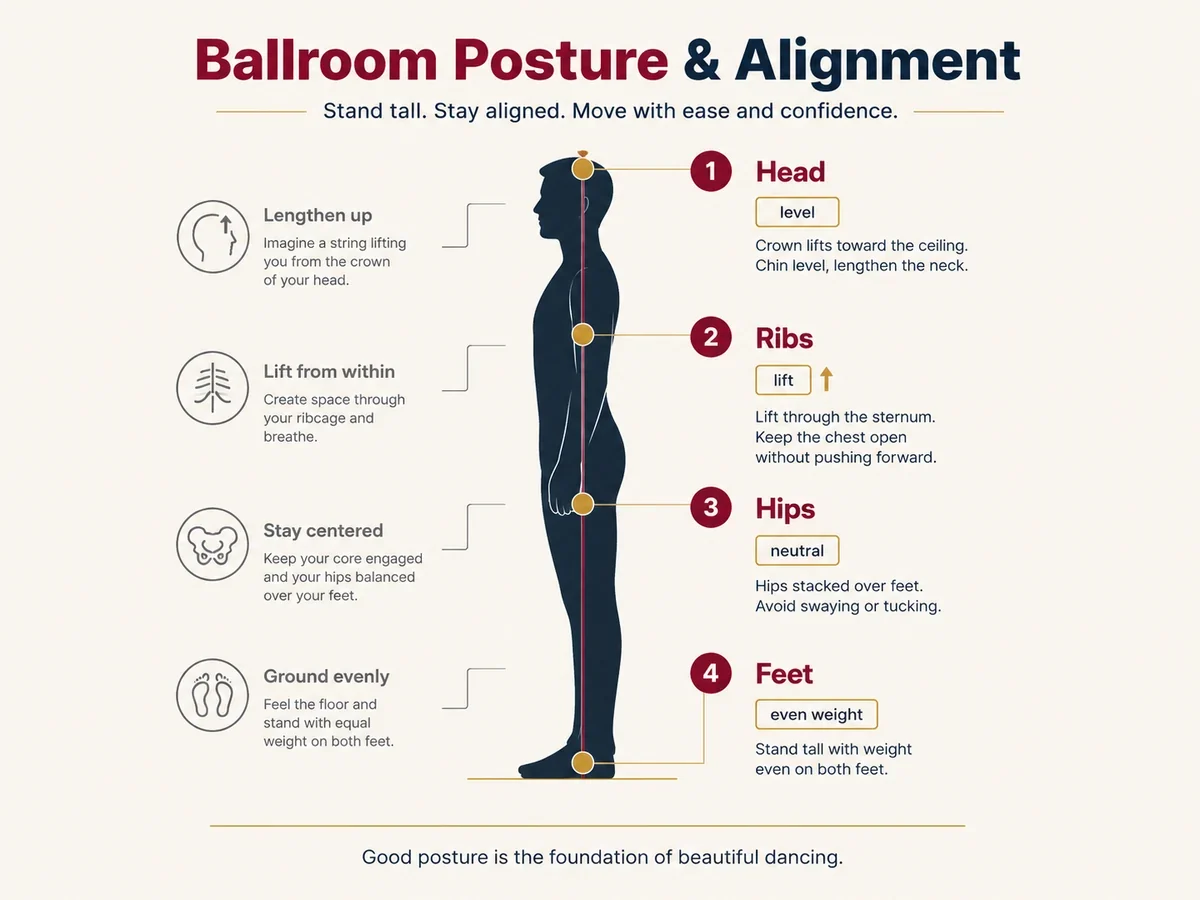
Posture is how the whole body stacks. The head sits over the ribs, the ribs sit over the hips, the hips sit over the feet. When this stack is aligned, weight transfers cleanly from one foot to the other, frame becomes stable, and the body can move without losing balance.
In ballroom specifically, posture isn’t the same as “stand up straight” from gym class. It’s a lifted, lengthened, slightly engaged alignment—like someone gently pulling the top of your head toward the ceiling while your shoulders stay relaxed and down. Picture a string from the crown of your head straight up.
What posture is not: military-stiff, shoulder-hunched, or fashion-tilted. Beginners often overcorrect into stiffness; experienced dancers look lifted but relaxed.
Posture vs Frame
Two terms that get used interchangeably but mean different things.
| Posture | Frame |
|---|---|
| Full-body vertical alignment | Upper-body shape (arms, shoulders, ribcage) |
| About balance and structure | About connection and lead/follow communication |
| Looks the same with or without a partner | Only exists in partnership—needs a partner to complete it |
| Foundation—built first | Sits on top of posture—built second |
| Affects how you balance and move | Affects how the lead transmits |
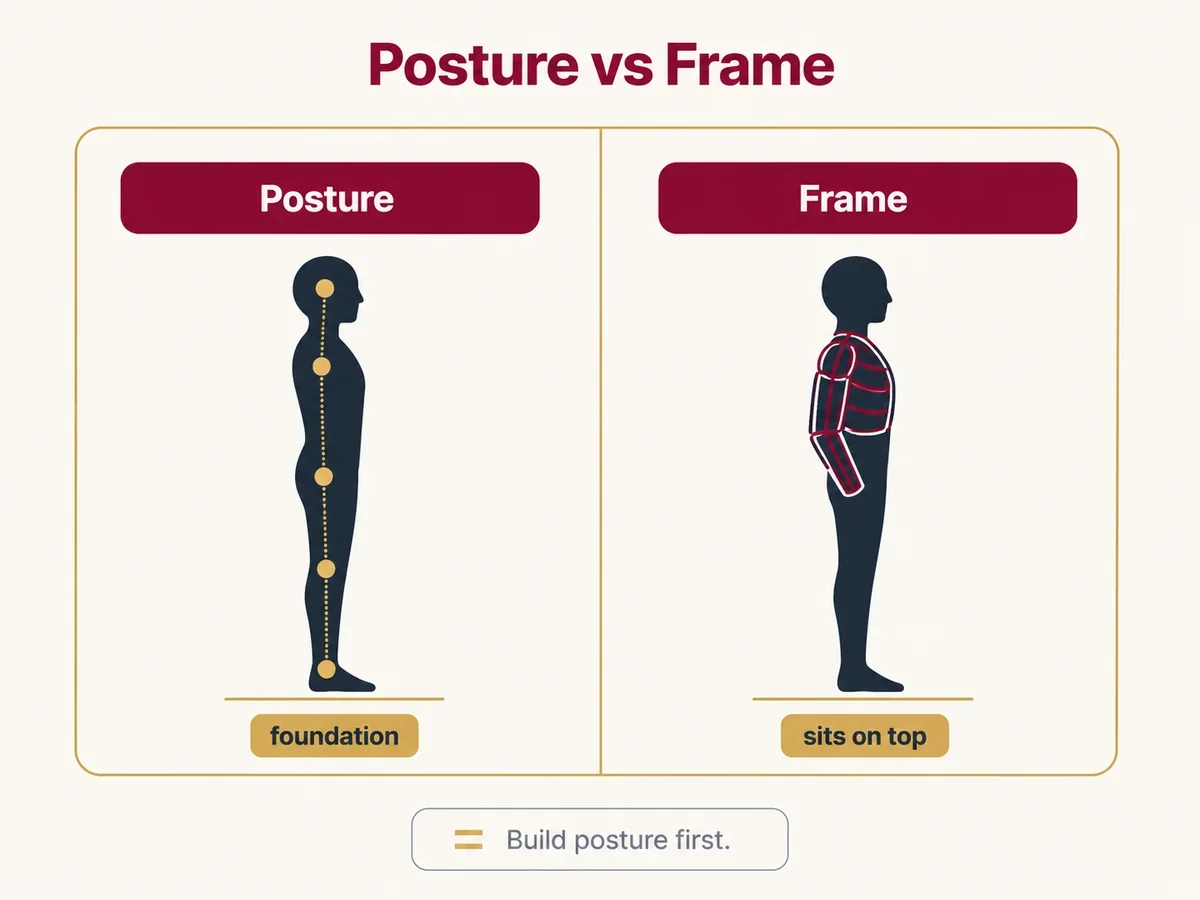
You need both. But if you have to fix one first, fix posture. Frame built on bad posture collapses the moment movement starts.
The four alignment points
From the ground up, the four stacked points that make ballroom posture work:
1. Feet (the base)
Feet under the hips, weight balanced through the whole foot (not just the heel, not just the ball). Knees soft but not bent. The base supports everything above it.
2. Hips (centered over feet)
Hips stacked over the feet—not pushed forward, not stuck back. The pelvis sits in a neutral position; it neither tilts up (lower back arched) nor tucks under (pelvis curled). This is where most beginners lose alignment first.
3. Ribcage (lifted over hips)
The ribcage rises up from the hips, creating length through the torso. Imagine taking the bottom of the ribcage and lifting it gently away from the hips—not flaring it forward, just lifting it up. This creates space, supports breathing, and stops the spine from collapsing.
4. Head (balanced over ribs)
The head sits centered over the ribcage—not jutted forward, not tilted back. Chin parallel to the floor or slightly lifted (varies by style). Crown of the head lengthens toward the ceiling. Eyes forward, never down at feet.
The 30-second posture self-check
- Feet: weight even through both feet, knees soft.
- Hips: stacked over feet, pelvis neutral (no arch, no tuck).
- Ribs: lifted away from hips, not flared forward.
- Head: centered over ribs, chin level, eyes forward.
- Shoulders: wide and down, not rolled forward.
Posture by dance style
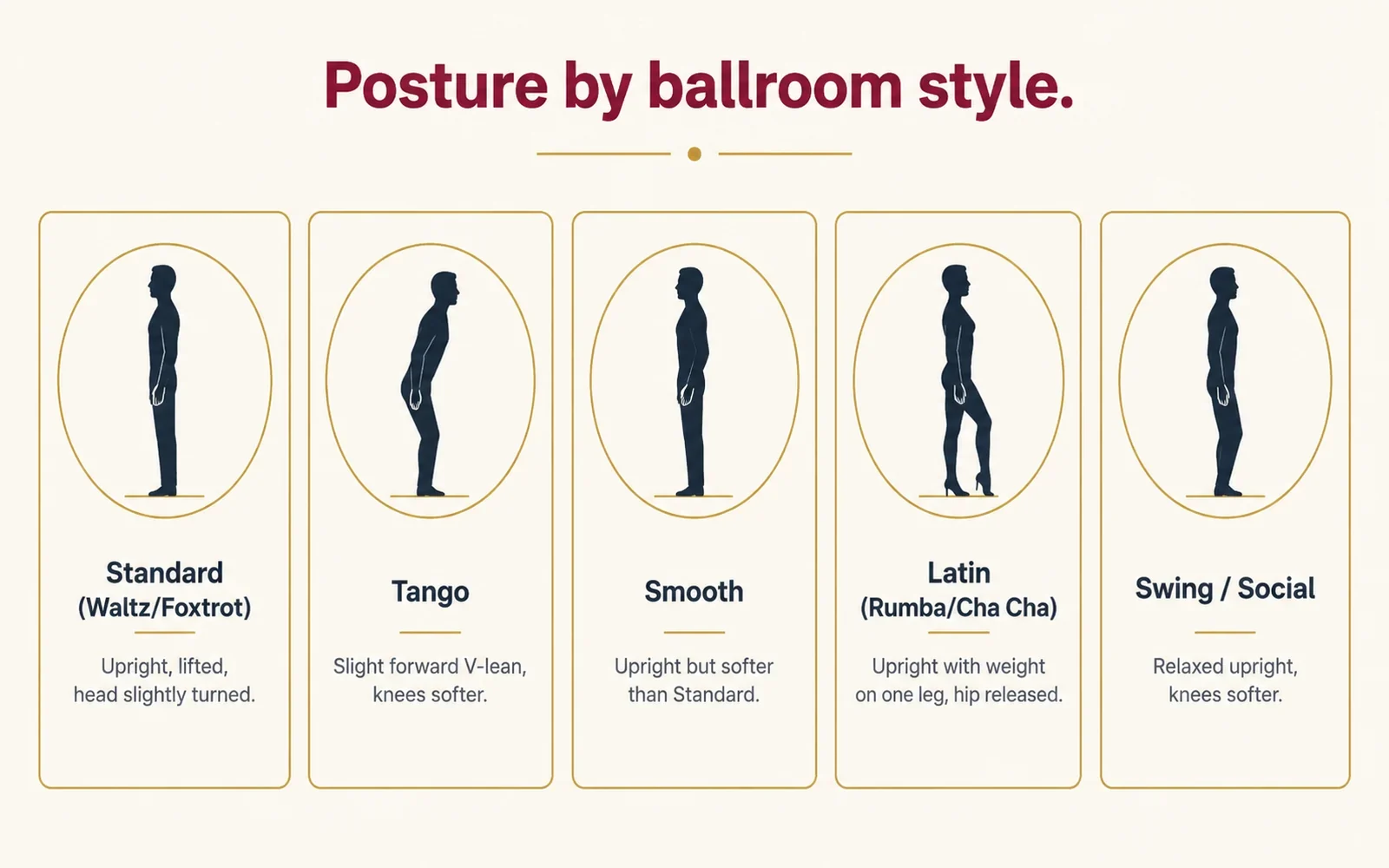
Posture isn’t one fixed shape—each ballroom family adjusts the basic alignment to fit the dance.
Standard / International Ballroom
The most upright posture. Lifted ribcage, weight slightly forward on the balls of the feet, head turned slightly to the left for both partners. The body shape is closer to vertical than any other ballroom style.
- Waltz: tall, lifted, with rise and fall coming from leg action—not posture changes.
- Foxtrot: same upright frame, just smoother and more horizontal.
- Viennese Waltz: upright with continuous slight forward lean from the ankles.
- Quickstep: upright and very light—weight more on the balls of the feet.
Tango (Standard family but different)
Tango uses a more grounded posture with a slight forward incline between partners—the famous “V shape.” Knees stay soft and slightly bent, weight more grounded than in Waltz or Foxtrot. Posture is upright through the spine but the whole frame leans slightly into the partnership.
Smooth / American Smooth
Softer than Standard. The same vertical alignment but with more freedom in the head and arms because Smooth uses open and closed positions interchangeably. Still upright, just less rigid.
Latin / Rhythm
Vertical alignment is the same—head over ribs over hips over feet—but with more weight on a single foot (the “standing leg”) at any moment, and more freedom for hip action. Latin posture is upright but never “stiff”; the body is alive between the ribs and hips for Cuban motion.
- Rumba: upright with strong weight commitment to the standing leg.
- Cha Cha: upright but lighter and more energetic.
- Salsa: upright with looser knees for spins.
- Samba: upright with bounce, knees softer than other Latin dances.
Swing & Social
Posture is upright but more relaxed—closer to “good walking posture” than to Standard’s lifted line. Knees are softer, the body is more grounded, and the head moves freely.
Common posture mistakes
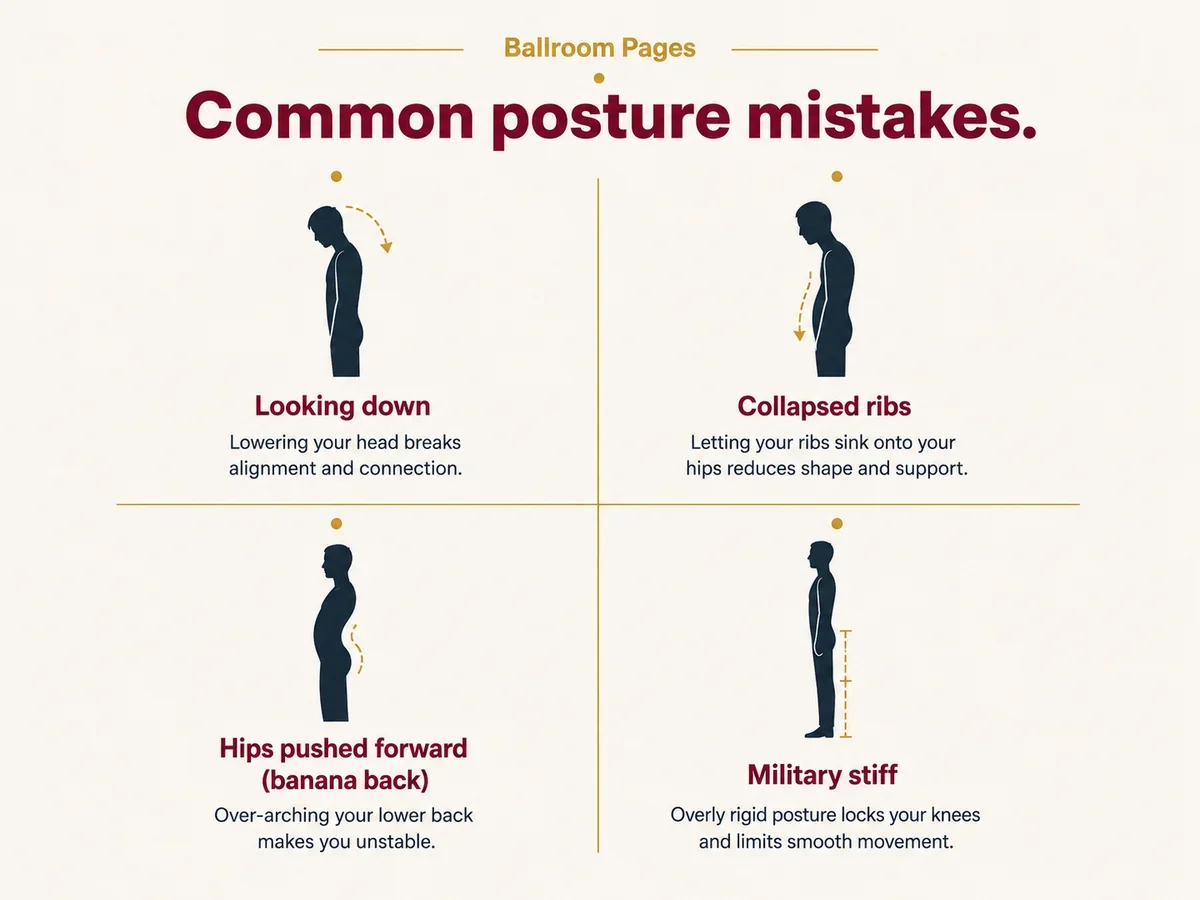
Looking down at the feet
Fix: Eyes forward. Looking down drops the head, collapses the ribs, and breaks the whole stack. Trust your feet to do their job without watching them.
Collapsed ribs (slouching)
Fix: Lift the ribcage up away from the hips. Picture creating space between your bottom rib and your hip bone.
Hips pushed forward (“banana back”)
Fix: Hips stacked over feet, not in front. The arch in the lower back should be neutral, not exaggerated. This is the most common ballroom posture mistake.
Tucked pelvis (over-correcting the banana back)
Fix: Pelvis is neutral. Don’t replace one extreme with another—you want stacked, not curled under.
Military stiff
Fix: Posture is lifted, not locked. Knees soft, shoulders relaxed down, breathing free. Stiffness reads as nerves on a dance floor.
Shoulders rolled forward
Fix: Roll shoulders back and gently down. Frame can’t function with collapsed shoulders. Picture wearing a tank top with the straps held wide.
Head jutted forward
Fix: Pull the chin back slightly so the head sits over the ribcage, not in front of it. Most office workers have to consciously fix this.
Practice posture
Three drills that build ballroom posture on your own time, no partner needed:
- The wall test. Stand with your back to a wall. Touch the wall with your heels, butt, upper back, and the back of your head simultaneously. If any of these can’t touch, that’s where your alignment needs work. Hold for 30 seconds, breathing normally.
- The book test. Place a paperback on the crown of your head. Walk slowly across the room. If the book falls, your head wasn’t over your ribs. Repeat until you can walk 10 steps without dropping it.
- The rib-lift drill. Stand normally. Place your hands on the bottom of your ribcage. Lift the ribcage up away from your hips a little—you should feel space open up between your bottom ribs and your hip bones. Hold for 10 seconds. Release. Repeat 10 times. This isolates the rib lift that defines Standard posture.
-
Slow Waltz (Standard posture)
Practice upright Standard posture at low tempo. Easier to feel the lift.
-
Rumba (Latin posture)
Slow Latin. Practice upright posture with weight commitment to the standing leg.
-
Tango (V-shape posture)
Practice the slight forward incline. Grounded knees, upright spine.
-
BallroomPages Music (Telegram)
Mixed-style practice tracks. Posture-specific drills coming soon.
Office workers and people who sit a lot generally need extra posture work before frame work pays off. If you sit 8+ hours a day, 10 minutes of posture drills before practice unlocks everything else.
FAQ
Posture FAQ
What does posture mean in ballroom dance?
Posture is the vertical alignment of the body—head over ribs over hips over feet. It’s the foundation that frame, balance, and lead/follow all depend on.
What’s the difference between posture and frame?
Posture is full-body vertical alignment; frame is upper-body shape. Posture is the foundation; frame sits on top of it. You can have good posture without a partner, but frame only exists in partnership.
Does posture change between dances?
The underlying alignment (head over ribs over hips over feet) stays the same. But the emphasis shifts: Standard is upright and lifted, Latin is more grounded with hip action, Tango has a forward V-shape, Smooth is softer than Standard.
Is posture the same as “stand up straight”?
Related but not the same. Ballroom posture is lifted, lengthened, and slightly engaged—not stiff or military. The crown of the head reaches toward the ceiling, the ribcage lifts, but the shoulders stay relaxed.
How long does it take to fix bad posture?
A few weeks of daily 10-minute drills will produce noticeable change. Six months will produce automatic ballroom posture. Old habits (especially from desk work) take ongoing maintenance.
Why does my back hurt when I try to use ballroom posture?
Usually means you’re arching the lower back to fake the lift, instead of lifting through the ribcage. The lift should feel like length, not arch. If pain persists, consult a qualified instructor or physiotherapist.
Should beginners worry about posture or frame first?
Posture first. Frame built on bad posture collapses the moment movement starts. Spend a few weeks on posture drills before adding partner frame work.
What’s the single biggest posture mistake?
Looking down at the feet. It drops the head, collapses the ribs, and breaks the entire stack. Eyes forward, always.
Editorial
Sources and review notes
This glossary entry should be reviewed by a qualified ballroom instructor before launch. Posture descriptions follow widely accepted conventions from NDCA, WDSF, ISTD, and Arthur Murray syllabus materials. If you experience pain trying to adopt ballroom posture, consult a qualified instructor or physiotherapist—posture is structural, and individual bodies vary.
This is dance terminology, not medical advice. Ballroom Pages follows an editorial policy of education-first guidance. Questions? Contact us. Updated May 29, 2026.