
Glossary
Leader in Ballroom Dance
The leader is the partner who initiates—direction, timing, figure selection, and musicality. The role is open to anyone, regardless of gender. Here’s what the leader role really is, the five skills that define a great leader, and the developmental arc most leaders travel from beginner to confident social dancer.
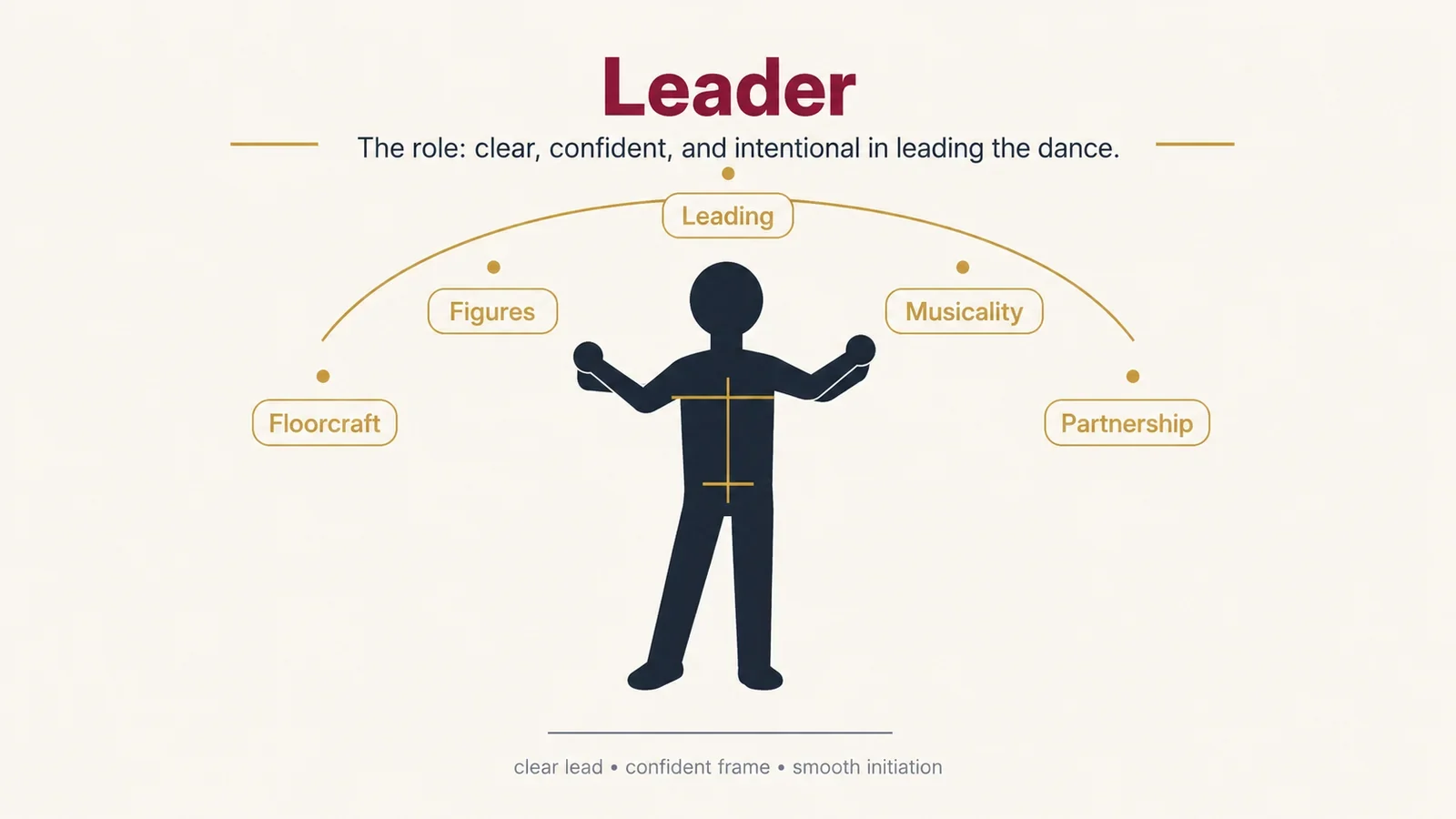
Definition of leader
Leader
- Pronunciation
- lee-der
- Skill category
- Roles & technique
- Companion term
- Lead (the action)
- Related terms
- follower, follow, frame, connection, floorcraft, musicality
In ballroom dance, the leader is the partner who initiates direction, timing, and movement through frame and intention. The leader chooses figures, navigates the floor, and sets up musicality so the partnership can express the dance. The role can be danced by any partner regardless of gender.
Leader is the role; lead is the action. Both halves matter.
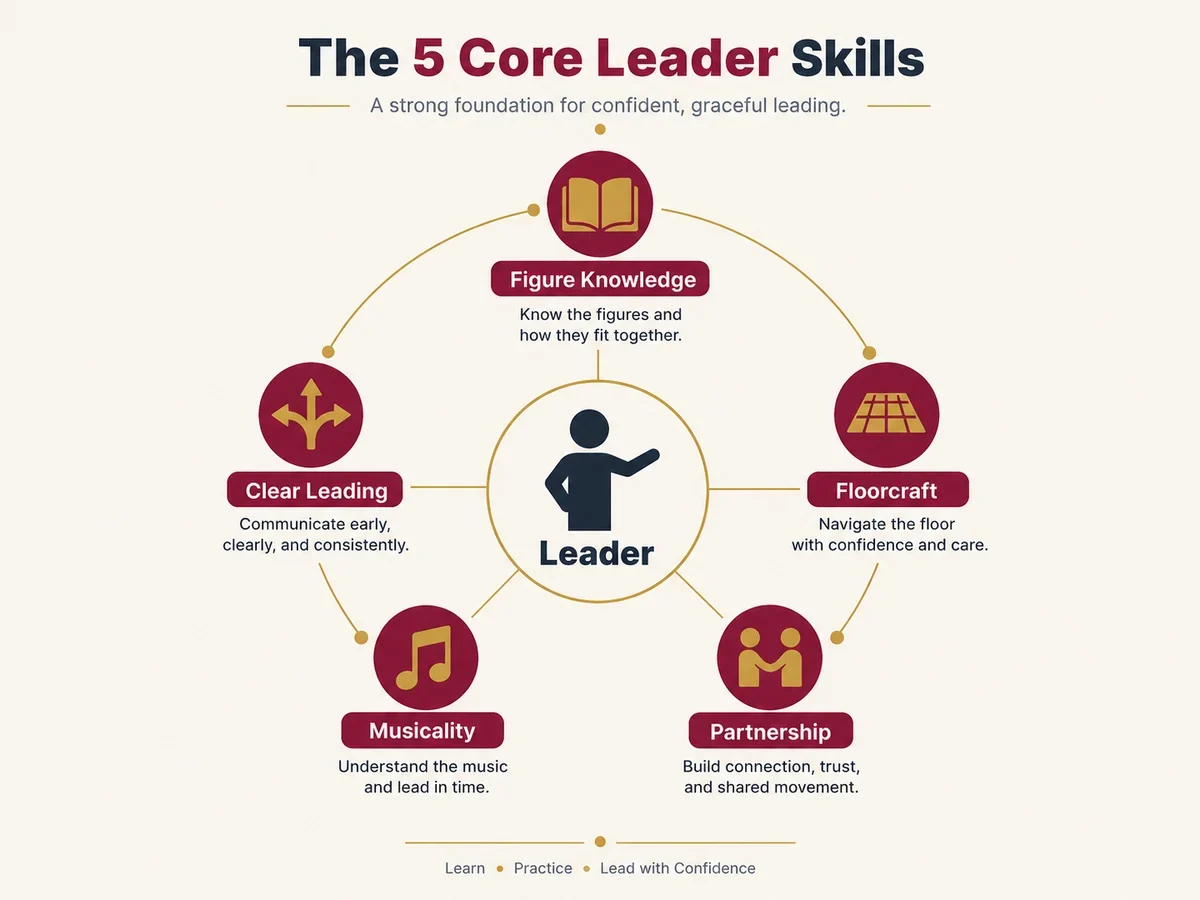
What “leader” means in ballroom dance
The leader is the partner who initiates. Where the follower responds to signals, the leader sends them: choosing the next figure, signaling direction and timing through frame and body, and navigating the floor so the couple has space to move.
Being a leader doesn’t mean being “in charge.” It means being responsible for the architecture of the dance: which figures, in what order, on what beats, going which direction. The follower fills in the details—balance, styling, musicality—that bring it to life.
In ballroom (and partner dance generally), either partner can take the leader role. Traditionally the role has been gendered, but the mechanics are role-based, not gender-based. Many experienced dancers train both roles for a fuller understanding of partnership.
Leader vs Lead
Same root, different things. The distinction matters when you’re reading dance instruction.
| Leader (this page) | Lead (companion page) |
|---|---|
| The role—a person in a partnership | The action—the verb “to lead” |
| About identity, dev arc, partnership skills | About mechanics: frame, body, timing, signaling |
| “He is the leader in this couple.” | “She leads the underarm turn through frame.” |
| Person-focused: figure knowledge, floorcraft, partnership | Technique-focused: how leading mechanics work |
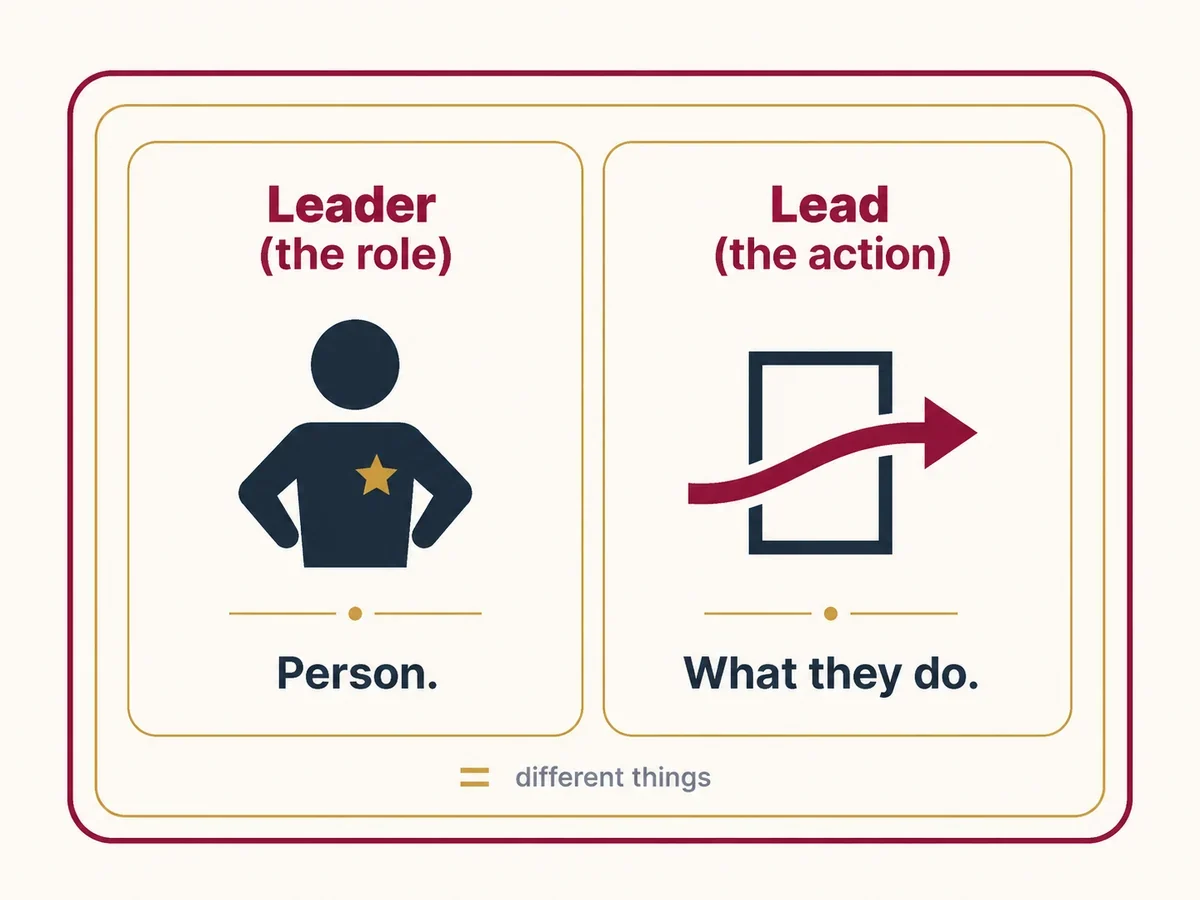
The lead page covers how leads travel through frame and body. This page covers what defines a skilled leader as a person—the figures they know, the partnerships they build, the floors they navigate.
The 5 core leader skills
The skills that separate a skilled leader from a beginner. These compound over years.
1. Figure knowledge
The leader is responsible for knowing what to lead. Basics first—the box step, basic of each dance, common turns. Then patterns. Then variations. A leader with 5 clean figures dances better than a leader with 30 messy ones.
2. Clear leading (the action)
The mechanics of leading—frame, weight transfer, timing of the prep, intention. Covered in detail at /glossary/lead/. The short version: prep before the step, lead through the body not the arms, less is more.
3. Floorcraft
Navigating the floor without colliding with other couples. Reading traffic. Knowing which figures fit a crowded floor and which need space. Floorcraft is what separates “technically good” leaders from “easy to dance with” leaders.
4. Musicality
Choosing figures that fit the music. Hitting accent beats. Slowing down for slow songs and not over-cramming fast ones. Musicality is the leader’s creative job—the follower can add styling, but the leader sets up which moments the styling lives in.
5. Partnership
Being easy to dance with. Adapting to different followers. Reading what they can do versus what they’re ready for. Asking and being asked to dance graciously. Like with followers, partnership is the longest-developing skill and the one that defines “great” vs “good.”
The leader’s checklist (every dance)
- Know the next figure before you lead it. Don’t lead something you can’t finish.
- Prep early, commit fully. Prep is the actual lead; the step is just commitment.
- Lead through the body, not the arms. Arms hold the frame; the body generates the lead.
- Look around. Floor traffic, song ending, follower’s comfort level.
- Match the music. Slow song? Slow figures. Hot song? Earn the energy.
The leader’s developmental arc
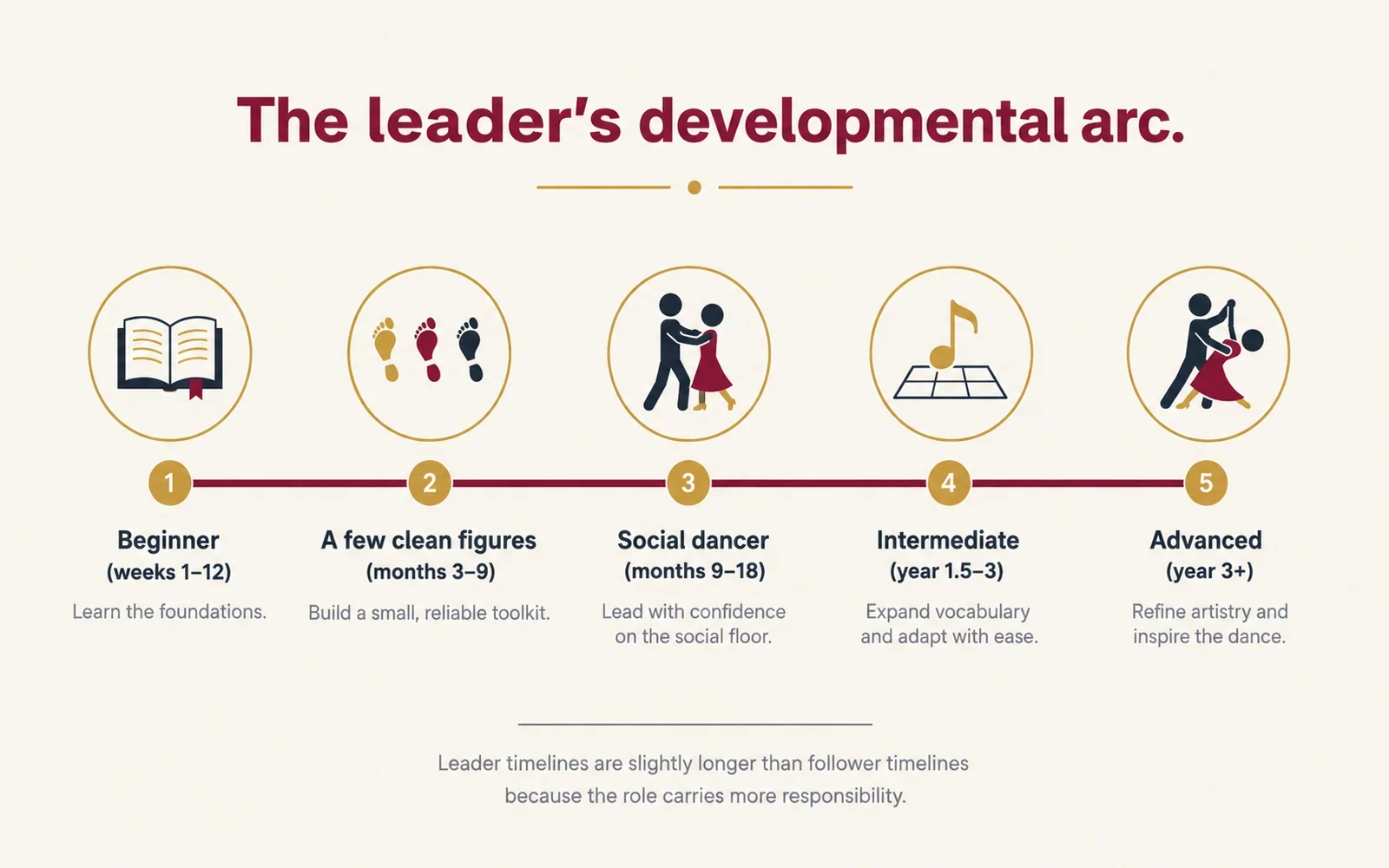
Leaders take longer than followers to reach “social-dance comfortable.” The role carries more responsibility, more figures to remember, and more floorcraft. Don’t compare timelines to a follower friend—the arcs are different.
Phase 1 — Beginner (weeks 1-12)
Memorizing the basic step of 2-3 dances. Looking down a lot. Leads are timing-late and muscly. Follower confusion is normal. Frustration is normal too—leading is harder than following at the start.
Phase 2 — A few clean figures (months 3-9)
You can lead the basic of 3-4 dances without thinking. You start adding one or two turns or pattern variations per dance. Leads get cleaner—less arm, more body. You start to feel when a lead landed correctly.
Phase 3 — Social dancer (months 9-18)
You can dance with strangers at a social and keep the dance going for a full song. You start to read floor traffic. You discover that different followers feel different. Partnership starts to mean something.
Phase 4 — Intermediate (year 1.5-3)
Figure library expands. Musicality clicks—you start choosing figures based on what the song is doing. Floorcraft becomes background processing. You can make beginner followers feel capable.
Phase 5 — Advanced (year 3+)
Partnership becomes the focus. You can make any follower look better. You read song structure, floor traffic, and follower readiness without thinking. The dance feels conversational—ideas, not figures.
Timelines vary. A leader practicing 5 hours a week may cover this arc faster than someone in monthly lessons. The phases matter more than the months.
What leaders do across dance styles
- Waltz: Closed-hold smooth dancing. Leaders use rise/fall and body rotation; floorcraft is constant (Waltz moves around the floor).
- Foxtrot: Smooth horizontal travel. Leaders read floor traffic carefully—Foxtrot covers ground fast.
- Tango: Sharp, dramatic figures. Leaders set up clear accents with the music.
- Rumba: Slow Latin. Leaders use the time between steps to set up clean leads.
- Cha Cha: More open figures with hand and visual leads in addition to body.
- Salsa: Lots of turns and visual leads. Leaders earn their reputation through musicality and turn-pattern variety.
- East Coast Swing: Hand leads, prep moves, visual signals. Leaders work on pattern variety early.
- West Coast Swing: Slot-based dancing with heavy emphasis on musicality. Leaders work on song interpretation more than figure count.
Common beginner leader mistakes (role-level)
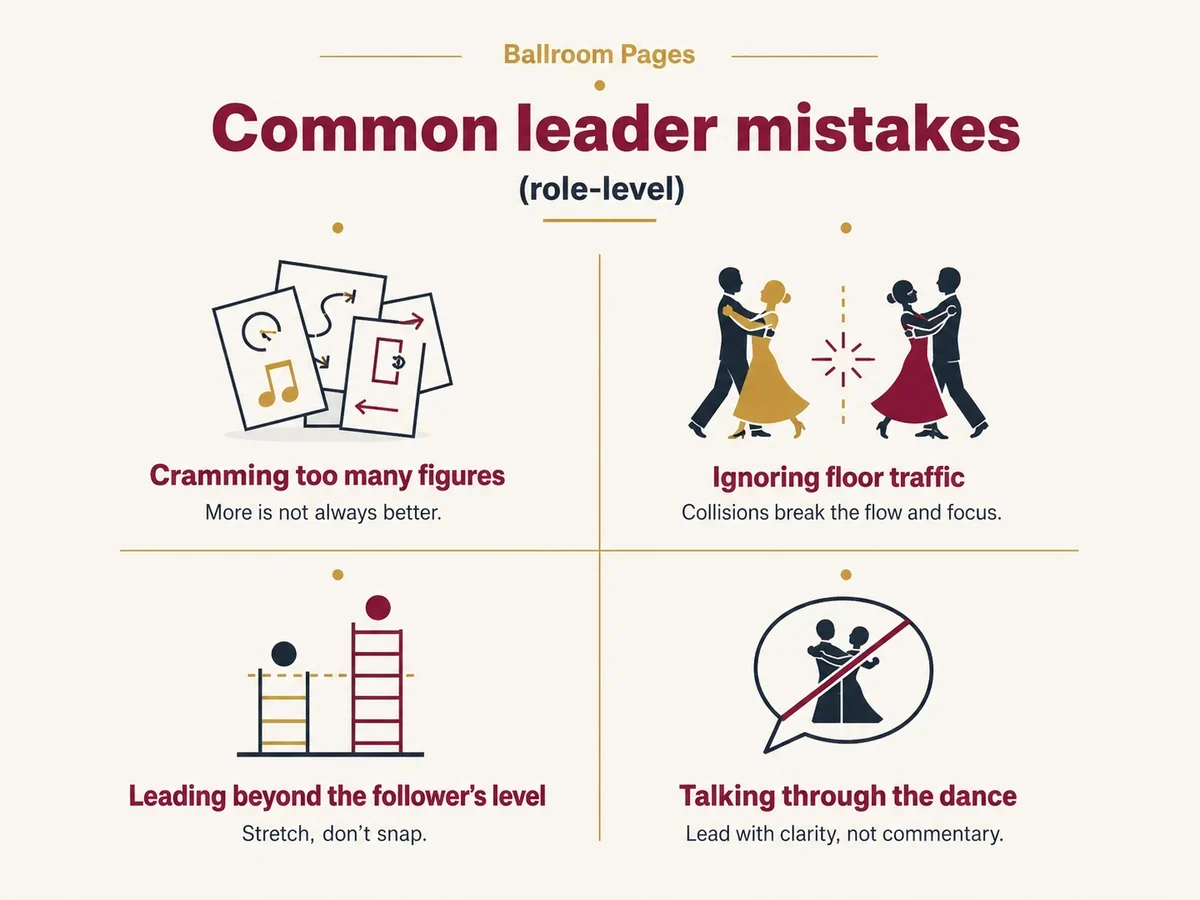
These are role-level mistakes—patterns that hold a leader back over months. Mechanics mistakes (pushing, gripping, late leads, etc.) are covered in /glossary/lead/.
Cramming as many figures as possible into every dance
Fix: 3 clean figures beats 8 messy ones. Build a small clean repertoire first, then expand.
Ignoring floor traffic
Fix: Eyes up, look around. Don’t lead a long figure into another couple’s space. Floorcraft is non-optional.
Leading beyond the follower’s level
Fix: Read the follower’s comfort and adjust. Leading a brand-new follower into a complex turn pattern doesn’t make either of you look good.
Only dancing with the same partner
Fix: Different followers reveal different gaps in your lead. Asking varied partners to dance is how leaders grow.
Talking through the dance to “help” the follower
Fix: If you’re verbally instructing on the dance floor, your lead isn’t clear. Save the talk for off-floor practice.
Treating “leader” as “in charge”
Fix: Leader runs the architecture, not the partnership. You initiate; the follower contributes. Both halves are equal.
Avoiding social dances until you’re “ready”
Fix: Nobody’s ever ready. Go early, lead 3 basics, leave proud. Social-dance miles are how leaders develop.
How to grow as a leader
Three practices that build the role, not just the action:
- Solo practice 30 minutes a week. Walk basics in front of a mirror. Watch your frame. Practice the prep—the actual lead happens before the step.
- Group classes that rotate partners. The single fastest way to find what’s wrong with your lead is leading 8 different followers in 90 minutes.
- Take video. Once a quarter, have someone film you at a social. Watch for arm-leading, ignored floor traffic, and cramming figures. Painful but fast.
-
Slow Standard (clean basics)
Slow Waltz and Foxtrot tracks. Practice the basics solo at low tempo before adding figures.
-
Rumba (lead-prep drills)
Slow Latin tempo. Perfect for isolating the prep-before-step rhythm.
-
Swing (hand-lead drills)
East Coast Swing tracks. Practice single-hand and prep-arc leads.
-
BallroomPages Music (Telegram)
Mixed-style tracks for variety. Leader-specific drills coming soon.
The fastest way to grow as a leader is volume. Group classes plus one social per month plus 30 minutes of solo work per week beats one private lesson a month every time.
FAQ
Leader FAQ
What does “leader” mean in ballroom dance?
The leader is the partner who initiates direction, timing, and movement through frame and intention. The leader also chooses figures and navigates the floor. It’s a role, open to anyone regardless of gender.
What’s the difference between leader and lead?
Leader is the role; lead is the action. The leader is the person; leading is what they do. The mechanics live on the lead page; this page is about the role itself.
Is leading harder than following?
Different, and at the beginner stage, often slower to reach social-dance comfort. Leaders have to remember figures, navigate the floor, and time everything. Followers have to read signals and contribute styling. Both are full skills; neither is harder.
Can a woman be the leader?
Yes. The leader role is defined by what the partner does in the partnership—not by gender. Many modern ballroom and social-dance communities are explicit about this. The mechanics work the same regardless.
How long does it take to become a confident leader?
For a beginner practicing once a week in a class plus a monthly social, “confident social dancer” takes 9-18 months. Leaders generally take longer than followers to reach this point—the role carries more responsibility.
How many figures should a beginner leader know?
Per dance: the basic step + 2-3 variations is plenty for the first 6 months. 3 clean figures beats 8 messy ones every time.
What if my follower doesn’t respond to my lead?
Usually means the lead wasn’t clear. Check: did you prep early? Did you commit fully? Was the figure within their level? If a clean lead still doesn’t land, simplify and try again later.
Do leaders need to know how to follow?
Not required, but learning to follow is one of the fastest ways to improve as a leader. It teaches you what a clean lead feels like from the receiving end.
Editorial
Sources and review notes
This glossary entry should be reviewed by a qualified ballroom instructor before launch. Leader-role descriptions follow widely accepted conventions from NDCA, WDSF, ISTD, and Arthur Murray syllabus materials. Developmental-arc timelines are approximate and vary by practice frequency and individual.
This is dance terminology, not medical advice. Ballroom Pages follows an editorial policy of education-first guidance. Questions? Contact us. Updated May 29, 2026.