
Glossary
Follow in Ballroom Dance
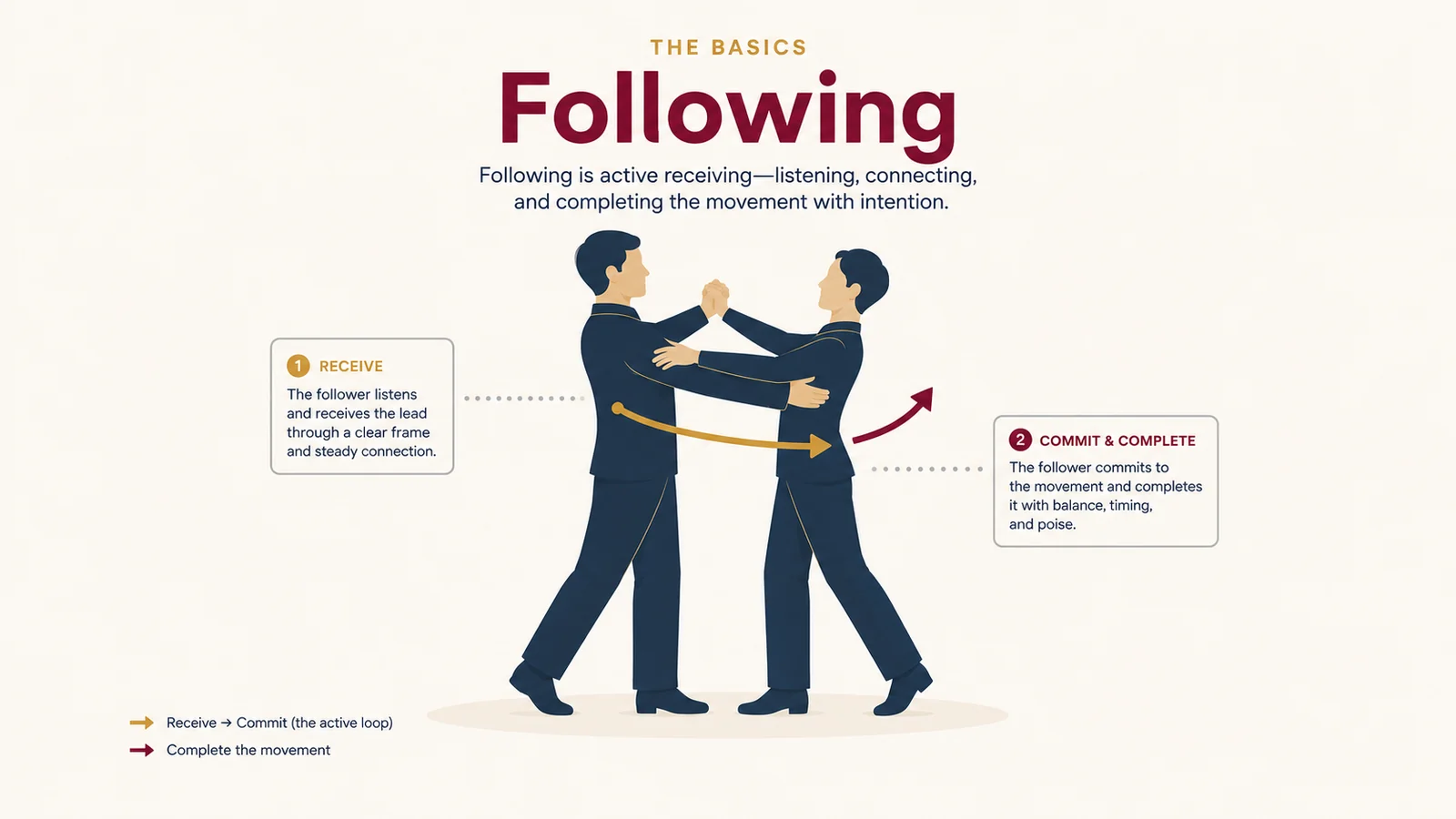
Following is active, not passive. The follower receives the lead’s signal, maintains frame and balance, completes the movement, and adds musicality. Done well, the follower’s contribution is as visible as the leader’s. Here’s what following really means, what it isn’t, and how beginners can practice it.
Definition of follow
Follow
- Pronunciation
- fol-oh
- Part of speech
- verb (to follow) and noun (the follower)
- Skill category
- Roles & technique
- Related terms
- lead, follower, leader, frame, connection, posture
In ballroom dance, to follow is to receive the leader’s signal, maintain frame and balance, and complete the indicated movement with musicality. Following is active interpretation, not passive obedience—the follower makes hundreds of micro-decisions per dance about timing, footwork, and styling.
A great follower is not a passenger. They’re the second half of the conversation.
What “follow” means in ballroom dance
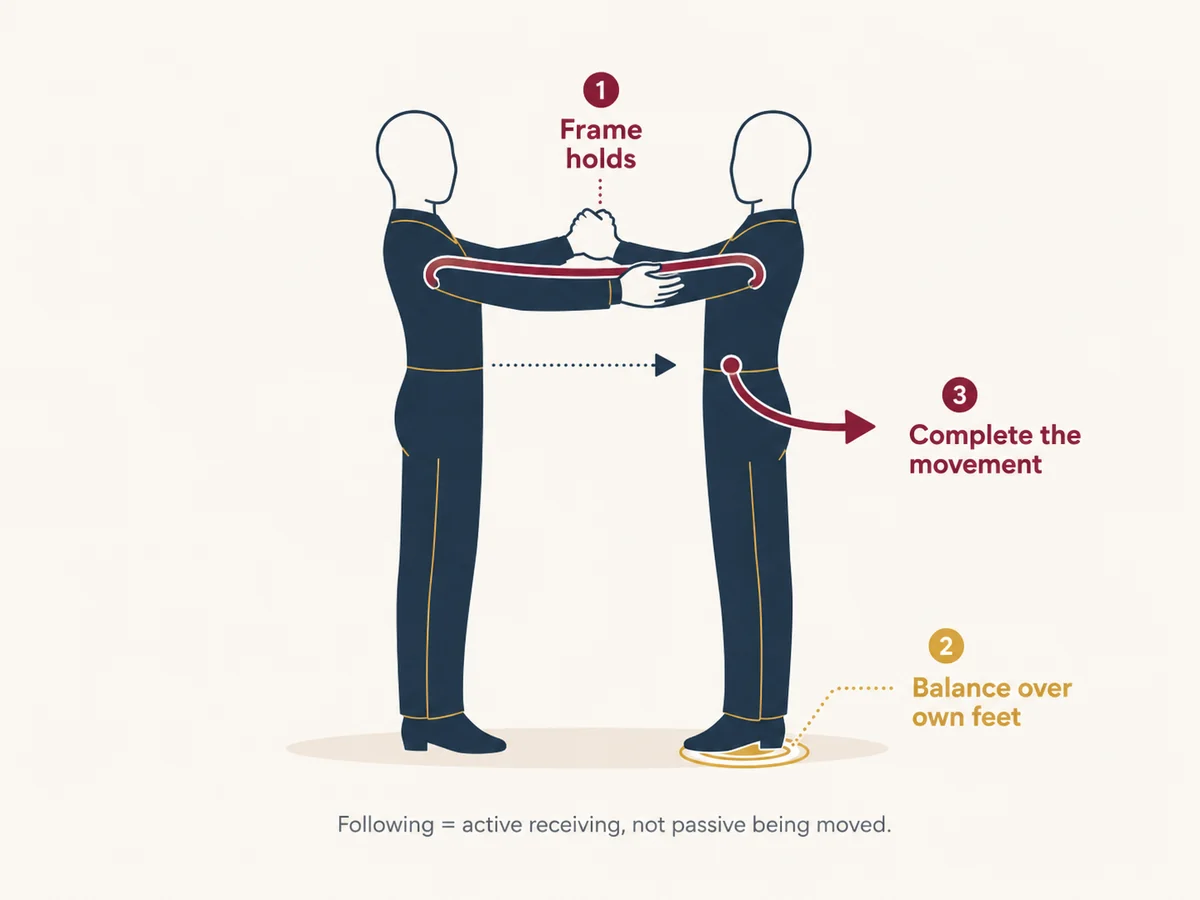
To follow is to receive—not to obey. The follower’s body listens to the lead through the frame, interprets what’s being asked, and completes the movement with timing, balance, and style. Done well, following is a constant active conversation, not a one-way instruction.
The word “follow” can be misleading because in everyday English it sounds passive. In dance, it’s anything but. A skilled follower is making constant micro-decisions: how big a step to take, when exactly to commit, how much rise or hip action to add, when to extend the line. The leader sets the architecture; the follower fills it in.
Like leading, following isn’t about gender or strength. Either partner can take the follow role, and the mechanics work the same way.
What following is (and isn’t)
The biggest misconception about following is that it’s passive. It’s not.
| Following IS | Following is NOT |
|---|---|
| Active receiving—feeling the lead and committing to the response | Waiting to be moved like a doll |
| Maintaining your own balance on your own feet | Hanging weight on the leader’s frame |
| Completing the figure the lead indicates | Predicting figures and stepping early |
| Adding styling, musicality, and shape | Doing only what’s “told” with no expression |
| Holding a stable, responsive frame | Going limp or going rigid |
| Trusting the lead while staying alert | Memorizing routines and dancing them solo |
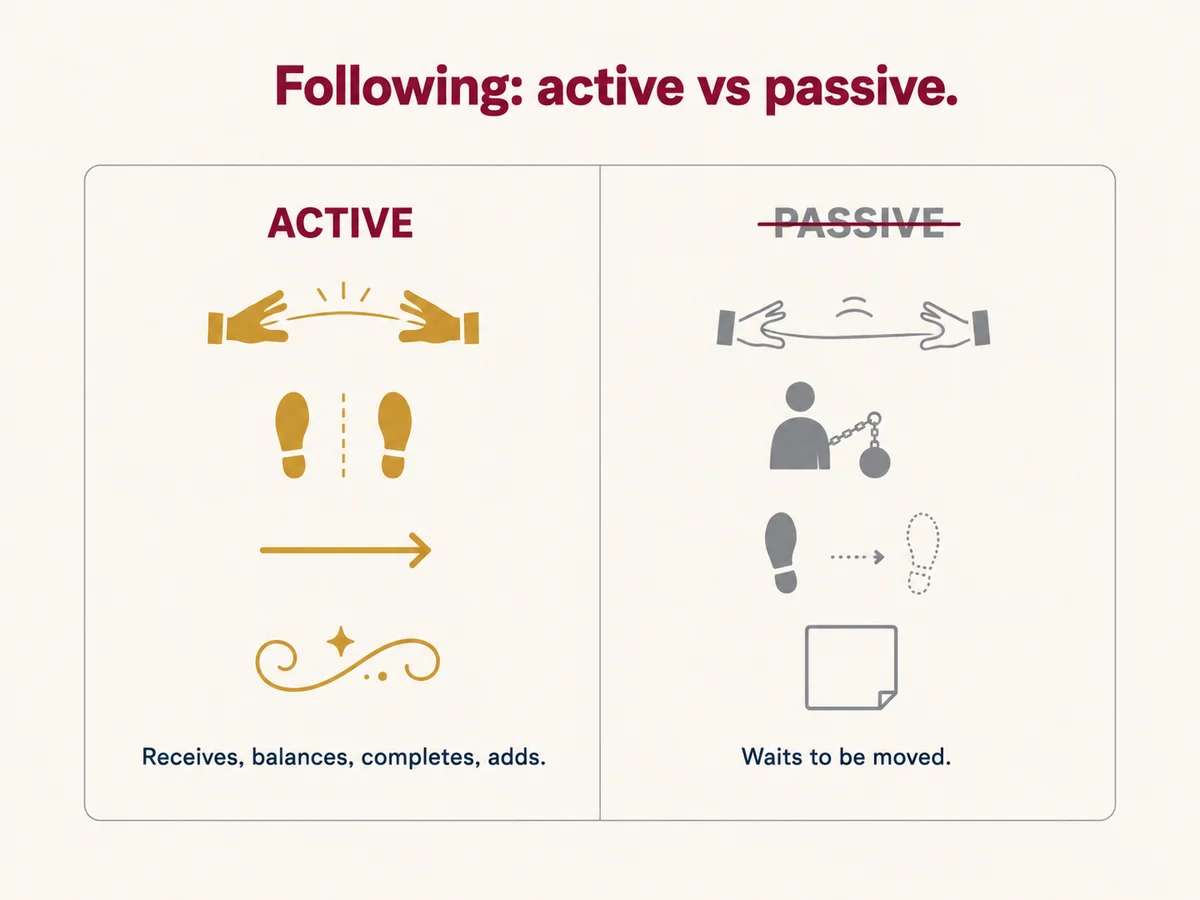
The fastest way to improve as a follower is to internalize one idea: the leader sets up the figure, the follower completes it. Both halves are required for the partnership to work.
How following actually works
Four jobs, in roughly this order, every step:
1. Maintain your own balance
Stand over your own feet. Don’t lean on the leader. A follower who holds their own weight is easy to lead; a follower who hangs on the leader’s frame is impossible to lead well. This is the foundation.
2. Hold a responsive frame
Frame is the medium through which you receive information. Too loose, and you don’t feel the lead. Too tight, and you resist it. The right frame is “present but not pushing”—you can feel a small movement, and you can move with it without forcing.
3. Wait for the lead, then commit
Don’t step ahead of the lead, even if you’re sure what’s coming. The leader needs the option to change plans. Once you feel the lead, commit fully—a half-committed step breaks the flow as badly as anticipating one.
4. Add musicality and styling
The lead tells you what; you decide how. Step size, hip action, head position, extension—these are the follower’s creative contributions. A great follower makes the leader look better.
The 4-part follow checklist
- Own your balance. Stand over your own feet. Always.
- Responsive frame. Present but not pushing. Can transmit but doesn’t resist.
- Wait, then go. No anticipation. Once the lead arrives, commit fully.
- Add your half. Styling, musicality, and shape are yours to contribute.
Following by dance style
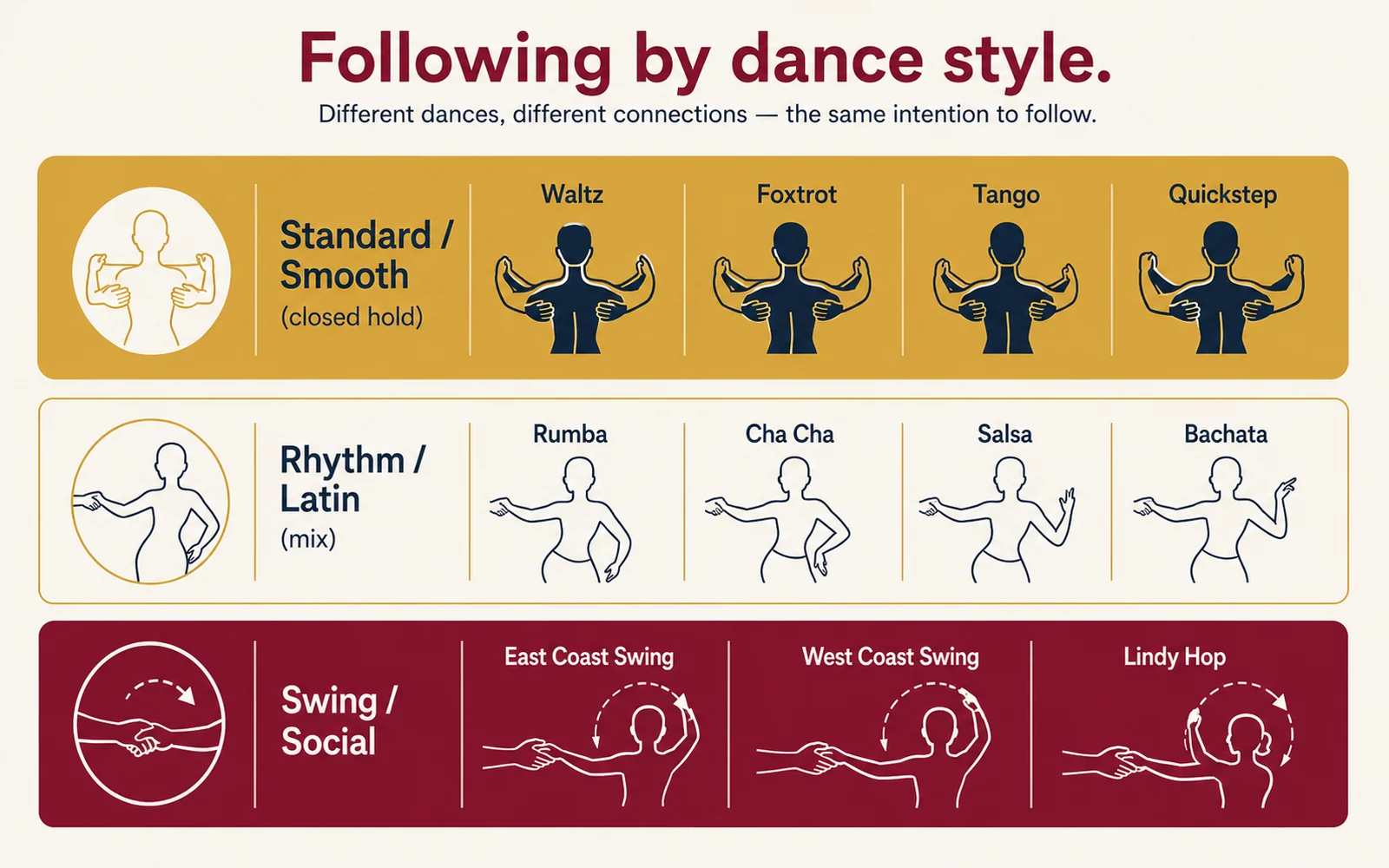
The fundamentals don’t change, but the emphasis shifts.
Standard and Smooth (closed hold)
- Waltz: continuous frame contact. Following is mostly through the body—weight, rotation, rise and fall.
- Foxtrot: smooth horizontal travel. Followers read the leader’s body shift very early.
- Tango: sharper, more deliberate response. Following is firmer and more grounded.
- Quickstep: high-tempo. Followers must read leads early and stay light.
Rhythm and Latin (mix of closed and open hold)
- Rumba: slower tempo gives time for body-rotation reception. Hip action is the follower’s styling space.
- Cha Cha: more open figures mean reading hand and visual leads in addition to body.
- Salsa: lots of hand leading. Followers spin a lot—balance over the standing leg is critical.
- Bachata: relaxed hip styling is the follower’s primary creative space.
Swing and Social
- East Coast Swing: bouncy hand leads. Followers triple-step on time and stay light.
- West Coast Swing: anchor steps, slot direction, lots of room for follower styling.
- Lindy Hop: more visual and bouncier; followers contribute as much rhythm as the leader.
Common following mistakes
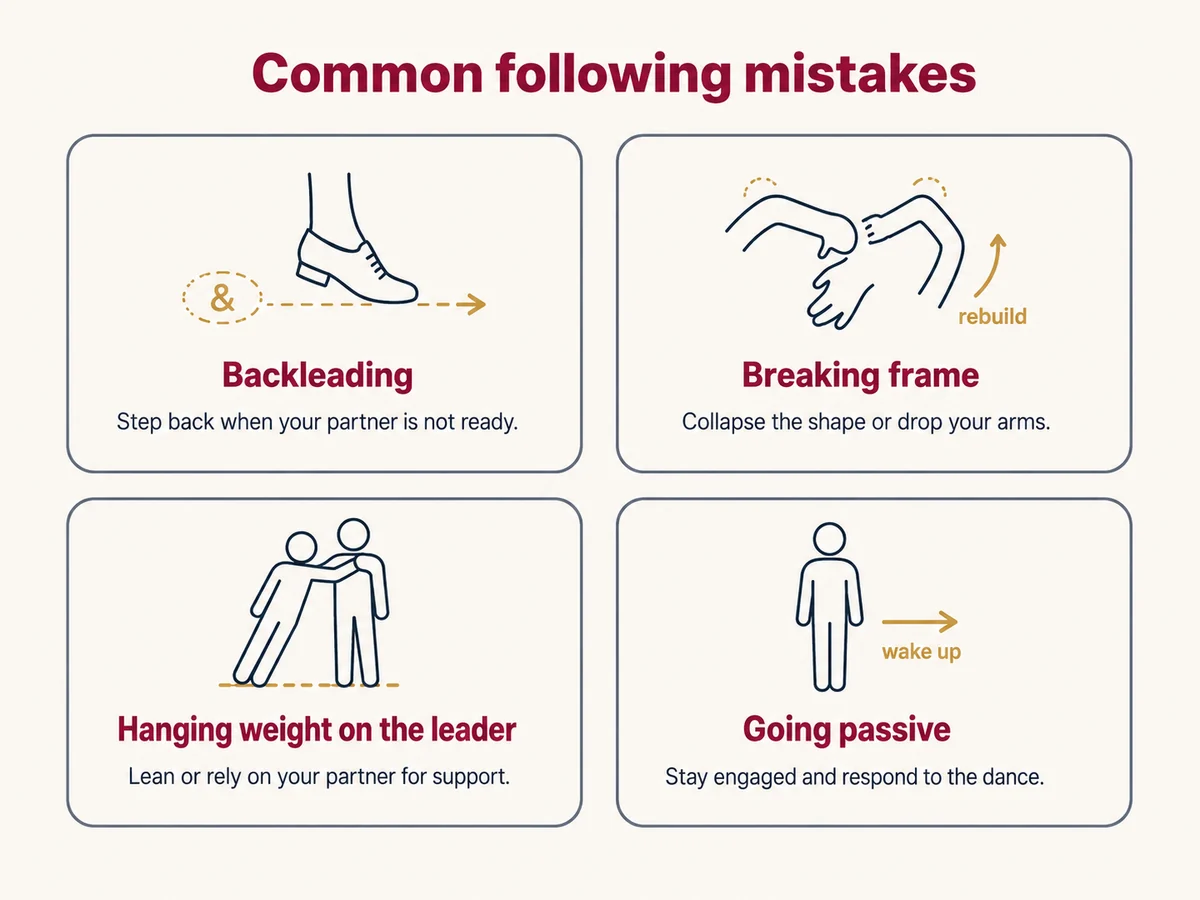
Backleading—stepping into a figure before being led
Fix: Wait for the lead even if you know what’s coming. The leader needs the option to change plans.
Breaking frame mid-figure
Fix: Frame stays consistent. If it collapses, the leader loses contact and the figure dies.
Going passive (waiting to be moved)
Fix: Following is active. Feel the lead, commit to the step, complete the figure. Move with the lead, not because of it.
Hanging weight on the leader
Fix: Own your balance. Stand on your own feet. The leader should be able to step away mid-figure without you falling.
Resisting or fighting the lead
Fix: Frame is present but not pushing. If a leader’s lead is too small or too late, that’s their problem to fix—don’t try to teach through resistance.
No styling or musicality—just stepping
Fix: The follower’s half of the dance is musicality, shape, and styling. Add your contribution.
Looking at the leader’s feet
Fix: Eyes up. Looking down breaks posture and turns the dance inward. Trust your feet to do their job.
Practice the follow
Three drills that build clean following:
- Solo balance drill. Practice the basic step alone, focusing on balance over your own feet. If you can do the basic with eyes closed and stay balanced, your follow is already cleaner.
- Closed-eyes following. With a real partner, close your eyes for a single figure (in a safe practice space). You’ll be forced to feel the lead through your frame rather than predicting visually.
- Frame check drill. Stand in front of a mirror. Notice when your shoulders rise, when your elbows drop, when your weight shifts off your standing leg. Each of those is a place the lead gets lost.
-
Slow Standard (balance + frame)
Slow Waltz and Foxtrot tracks for practicing balance and frame at low tempo.
-
Rumba (active receiving)
Slow Latin tempo. Perfect for practicing feeling body leads and adding hip styling.
-
Cha Cha (commit, then go)
Bright Latin 4/4. Practice committing to leads fully, not half-stepping.
-
BallroomPages Music (Telegram)
Mixed-style practice tracks. Following drills coming soon.
Telegram Music hub More follower-drill playlists coming soon
Following gets exponentially better when you dance with multiple leaders—each one will reveal a different facet of your follow. Group classes and social dances are where the skill actually develops.
FAQ
Follow FAQ
What does “follow” mean in ballroom dance?
Following is the active interpretation and completion of the lead. The follower receives the lead through frame, commits to the indicated movement, and adds musicality and styling. It’s a full half of the partnership, not passive obedience.
Is following passive?
No. Following is active receiving. The follower makes hundreds of micro-decisions per dance about timing, step size, balance, styling, and shape. A passive follower is a dragging weight.
What is backleading?
Backleading is when the follower steps into a figure they think is coming, instead of waiting for the lead. It looks similar from outside but breaks the partnership—the leader can’t change plans, and the dance becomes choreographed.
How do I know if I’m following well?
Best signal: leaders ask you to dance again. Specific markers: you stay over your own feet, your frame stays consistent, you don’t anticipate, and you add styling without losing balance.
What if my leader is bad?
Stay in your job. Hold your frame, own your balance, follow what you can read. Don’t try to teach the leader through resistance—that breaks both partners’ dancing. Find better leaders for the harder work.
Can the leader follow?
Yes—and learning to follow is one of the fastest ways to improve as a leader. Many advanced dancers train in both roles to better understand the other half of the partnership.
How do I add styling without anticipating?
Styling lives in the “how,” not the “what.” Once you’ve received the lead and committed to the step, the size, extension, head position, and hip action are yours to shape. Don’t add steps the leader didn’t indicate.
How do I get better at following?
Dance with many different leaders, drill balance on your own, and practice frame in front of a mirror. Closed-eyes drills with a trusted partner fast-track the “feel the lead” skill.
Editorial
Sources and review notes
This glossary entry should be reviewed by a qualified ballroom instructor before launch. Following principles follow widely accepted conventions from NDCA, WDSF, ISTD, and Arthur Murray syllabus materials, plus Dance Vision and other standard references. Specifics on follow mechanics vary slightly by syllabus body and teacher—follow your instructor’s convention within a single learning context.
This is dance terminology, not medical advice. Ballroom Pages follows an editorial policy of education-first guidance. Questions? Contact us. Updated May 27, 2026.