
Glossary
Rise and Fall in Ballroom Dance
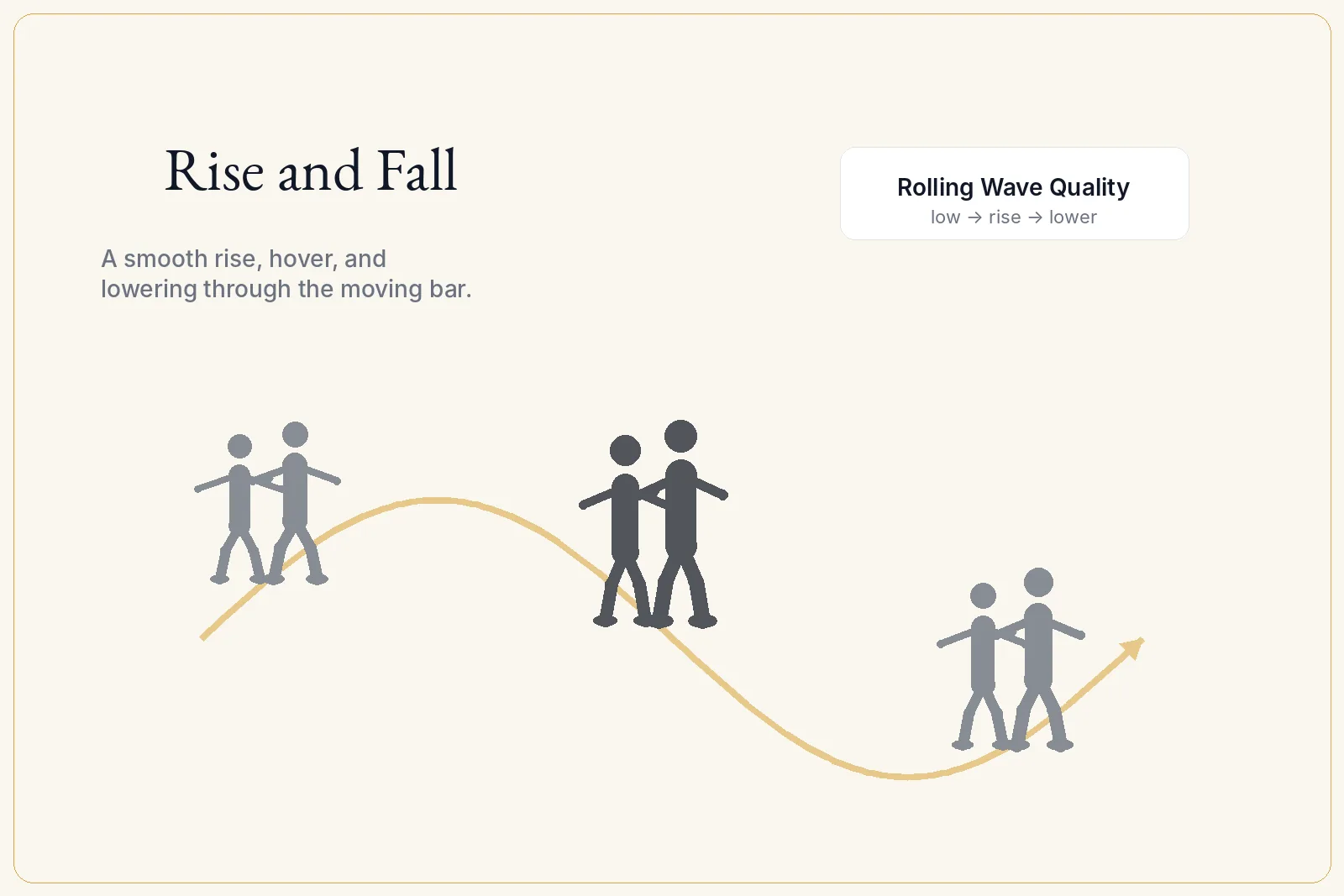
A Waltz doesn’t glide along a flat track—it breathes. The couple lifts softly through the middle of each bar and settles down into the next one, like a wave rolling across the floor. That vertical breath is rise and fall, the technique that makes the swinging Standard dances look weightless. Here is what it is, the classic Waltz pattern, the footwork underneath it, and why Tango refuses to do it at all.
Definition of rise and fall
Rise and Fall
- Skill category
- Technique & movement (Standard)
- Deep dive
- Rise & Fall technique guide
- Companion term
- Sway (the sideways shape to this vertical breath)
- Related terms
- sway, posture, timing, footwork, natural turn
Rise and fall is the controlled elevation and lowering of the body—through the feet, ankles, knees, and torso—that gives the swinging Standard dances their characteristic breath. It is strongest in Waltz, flows continuously in Foxtrot, and is deliberately absent in Tango.
The wave, not the elevator: rise and fall travels forward while it moves up and down.
What rise and fall means
Watch a good Standard couple from across the room and you’ll see the floor seem to ripple: the couple softens down, swells up through the middle of the bar, floats for a moment, and settles again—in time with the music, over and over. That is rise and fall. It isn’t bouncing (bouncing is what happens when it goes wrong); it is a smooth, controlled change of elevation that the couple shares, driven by the legs and feet while the posture stays tall throughout.
Musically, it is how the body expresses the bar: the strong downbeat gets the couple’s full weight low into the floor, and the lighter beats carry them up. This is why rise and fall is inseparable from timing—the wave has to crest and land exactly where the music does.
The classic Waltz pattern
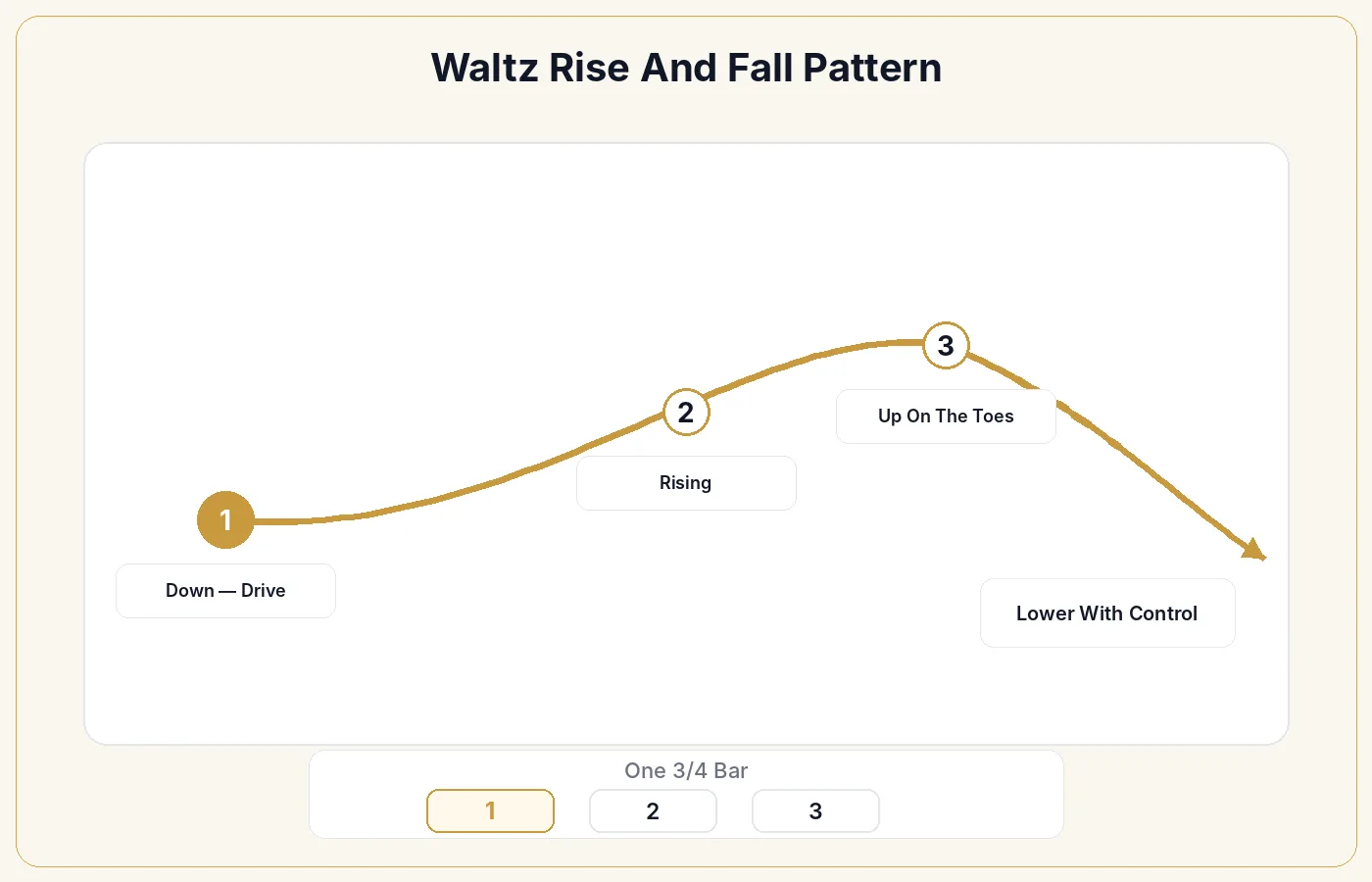
Waltz is where rise and fall lives largest, and its basic pattern is worth memorizing:
One bar of Waltz (1-2-3)
- Beat 1: The lowest point. Step out through a flexed knee, weight driving into the floor—this is where the power lives.
- Beat 2: Rising. The body travels up through the ankles and knees as the feet come toward each other.
- Beat 3: Up. Full height on the toes as the feet close—then, at the end of 3, lower with control to arrive down and ready for the next “1.”
Syllabus shorthand: commence to rise at the end of 1, continue to rise on 2 and 3, lower at the end of 3. The lowering is the part beginners skip—and it is the most important part, because the controlled descent is what powers the next bar.
The footwork underneath
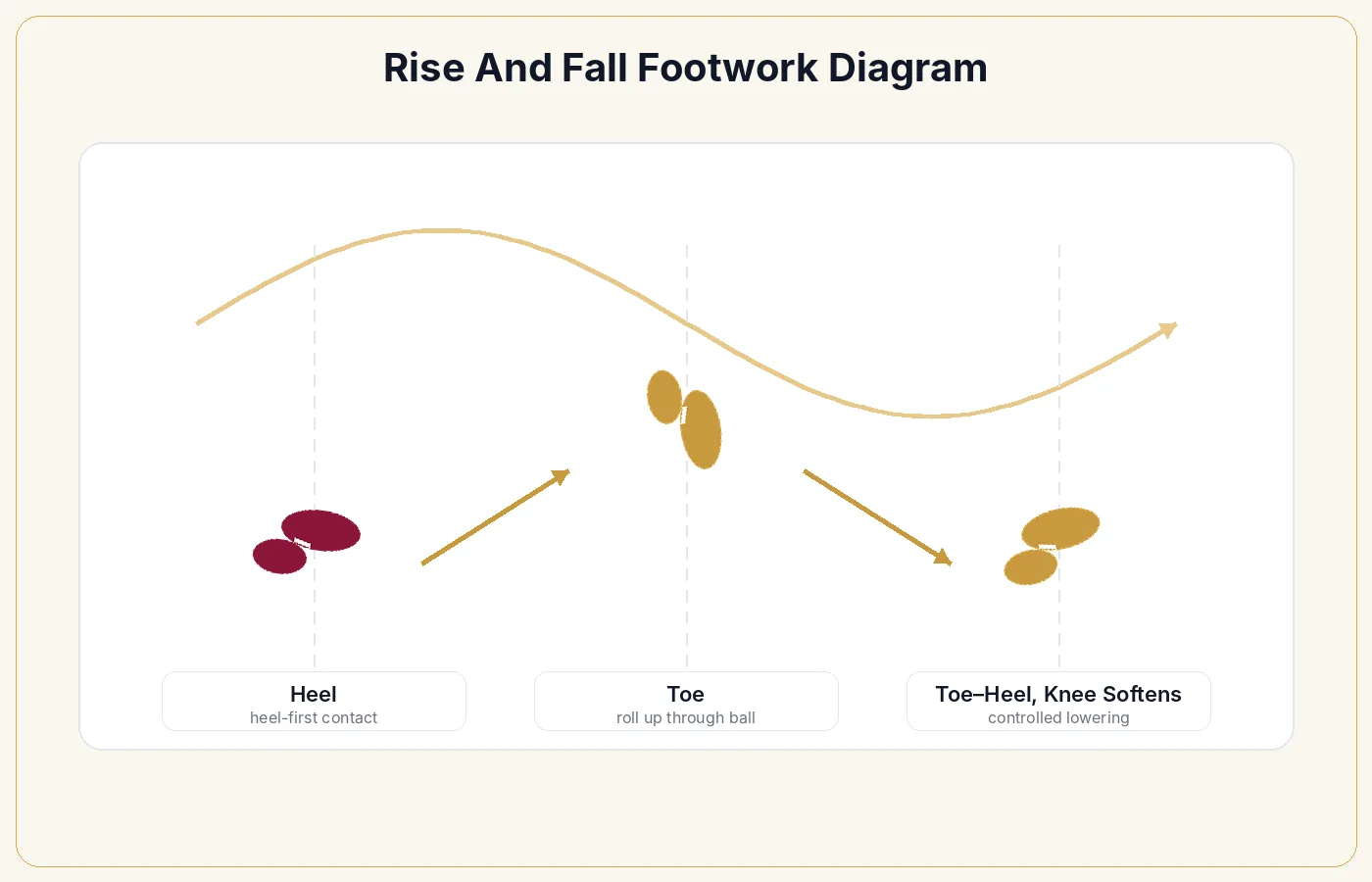
Rise and fall is written into the feet. At the low point, forward steps land heel first; as the body rises, weight rolls forward onto the toes (syllabus footwork reads “heel-toe” then “toe”); and the lowering rolls back down toe-to-heel with the knee softening to receive the weight. The ankles do the fine work—which is why dancers talk about “using your feet” and why rise and fall improves dramatically when practiced slowly. The full mechanics, with drills, live in the Rise & Fall technique guide.
Rise and fall by dance style
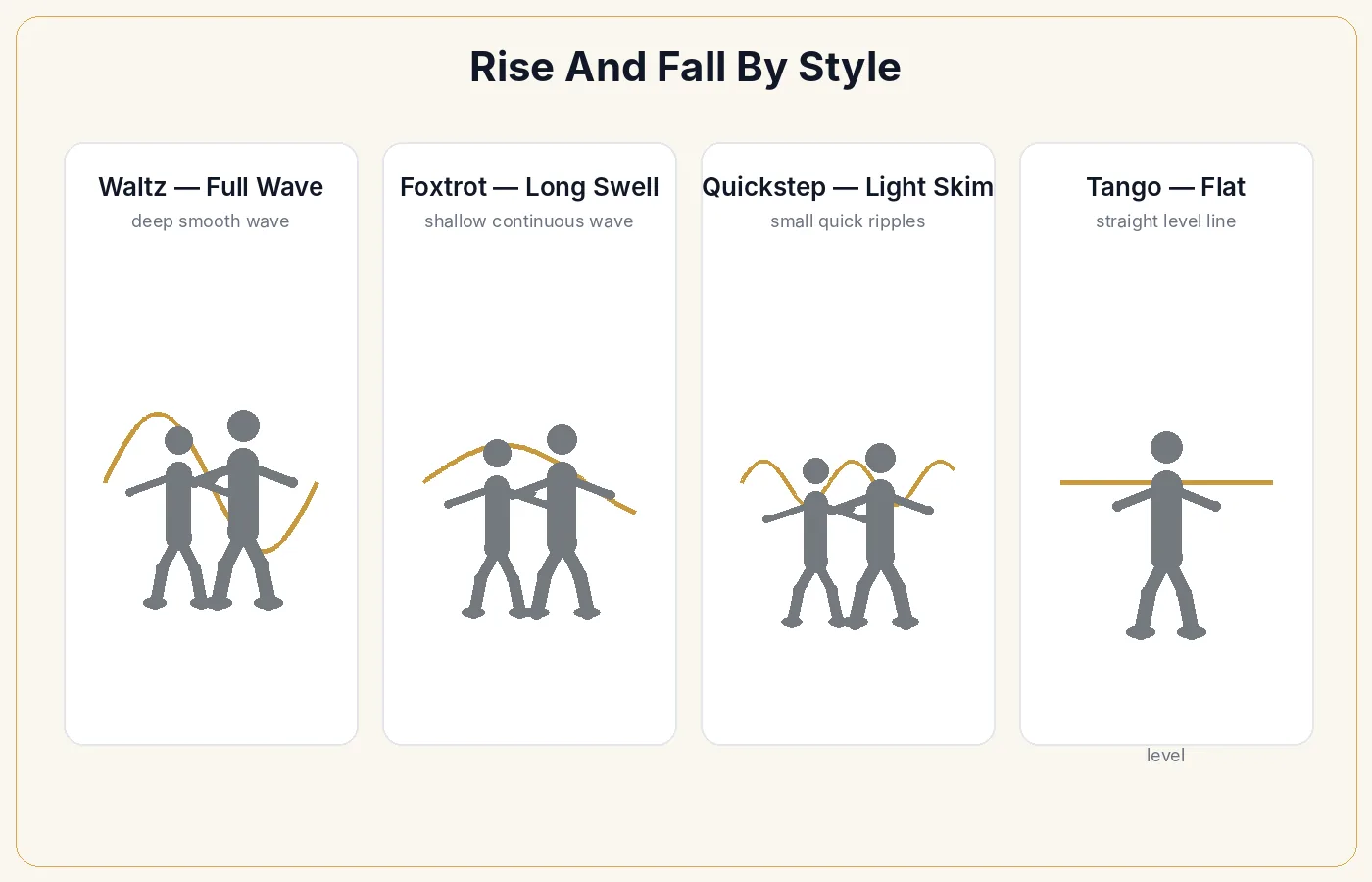
| Dance | Rise and fall character |
|---|---|
| Waltz | Strongest and clearest—a full wave every bar |
| Foxtrot | Continuous and shallow—a long rolling swell, never fully “down” |
| Quickstep | Light and quick—skimming rises that match the tempo |
| Viennese Waltz | Subtle—the continuous rotation flattens the wave |
| Tango | None. Level and grounded by design—flexed knees, no rise |
Tango’s flatness isn’t a missing feature—it is the point. The stalking, staccato character of Tango comes precisely from refusing the wave the other Standard dances ride. (It’s also why adding Waltz-style rise to a Tango is one of the most common crossover mistakes.)
Rise and fall works with sway
Rise and fall is the vertical half of the Standard dances’ “swing.” The sideways half is sway—the controlled inclination through turns. They peak together: as the couple rises through steps 2 and 3 of a turning figure, the sway blooms; as they lower, the body returns to vertical. Add CBM to start the rotation, and you have the complete recipe for the floating turns that make Waltz mesmerizing. Each ingredient is learnable on its own—that is the reason they get separate glossary entries.
Common rise and fall mistakes
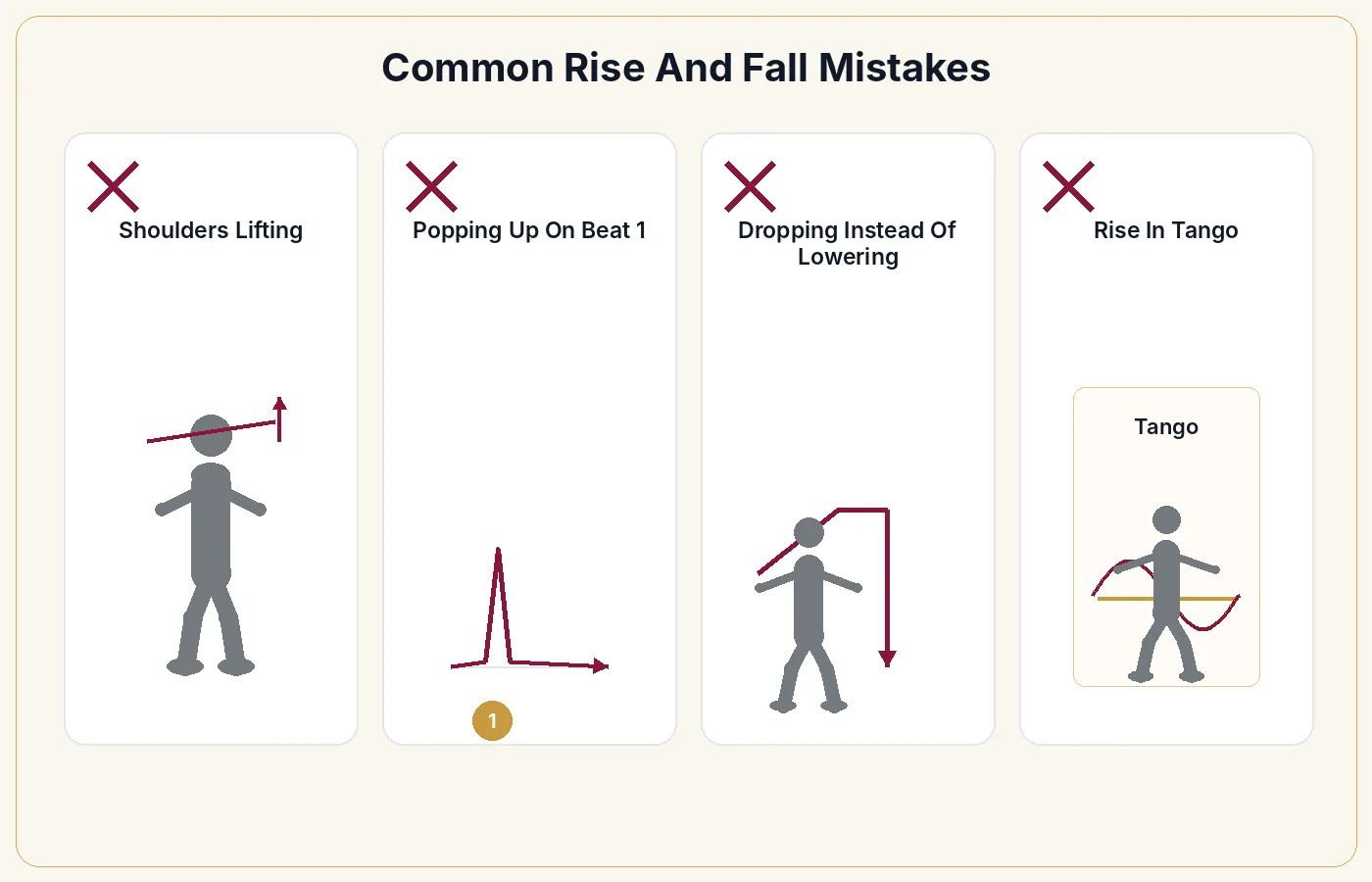
Rising from the shoulders
Fix: The shoulders never lift—the rise comes from ankles, knees, and stretching through the body. If your shoulders end higher than they started, it wasn’t rise.
Popping up on beat 1
Fix: Beat 1 is the LOW point. The rise begins at the end of 1 and grows through 2 and 3. Early rise kills the power of the driving step.
Dropping instead of lowering
Fix: The descent is the controlled half. Lower through the ankle and soften the knee over the full end of beat 3—a drop reads as a bounce and jolts your partner.
Taking the wave into Tango
Fix: Tango stays flat and grounded. Park the rise and fall at the door—its absence is what makes Tango look like Tango.
Practice rise and fall
Slow, deliberate reps beat fast sloppy ones—the wave is built at low speed:
- Standing waves. Feet together, rise to the toes over two slow counts and lower over two more—shoulders level, posture tall, ten reps.
- Walking waves. Walk forward in slow motion: heel-first at the bottom, roll to the toes as you rise, lower toe-to-heel into the next step.
- One-bar drill. To slow Waltz music, dance a single closed change repeating the mantra: down on 1, rise through 2, up on 3, lower.
-
Waltz (the full wave)
Slow 3/4 with a clear “1”—the natural habitat of rise and fall.
-
Quickstep (the light version)
Feel how the same wave compresses at speed.
-
Full technique guide
The deep dive: mechanics, footwork charts, and progressive drills.
-
BallroomPages Music (Telegram)
Mixed-style practice tracks. Wave drills coming soon.
FAQ
Rise and Fall FAQ
What is rise and fall in ballroom dancing?
Rise and fall is the controlled elevation and lowering of the body through the feet, ankles, knees, and torso that gives the swinging Standard dances—especially Waltz—their characteristic breath. The couple is lowest on beat 1, rises through the bar, and lowers with control to begin again.
What is the rise and fall pattern in Waltz?
Down on 1, rising through 2, up on the toes on 3, then lowering at the end of 3 to arrive down for the next bar. Syllabus shorthand: commence to rise at the end of 1, continue to rise on 2 and 3, lower at the end of 3.
Which dances use rise and fall?
Waltz (strongest), Foxtrot (continuous and shallow), Quickstep (light and quick), and Viennese Waltz (subtle). Tango deliberately has none—it is danced level and grounded, which is exactly what gives it its staccato character.
Why is there no rise and fall in Tango?
By design. Tango’s character is flat, compact, and staccato—danced with flexed knees at a constant level. The absence of the wave is what separates its look and feel from the swinging Standard dances, and adding rise to Tango is a classic crossover mistake.
Does the rise come from the shoulders?
No—never. The rise is created by the ankles, knees, and a stretch through the body while the shoulders stay level and relaxed. Lifting the shoulders is the most common rise-and-fall fault and reads instantly as tension.
Editorial
Sources and review notes
This glossary entry should be reviewed by a qualified ballroom instructor before launch. Rise and fall is a technique-heavy topic—the pattern and footwork descriptions follow widely used syllabus conventions (ISTD-style), but the mechanics deserve expert verification before being treated as teaching material.
This is beginner orientation, not a substitute for instruction. Ballroom Pages follows an editorial policy of education-first guidance. Questions? Contact us. Updated July 9, 2026.