
Glossary
Follower in Ballroom Dance
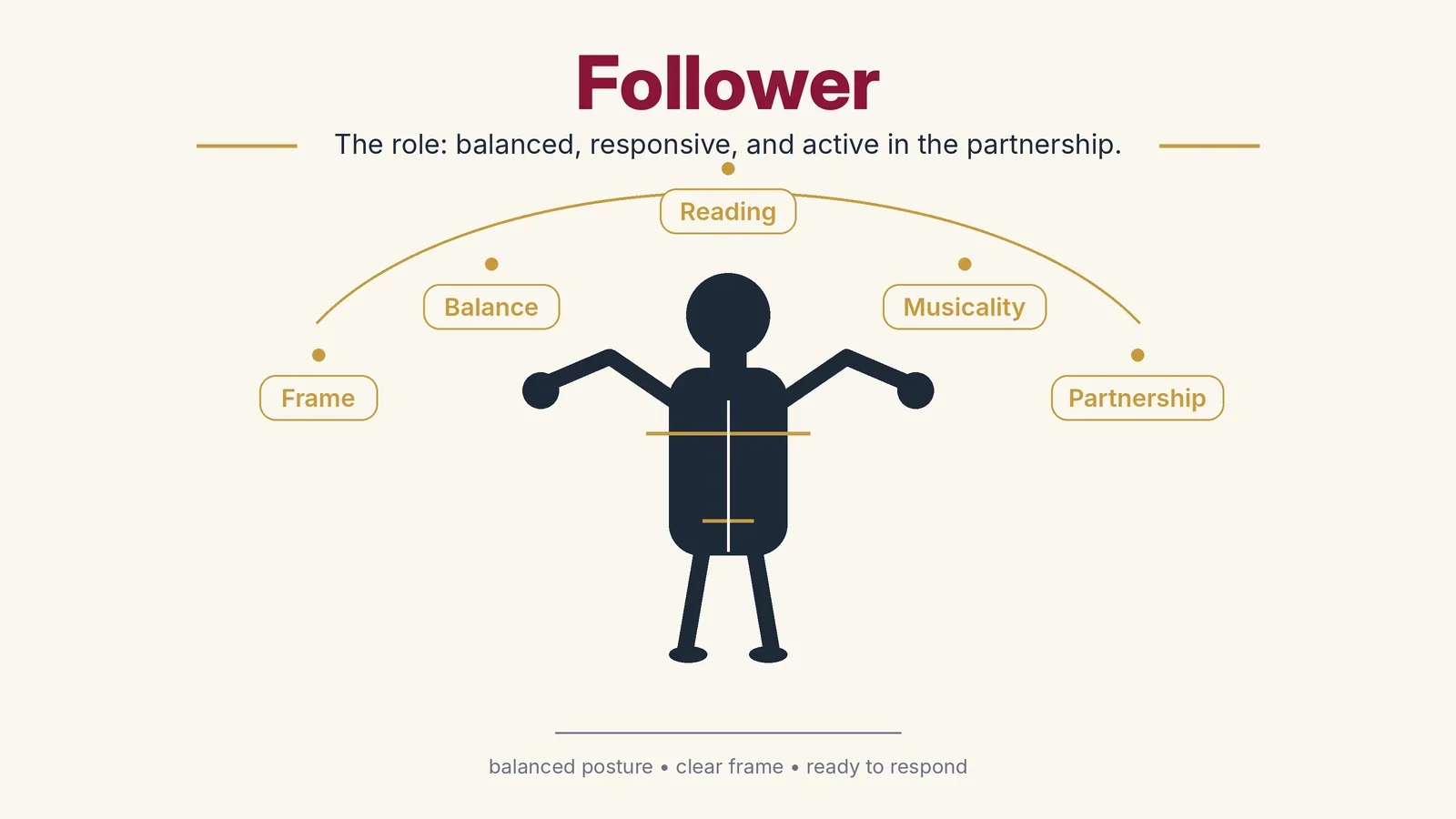
The follower is the partner who responds to the lead—receiving signals through frame, completing the movement, and adding musicality. The role is open to anyone, regardless of gender. Here’s what the follower role really is, the five skills that define a great follower, and the arc most followers travel from beginner to confident social dancer.
Definition of follower
Follower
- Pronunciation
- fol-oh-er
- Skill category
- Roles & technique
- Companion term
- Follow (the action)
- Related terms
- leader, lead, frame, connection, posture, musicality
In ballroom dance, the follower is the partner who responds to the leader’s lead. The follower receives signals through frame, completes the indicated movements, and contributes musicality and styling. The role can be danced by any partner regardless of gender—and many advanced dancers train in both roles.
Follower is the role; follow is the action. Both halves matter.
What “follower” means in ballroom dance
The follower is the partner who responds. Where the leader initiates direction, timing, and movement, the follower receives those signals, commits to the indicated movement, and completes it with their own contribution—balance, styling, and musicality.
The word “follower” is often misunderstood as meaning passive or subordinate. It’s neither. A skilled follower is making hundreds of micro-decisions per dance: how big a step to take, when exactly to commit, how much hip action or rise to add, when to extend a line for shape. The leader sets up the figure; the follower completes it.
In ballroom (and in partner dance generally), either partner can take the follower role. Traditionally the role has been gendered, but the mechanics are role-based, not gender-based. Many advanced dancers train both roles to better understand the partnership.
Follower vs Follow
Two words, almost the same, but they refer to different things.
| Follower (this page) | Follow (companion page) |
|---|---|
| The role—a person in a partnership | The action—the verb “to follow” |
| About identity, dev arc, partnership skills | About mechanics: frame, balance, receiving the lead |
| “She is the follower in this couple.” | “He follows the lead through the frame.” |
| Person-focused: skills, growth, social aspects | Technique-focused: how the mechanics work |
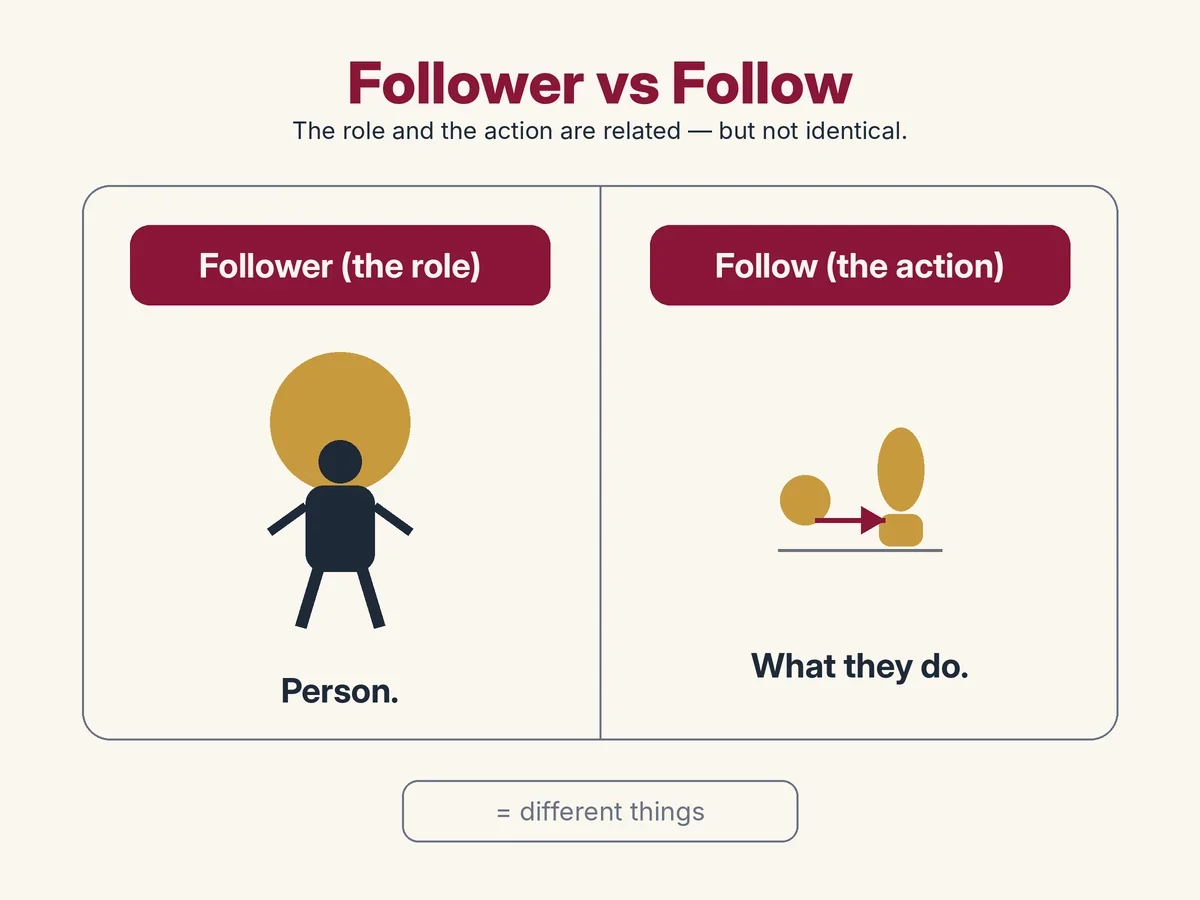
If you’re looking for the mechanics—how to receive a lead, how to hold frame, how to avoid backleading—the /glossary/follow/ page covers that. This page is about the role: what defines a skilled follower, the developmental arc, and how to grow over years of dancing.
The 5 core follower skills
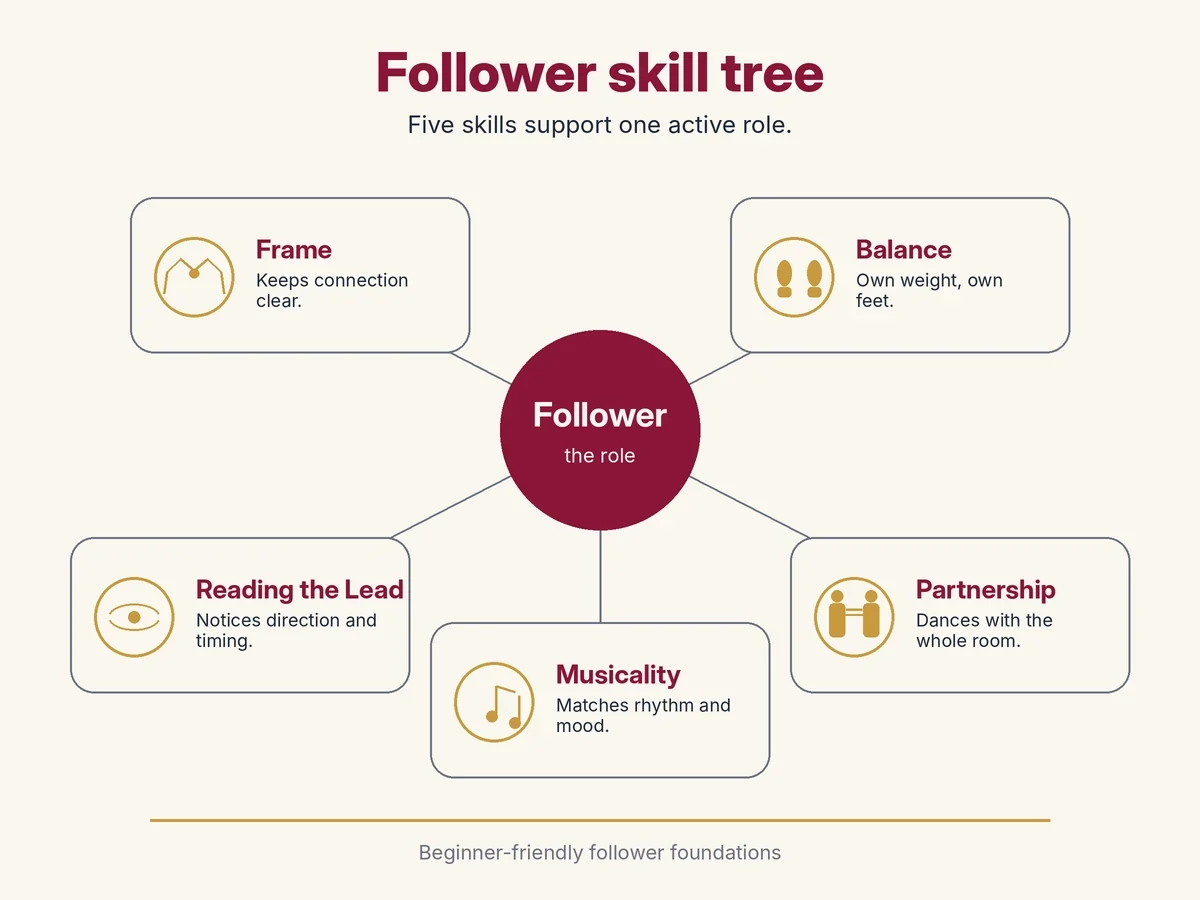
What separates a skilled follower from a beginner isn’t the figures they know. It’s these five skills, in roughly the order they develop.
1. Frame
Frame is the medium through which the lead reaches you. Too loose, and you can’t feel the lead. Too tight, and you resist it. A skilled follower’s frame is present, consistent, and never collapses mid-figure.
2. Balance
Stand over your own feet. Always. A follower who hangs weight on the leader is impossible to lead. A follower who owns their balance is easy to lead and easy to look good with.
3. Reading the lead
Knowing what’s being asked—through subtle weight shifts, frame rotation, hand pressure, visual cues. A skilled follower reads early but doesn’t step early; the response is on time and complete.
4. Musicality
The lead tells you what; you decide how. Step size, hip action, extension, head position, timing nuances—these are the follower’s creative contribution. A musical follower makes the leader look better and the dance look like the dance it is.
5. Partnership
Being easy to dance with. Adapting to different leaders. Asking and being asked to dance. Knowing when to add styling and when to keep it simple. This is the longest-developing skill—and the one most experienced followers point to as what separates "good" from "great."
The follower’s checklist (every dance)
- Own your balance. Stand on your own feet. The leader shouldn’t carry your weight.
- Hold consistent frame. Present but not pushing. Never collapse mid-figure.
- Wait for the lead, then commit. No anticipation. Once you feel it, finish it.
- Add your half. Styling and musicality are yours to contribute.
- Make the leader’s job easier. If the same lead works repeatedly with you, you’re a good partner.
The follower’s developmental arc
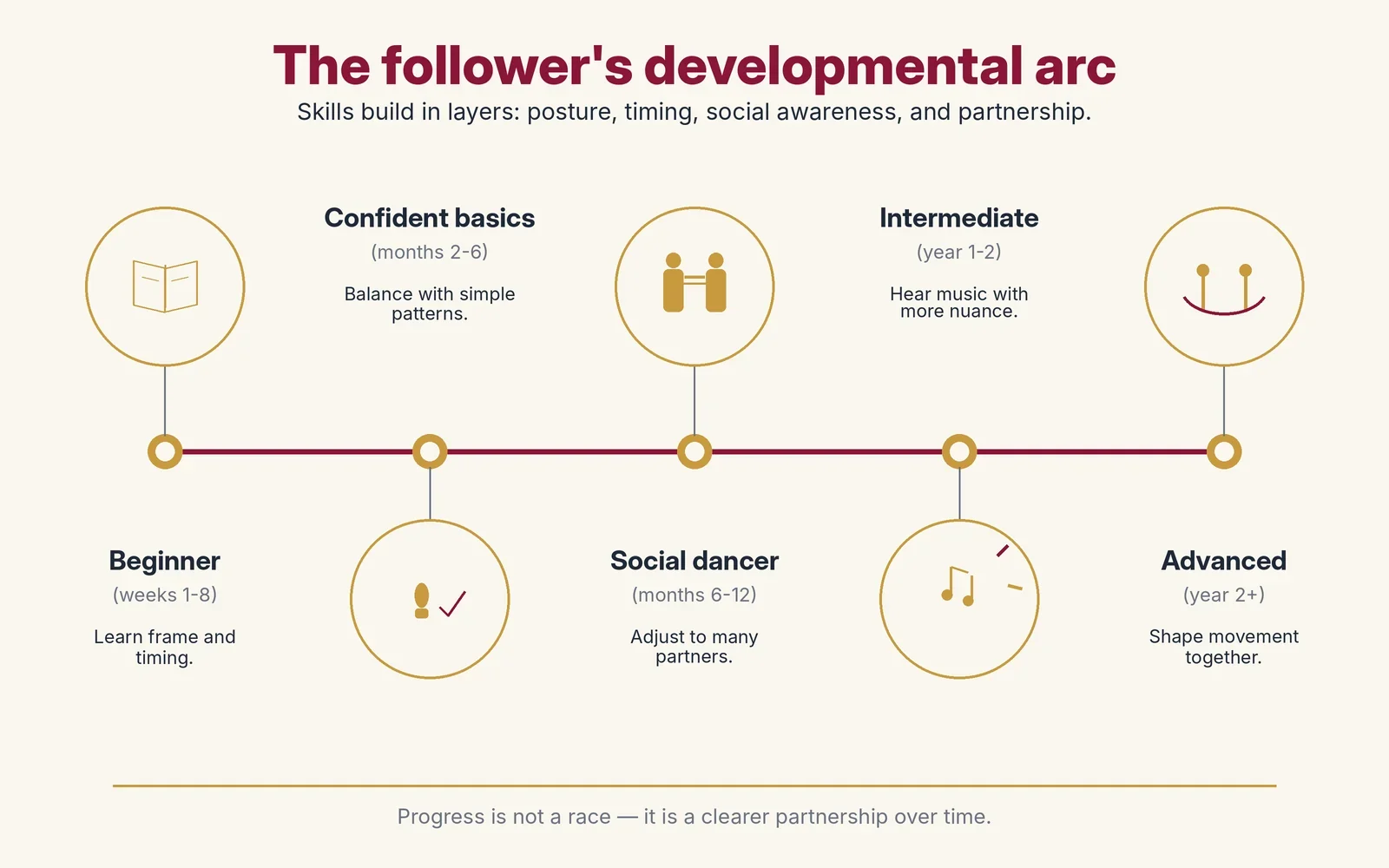
Followers don’t grow in a straight line, but most travel a recognizable arc.
Phase 1 — Beginner (weeks 1-8)
Learning what frame feels like. Learning to step on time. Lots of looking down at feet. Backleading is common—you predict the figure and step ahead. Normal. Frustration is normal too.
Phase 2 — Confident with basics (months 2-6)
Frame starts to feel automatic. You can step the basic of 3-4 dances without looking down. You start to feel the lead instead of guessing at it. Backleading drops dramatically.
Phase 3 — Social dancer (months 6-12)
You can dance with strangers at a social and have it work. You start to add personal styling. You discover that different leaders feel different. You start having a favorite dance.
Phase 4 — Intermediate (year 1-2)
Musicality clicks. You stop just stepping in time and start dancing to the music. Frame is now a tool you can use more or less of, not a fixed thing. You can follow figures you don’t recognize.
Phase 5 — Advanced (year 2+)
Partnership becomes the focus. You can make any leader look better. You read floor traffic, song endings, and other couples without consciously thinking about it. The dance feels conversational.
Timeline varies. A dancer practicing 5 hours a week may cover this arc faster than someone in monthly lessons. The phases matter more than the months.
What followers do across dance styles
- Waltz: Closed-hold smooth dancing. Followers receive through body rotation and rise/fall, add sway and head position.
- Foxtrot: Smooth horizontal travel. Followers read leader’s body shift very early, contribute extension and shape.
- Tango: Sharp, grounded responses. Followers contribute attitude and precise timing.
- Rumba: Slow Latin. Followers use the slower tempo to add hip action and styling between leads.
- Cha Cha: Open figures with hand and visual leads. Followers spin a lot, balance over standing leg.
- Salsa: Lots of spins. Followers contribute musicality on breaks and individual shines.
- East Coast Swing: Bouncy hand leads. Followers triple-step in time and add personal style.
- West Coast Swing: Lots of slot-based following with heavy anchor styling. Followers have huge creative space.
Common beginner follower mistakes (role-level)
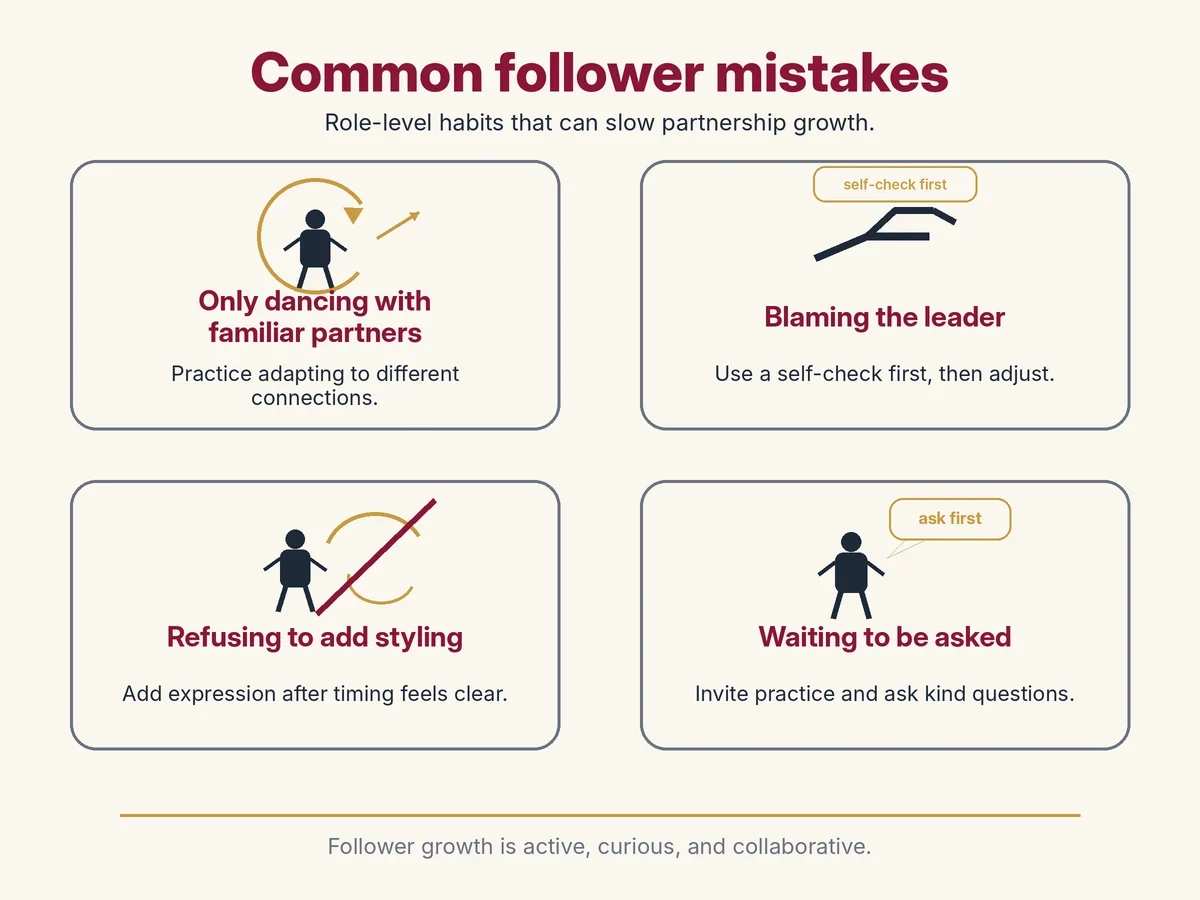
These are role-level mistakes—the kind that hold a follower back over months, not seconds. Mechanics mistakes (backleading, breaking frame, etc.) are covered in /glossary/follow/.
Only dancing with familiar partners
Fix: Different leaders reveal different gaps. Dance with everyone you can—especially strangers at socials. Growth comes from variety.
Blaming the leader when figures don’t work
Fix: If a lead is unclear, that’s the leader’s issue—but check your own frame and balance first. Most "bad leads" reveal a follower issue too.
Refusing to add styling because “the leader is in charge”
Fix: Styling and musicality are yours to contribute. The leader runs the architecture; you fill it in.
Waiting to be asked instead of asking
Fix: In modern ballroom culture, followers ask too. Asking shows confidence and gets you more practice with more leaders.
Trying to learn figures instead of skills
Fix: Followers don’t need to know the figures—the leader does. Spend practice time on frame, balance, and listening. Figures will come.
Treating bad dances as wasted time
Fix: A confusing dance with a struggling leader is a chance to practice frame, balance, and patience. Every dance is practice.
Believing “follower” means “less skilled”
Fix: Following is a full skill set. Many of the most respected dancers in the ballroom world built their reputation as followers first.
How to grow as a follower
Three practices that build the role, not just the action:
- Solo practice 30 minutes a week. Basic step alone, eyes closed when safe, focused on balance and frame consistency. Skills built solo show up immediately in partnership.
- Social dance regularly. Group classes are for learning; socials are for practice. Aim for one social dance per month at minimum.
- Take video. Once a quarter, have someone film you dancing. Watch with the sound off and look for frame collapses, weight hanging, and looking down. Painful but fast.
-
Slow Standard (frame + balance)
Slow Waltz and Foxtrot tracks. Practice the basics solo at low tempo.
-
Rumba (styling space)
Slow Latin tempo. Perfect for practicing what to add between leads.
-
Cha Cha (commit drills)
Practice committing fully to leads. No half-stepping.
-
BallroomPages Music (Telegram)
Mixed-style tracks for variety. Follower-specific drills coming.
The single fastest way to grow as a follower is to dance with many different leaders. Group classes rotate partners for a reason—every leader reveals a different facet of your follow.
FAQ
Follower FAQ
What does “follower” mean in ballroom dance?
The follower is the partner who responds to the leader’s lead—receiving signals through frame, completing the indicated movements, and adding musicality. It’s a role, open to anyone regardless of gender.
What’s the difference between follower and follow?
Follower is the role; follow is the action. The follower is the person; following is what they do. The mechanics live on the follow page; this page is about the role itself.
Is being a follower less skilled than leading?
No—they’re different skills, not different levels. Followers are reading micro-signals and committing to movements without knowing what’s next. Many advanced dancers in ballroom built their reputation as followers first.
Can a man be the follower?
Yes. The follower role is defined by what the partner does in the partnership—not by gender. Many modern ballroom and social-dance communities are explicit about this. The mechanics work the same regardless.
How long does it take to become a confident follower?
For a beginner practicing once a week in a class plus a monthly social, “confident social dancer” is realistic in 6-12 months. Going further—to musicality, partnership intuition, advanced styling—is a multi-year arc.
Should followers learn figures?
Helpful but not required. The leader needs to know the figures. The follower needs to read the lead. Many great followers can’t name half the figures they dance—they just feel them.
What if my leader is doing something wrong?
Stay in your role. Hold your frame, own your balance, follow what you can read. Don’t try to teach through resistance. Save feedback for off-floor conversations if it’s appropriate (and only if asked).
How do I find good leaders to dance with?
Group classes that rotate partners are the fastest path. Social dances are next. After 3-6 months, you’ll know who in your local community feels good to dance with—ask them.
Editorial
Sources and review notes
This glossary entry should be reviewed by a qualified ballroom instructor before launch. Follower-role descriptions follow widely accepted conventions from NDCA, WDSF, ISTD, and Arthur Murray syllabus materials. Developmental-arc timelines are approximate and vary by practice frequency and individual.
This is dance terminology, not medical advice. Ballroom Pages follows an editorial policy of education-first guidance. Questions? Contact us. Updated May 29, 2026.