How Latin and ballroom dance shoes actually differ
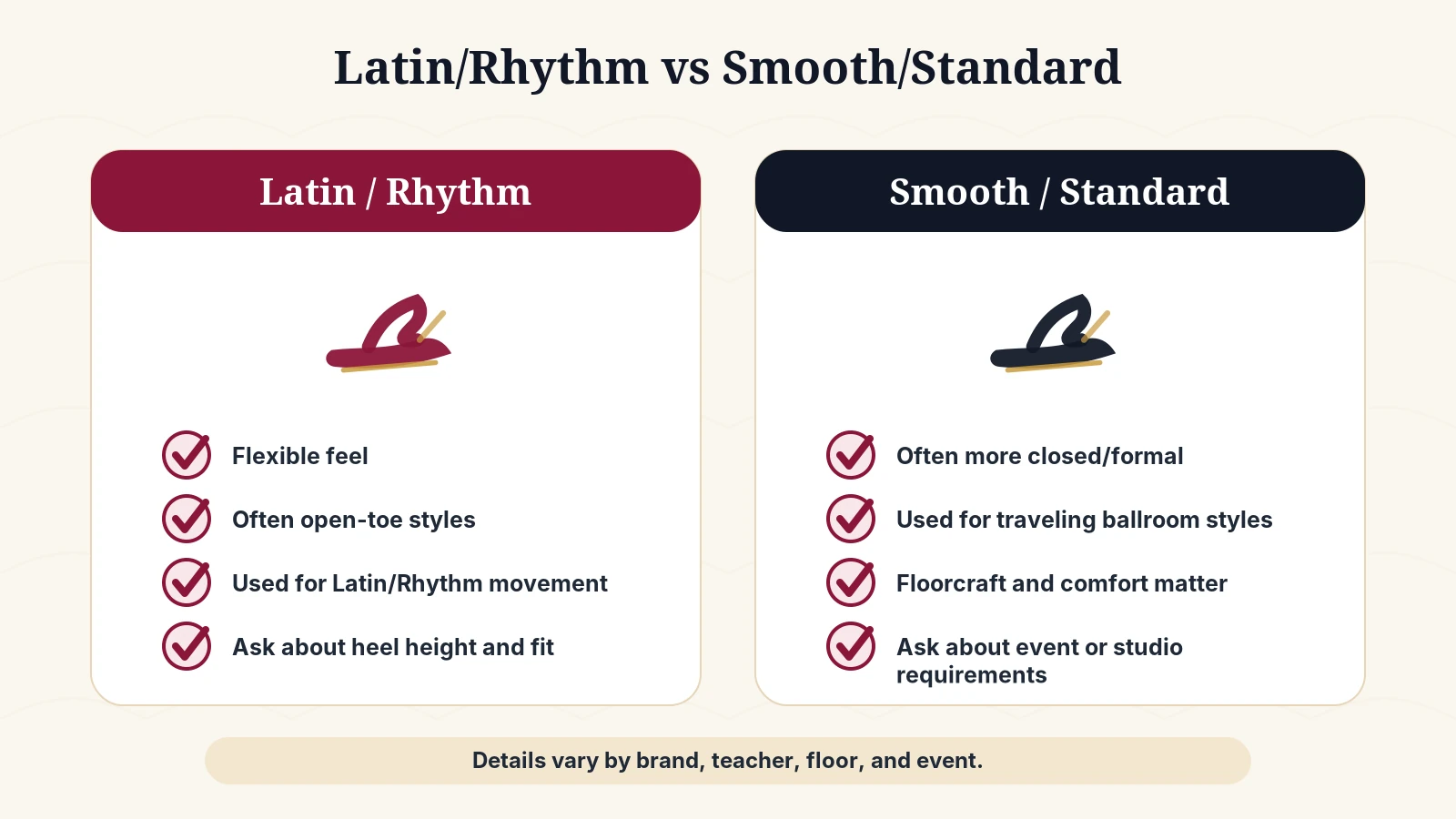
Put a Latin/Rhythm shoe and a Smooth/Standard ballroom shoe side by side and the first thing most people notice is the look: one is open and strappy, the other is closed and formal. That is the least useful difference. Turn both shoes over and you will usually find the same thing on the bottom—a brushed suede sole, made for indoor dance floors, offering the same mix of slide and grip. The material under your foot is not what separates these two categories.
What separates them is the job the shoe is being asked to do. Latin and Rhythm dancing spends a great deal of time with weight through the ball of the foot: pressing into the floor, straightening a leg, settling a hip, changing weight on the spot. A shoe for that work needs to bend with the foot rather than resist it, and it needs to hold the foot in place while the foot articulates. Smooth and Standard dancing travels. It moves across the floor in long, continuous swings, with heel leads and a rise and fall that wants a stable platform underneath. A shoe for that work needs to support a line more than it needs to fold in half.
| Latin/Rhythm | Smooth/Standard | |
|---|---|---|
| Built for | Weight through the ball of the foot, spot turns, and footwork that stays close to home. | Travelling, gliding movement with heel leads, swing, and a long shared line. |
| Sole flex | More flexible, so the foot can roll through and point without fighting the shoe. | Firmer and less flexible, giving a steadier platform under a moving body. |
| Heel height commonly offered | Follower styles are generally offered higher and slimmer than the Smooth/Standard equivalent. | Follower styles are generally offered lower and broader than the Latin equivalent. |
| Heel shape | Flared or slim, and generally narrower where it meets the floor. | Broader and straighter, spreading contact over a wider area. |
| Toe and upper | Usually open-toe or strappy, so the foot is visible and free to articulate. | Usually a closed court shoe or a closed oxford-style upper. |
| How the fit feels | Close and held, with toes reaching near the front edge on open-toe styles. | Snug but enclosed, with the foot supported all the way around. |
| Dances it suits | Rumba, Cha Cha, Jive, Samba, Salsa, Bachata, and Rhythm styles. | Waltz, Foxtrot, Tango, Quickstep, Viennese Waltz, and Smooth styles. |
| Sole material | Suede, indoor-only. | Suede, indoor-only. |
Nothing in that table makes one shoe better than the other. They are two tools shaped around two different demands, and plenty of social dancers go years—some of them forever—owning only one of them. If most of your dancing sits on one side of the room, one well-chosen pair is a complete answer, not a compromise.
Do you need Latin dance shoes yet?
Here is something worth saying out loud before anything else. Nearly every page that ranks for this question today is published by somebody with an interest in the answer: a shoe maker, a shoe retailer, or a studio that would like you inside the building more often. None of them are villains, and plenty of them give sound advice. But “wait” is never really on their menu, because “wait” is not something a shop can sell you. Ballroom Pages does not sell shoes or lessons, so we can put the honest option on the table first: for a lot of readers, the right answer this month is not to buy.
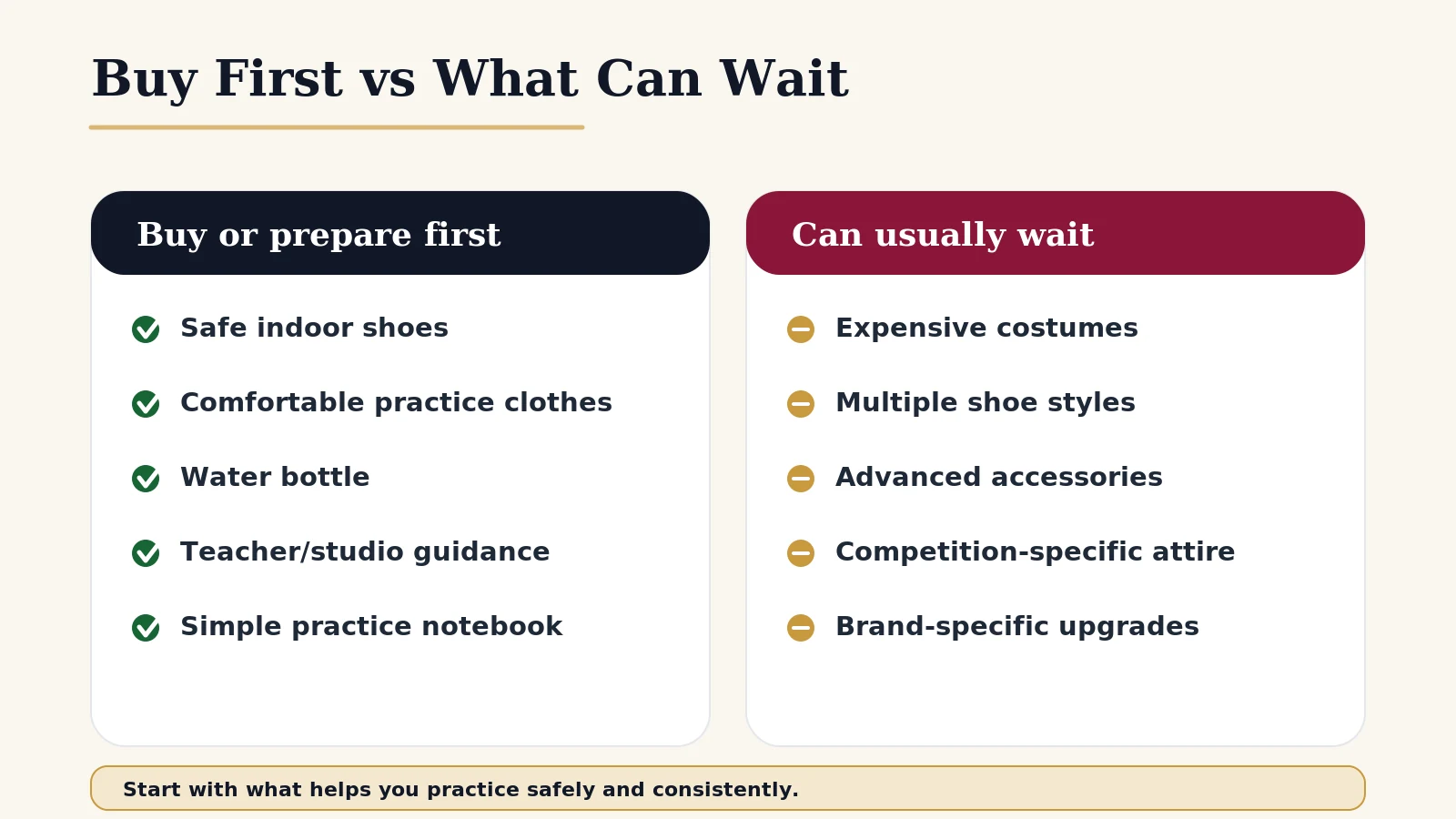
The useful test is not how long you have been dancing or how serious you feel. It is whether your current shoe is getting in the way of something a teacher has actually asked you to do. Until that happens, a second pair buys you a feeling rather than a skill. When it does happen, you will usually know, because the problem shows up in the same place every week.
Signs Latin shoes will help you now
- You dance Latin or Rhythm weekly or more, and it is the bulk of your floor time.
- Your teacher has asked you to work through the ball of the foot and your shoe fights it.
- Your current shoe rolls, slides or grips at the wrong moment during weight changes.
- Your foot is not held securely enough for spins and spiral turns.
- You have a showcase, medal test or competition booked.
Signs you can wait
- You are in your first term of group classes.
- You dance Latin occasionally at socials and mostly do other styles.
- You already own a flexible, secure suede-soled shoe.
- Heels are still new to you and you are working on balance.
- You have not settled on which styles you want to pursue.
That last one deserves a moment. If you buy a Latin pair early and then discover that what you really love is Foxtrot, there is no shame in it—most dancers wander before they settle—but it is an expensive way to find out. If you are still sampling, our guide to the best ballroom dances for beginners is a cheaper way to work out where you are heading, and the answer often reshapes the shoe question entirely.
It is also worth separating two things that get bundled together: needing a Latin shoe, and needing a better shoe. If your current pair slips at the heel, has a sole you cannot control, or hurts after an hour, that is a fit and quality problem, and buying a Latin shoe will not fix it. Solve the actual complaint. A secure, flexible suede-soled shoe in the right size does more for your Cha Cha than a beautiful Latin sandal half a size too big.
The honest route: a beginner with one working suede-soled shoe usually gets more out of the next three months of lessons than out of a second pair. If your current shoe genuinely is the problem, the cheaper fixes usually come first—read ballroom practice shoes if comfort and long sessions are the issue, or ballroom dance shoes for beginners if you are still on your first pair and it is not working.
Heel height and heel shape: flare, slim, and Cuban
Heel talk gets confused because two separate decisions get treated as one. Height is how far off the floor your heel sits. Shape is what happens between the top of the heel and the ground. Shape often matters more than height for how steady a shoe feels, and it is the part most first-time buyers never think about.
A flare heel widens as it approaches the floor, which puts a larger contact patch under you. That extra footprint is forgiving, and it is why flared heels turn up so often on first Latin shoes and on practice styles. A slim or stiletto heel narrows to a small point of contact. It is favoured for the line it draws and the way it finishes a leg, and it asks considerably more of your ankle and your balance in return. A Cuban heel is broader, straighter and lower, and it is the standard shape on men’s Latin shoes and on many unisex practice styles.
| Flare | Slim / stiletto | Cuban | |
|---|---|---|---|
| Contact with the floor | Wide, because the heel spreads as it drops. | Narrow, concentrated on a small point. | Broad and straight down the whole heel. |
| Stability in turns | Generally the steadiest of the three. | Least forgiving; rewards a controlled ankle. | Very steady, helped by the lower height. |
| Typical use | First Latin shoes, practice, long social nights. | Styling, showcase, performance, advanced Latin. | Men’s Latin, unisex practice, some Rhythm styles. |
| Who tends to choose it | Dancers new to heels, or anyone prioritising security. | Dancers whose footwork is already reliable. | Leaders in Latin and Rhythm, and practice-first dancers. |
Now the height itself. Raising a heel moves your weight forward and changes how much work your ankle does to stay over the foot, which means every turn, every hesitation and every slow weight change costs you a little more control. That makes heel height a stability decision, not a statement about how serious you are. Follower Latin heels are generally offered higher and slimmer than Smooth and Standard ones, which sit lower and broader. None of that settles what is right for you, and anyone who tells you otherwise has not watched you dance. Start lower than you think you should, get to the point where you can change weight and turn without tensing, and go up from there if you want to. Going up is straightforward once your footwork is reliable. Going up too early usually just means you dance worse for a few months.
How Latin dance shoes should fit — and whether to size up
A Latin shoe is normally fitted closer than a street shoe: space between foot and shoe is space your weight has to cross before the floor responds, and on a slow weight change that reads as vagueness.
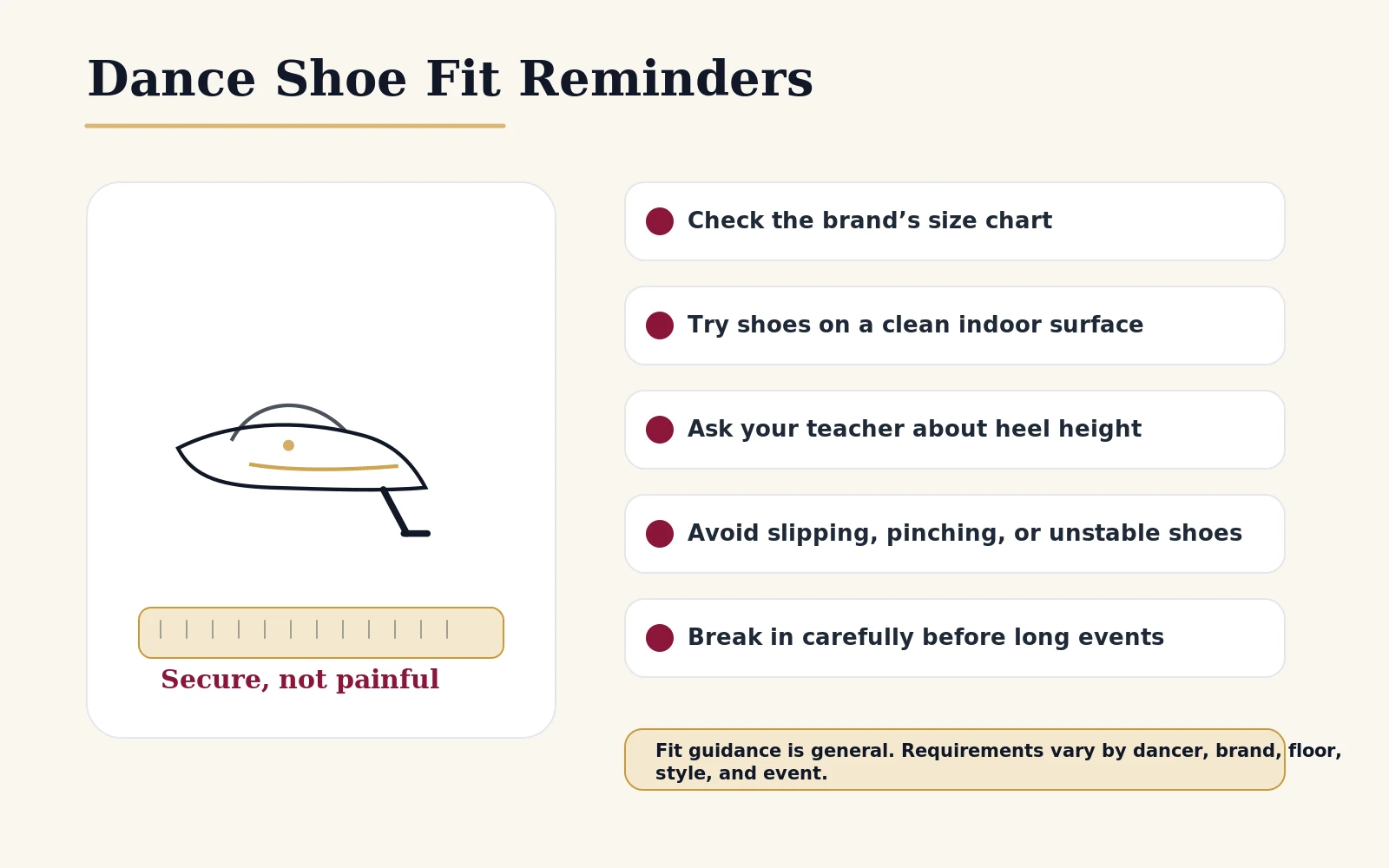
The open toe catches people out. On an open-toe style it is normal for your toes to reach close to the front edge of the sole. Toes hanging over the edge or curling to stay on board means the shoe is too small; toes arriving near the edge and sitting flat is how the style is cut.
Everything else — measuring, whether to size up, heel slip and straps — is covered in our ballroom dance shoe sizing guide.
Which shoe for Salsa, Bachata, Rumba, Cha Cha and Jive
The category names are less useful than the setting. What your shoe has to survive on a crowded Saturday night is different from what it has to do in a Tuesday class, even when the dance is the same. Here is what actually changes in each context.
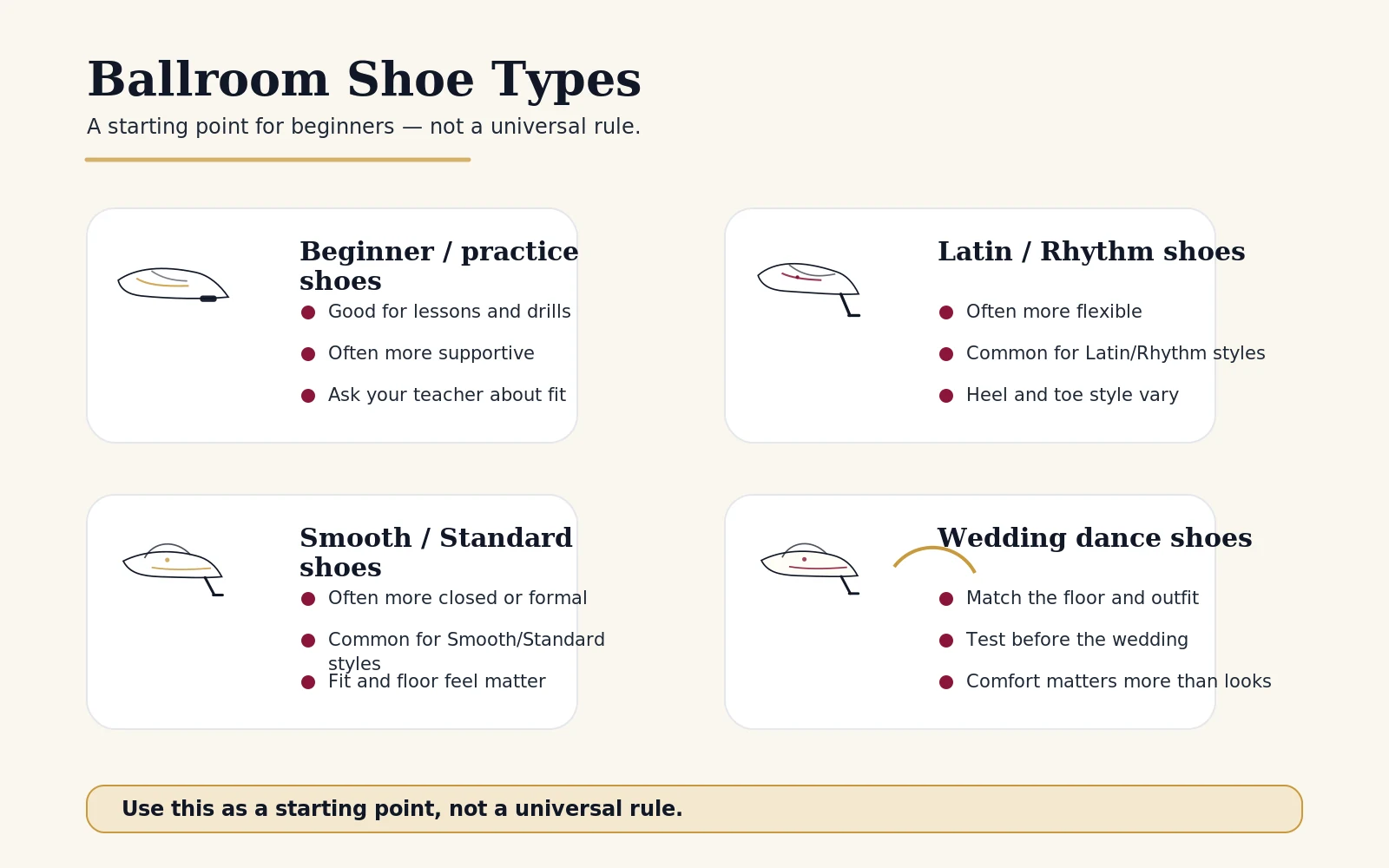
-
Salsa and Bachata socials
For Salsa and Bachata a flexible sole and a foot that stays put matter far more than heel height, and a crowded floor rewards a shoe you can stand in for three hours without thinking about it.
-
Rumba and Cha Cha in class
The slow, deliberate ball-of-foot weight changes in Rumba and Cha Cha are exactly where a stiff sole starts to fight you, because the shoe has to bend at the moment you are asking the foot to press.
-
Jive and fast Rhythm
Speed is the variable here. Secure straps and a heel you trust at pace matter more than anything decorative, because there is no time to recover from a foot that has shifted inside the shoe.
-
Smooth and Standard
A closed court shoe is the right tool. A Latin shoe is the wrong one here—the flexible sole and narrower heel give you less to stand on precisely when the movement is travelling and you need a stable base under a long line.
-
Showcase and performance
This is the one setting where finish genuinely starts to matter alongside function, since the shoe is being seen as part of a picture. If that is where you are heading, our guide to glitter sole heels covers what changes and what to test first.
Men’s Latin shoes vs men’s ballroom shoes
The men’s version of this question gets far less written about it, and what does exist is mostly shop listings. The differences are real but narrower than they are on the follower side, and they are almost entirely about construction rather than appearance.
| Men’s Latin | Men’s Smooth/Standard | |
|---|---|---|
| Heel height | Noticeably higher than a Smooth shoe, though still modest next to follower heels. | Low, close to a dress-shoe heel. |
| Heel shape | Cuban: broad, straight and stable. | Flat and wide, built for a heel lead. |
| Sole flex | More flexible, to allow Latin footwork through the ball of the foot. | Firmer, supporting a stable travelling line. |
| Build and last | Closer-fitting and more flexible around the foot. | Firmer oxford-style construction with more structure. |
| Formality | Not a dressier shoe—just a differently built one. | Reads more formal because of the oxford shape, not the function. |
That last row is the one worth holding onto. A men’s Latin shoe is sometimes assumed to be the “fancier” option because of the heel, and it is not. It is a working shoe built for a different set of demands, and wearing it to a Standard class does not make you better dressed, only less stable in the swing.
In practice, a great many leaders take a middle route and use one flexible suede-soled shoe across both sides of the room for a long time. That is a reasonable choice and it is not a compromise anyone should feel apologetic about. It stops working at a fairly predictable point: when the Cuban heel becomes something your teacher is actively asking for in Latin, or when your Standard work starts needing more platform than a flexible shoe gives you under a full swing. Until one of those two things happens, one pair is enough. If you are working out the rest of what to wear around the shoe, our guide to men’s ballroom dance attire covers lessons through to competition.
Breaking them in and caring for suede soles
A new Latin shoe feels stiffer through the sole than the flexible thing it becomes, and that is the part worth being patient about. The flex you bought the shoe for arrives with wear, not with force, so give it short indoor sessions before a long night, and never use heat or water to hurry it.
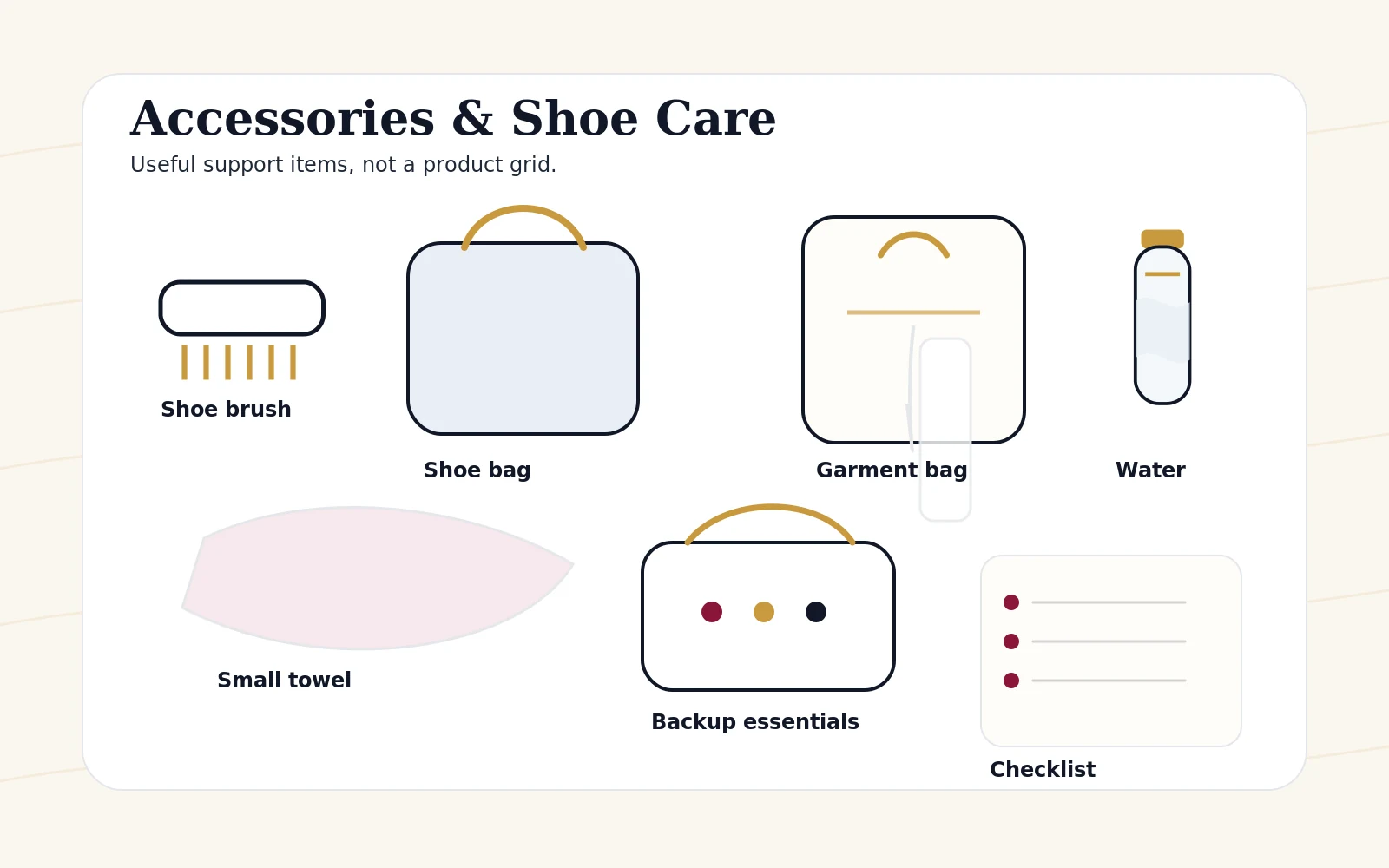
Suede-sole care — brushing, storage, and what to do when the grip changes — is covered in our guide to ballroom dance shoes for beginners.
Common mistakes when buying Latin shoes
Buying Latin shoes before you know which styles you are staying with
If your style preference is still moving, waiting until you know where your hours are going costs nothing and saves a pair.
Choosing heel height by ambition instead of by balance
A heel you cannot change weight on calmly makes every lesson harder. Pick the height your current balance supports and move up later.
Assuming your street shoe size transfers
Dance shoes are built on their own lasts and fitted closer than street shoes. Treat your street size as a place to start looking, not a result.
Treating open-toe as a comfort downgrade
It is a different fit standard, not a worse one. Toes sitting near the front edge is how the style is cut, and it is not evidence the shoe is too small.
Buying a shoe you can only wear at a competition
Most dancers spend the overwhelming majority of their hours in lessons and at socials. Buy for where the hours actually are.
Taking sizing advice from a forum thread
Somebody else’s foot in somebody else’s brand tells you very little. The maker’s own chart and a clear return policy are worth more than any anecdote.