
Do you actually need a dance partner?
Not always. If you are brand new, you can begin with a group class, a private lesson, or a beginner social. Many classes rotate partners, which helps you learn to dance with different people and removes the pressure of bringing someone with you.
You may want a consistent partner when you are practicing between lessons, preparing for a wedding dance, rehearsing a showcase, or exploring amateur competition. Even then, the “right” partner is not always the most advanced dancer. Often, the best partner is someone reliable, respectful, available, and interested in the same goal.
Use this rule: Need a partner for every class? Usually no. Need a partner for regular practice or competition? Often yes. Need a partner before you start? No. New to all of this? Begin with starting ballroom dancing and a first ballroom dance lesson.
What kind of dance partner are you looking for?
Before you ask anyone, get clear on the role you actually need. The expectations for a social-floor partner are very different from a competition partner.
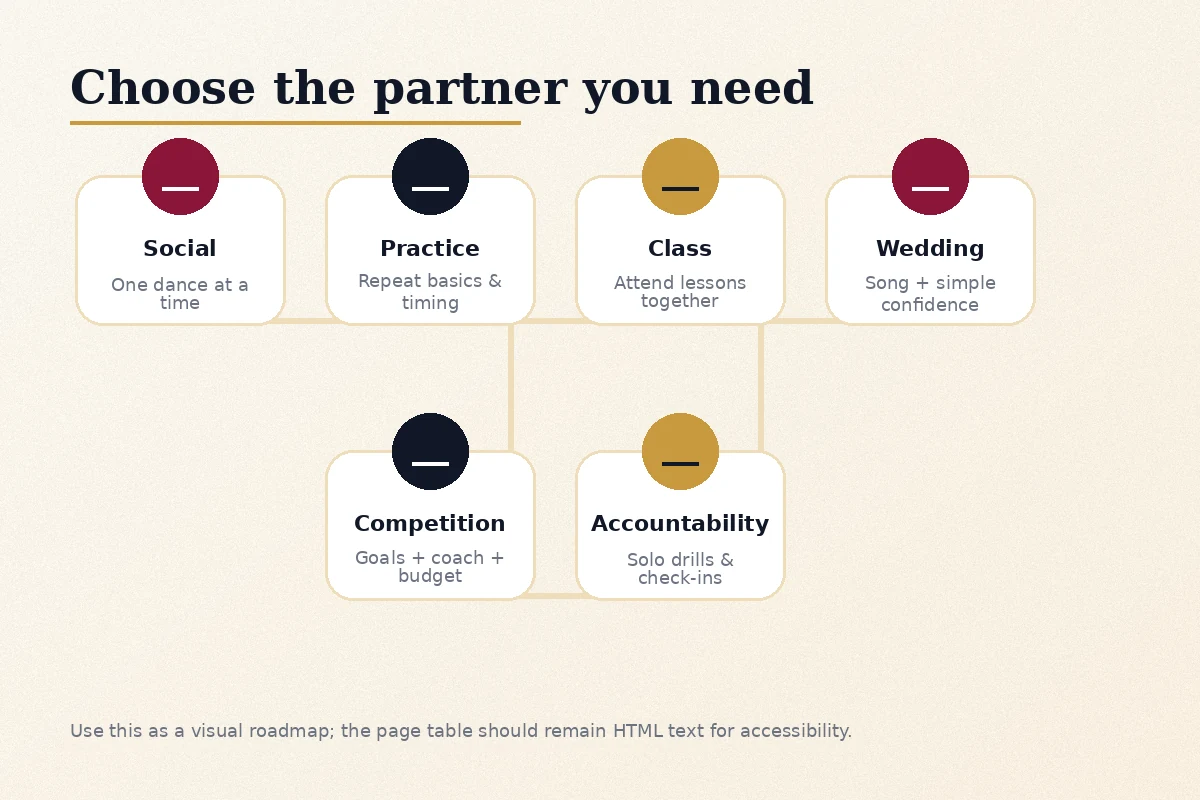
| Partner type | Best for | Where to find them | Expectations to clarify | Question to ask first |
|---|---|---|---|---|
| Social dance partner | Dancing at socials, parties, mixers, and community events. | Dance socials, studio parties, community clubs, friend networks. | One dance, a few dances, comfort level, dance style, boundaries. | “Would you like to dance this Foxtrot?” |
| Practice partner | Repeating basics, timing, frame, patterns, and lesson material. | Group classes, practice parties, instructor referrals, studio boards. | Frequency, schedule, dances, feedback style, public practice location. | “Would you like to practice Waltz and Rumba for 30 minutes after class?” |
| Class partner | Attending a recurring class together. | Current classes, studio classmates, community education programs. | Class level, attendance, whether you rotate partners, make-up plans. | “Are you looking for a partner for this beginner series?” |
| Wedding dance partner | First dance practice, song timing, simple choreography, confidence. | Your fiancé(e), wedding dance lessons, instructor-led practice sessions. | Song, timeline, lesson budget, practice frequency, comfort with dips or turns. | “Can we practice our first dance twice a week for the next month?” |
| Competition partner | Amateur competition, showcases, syllabus practice, performance goals. | Studios, coaches, competitions, collegiate teams, partner-search groups. | Style, level, training load, coach, budget, travel, costumes, commitment. | “Are you looking for social practice, showcase, or competition?” |
| Accountability partner | Staying consistent with solo drills, music practice, and beginner routines. | Friends, classmates, online communities, beginner groups. | Check-in frequency, goals, playlist practice, no-pressure support. | “Want to check in once a week on our practice goals?” |
Not sure which dances you want to practice? Compare dance styles first—Waltz, Rumba, Cha Cha, Foxtrot, East Coast Swing, Salsa, and Bachata are all common beginner choices.
Best places to find a dance partner
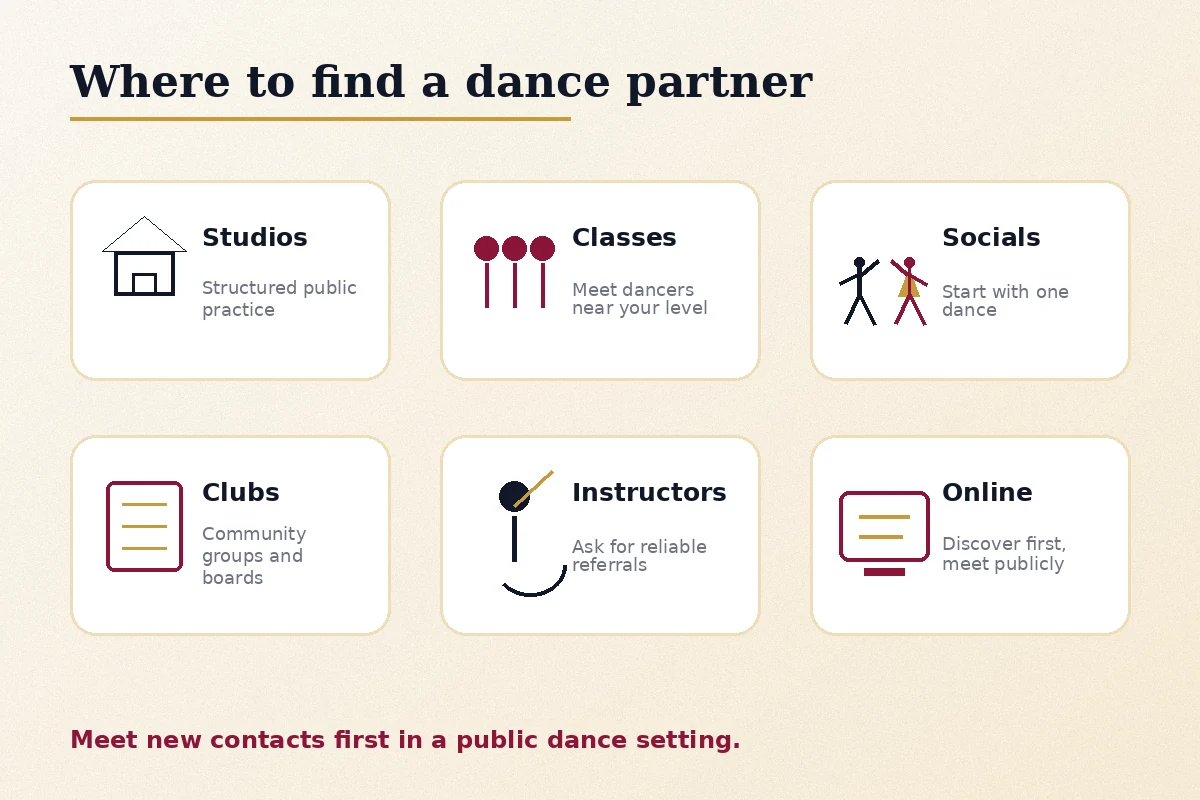
Local ballroom and social dance studios
Studios are usually the safest first place to look because you can meet people in a structured dance environment.
Group classes
Group classes put you next to people at a similar level, often with built-in partner rotation, so you can dance with several people before deciding who to practice with.
Practice parties and studio socials
Many studios host low-key practice parties. They are ideal for finding practice partners because everyone is there to repeat material, not perform.
Dance socials
Dance socials are better for finding social partners than serious practice partners. Keep the first ask simple. A social floor is for dancing, not interviewing someone for a long-term commitment.
University and community dance clubs
Collegiate and community clubs are friendly, affordable, and used to welcoming beginners and rotating partners.
Competitions and showcases
If your goal is performance or competition, watch local events and ask coaches; partnerships often form through studios and teams.
Facebook groups and community boards
Regional dance groups and studio boards can help you discover practice partners—use them to discover people, then meet in public dance settings.
Dance partner apps and sites
Use them as discovery tools, not as a replacement for judgment. Meet first in a public dance setting.
Ask your instructor
Ask the front desk or instructor: “I’m looking for someone around my level to practice beginner Waltz and Rumba with after class. Is there a classmate or practice group you recommend?”
Friends already learning
A friend who is also learning makes a low-pressure first practice partner—you can keep each other accountable.
How to ask someone to practice or dance
A good ask is clear, specific, and easy to decline.
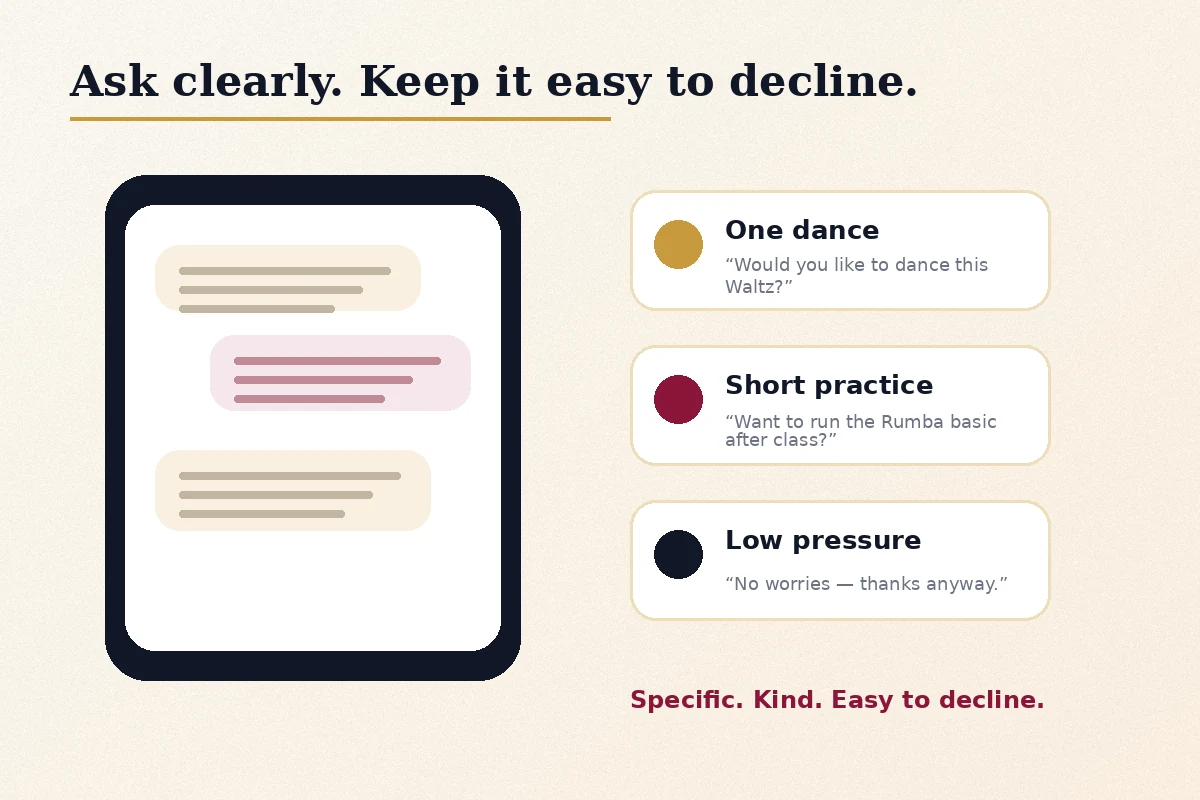
- “Would you like to dance this Waltz?”
- “I’m practicing the Rumba basic from class. Would you like to run it for 15 minutes after class next week?”
- “I’m looking for a low-pressure practice partner for beginner Waltz and Foxtrot once a week. I’m not looking for a teacher—just someone to practice timing and basics with. Would that interest you?”
- “Are you looking for social practice, showcases, or amateur competition? I’m still exploring, so I’d like to compare goals before committing to anything.”
Online template
“Hi, I’m taking beginner/intermediate ballroom classes in the [general area]. I’m looking for a practice partner for [Waltz/Rumba/Foxtrot/etc.] about [once a week/twice a month]. My goal is [social confidence / class practice / wedding dance / competition prep]. I prefer to meet first at a public studio practice or social. Does that sound close to what you’re looking for?”
If they say no
“No worries—thanks anyway. Have a good class.” A graceful response keeps the community friendly and keeps the door open for next time.
What to include in a dance partner message or profile
- Dance styles you want to practice.
- Level (beginner, bronze, intermediate, etc.).
- Goal (social confidence, class practice, wedding, competition).
- Schedule and availability.
- General area, not your home address.
- Setting (public studio practice or social).
- Role: leader, follower, both, or openness to role-switching.
- Boundaries (dance-only, no dating, comfort with closeness).
- Practice frequency you can realistically keep.
Two examples:
- “Beginner ballroom student in the Denver area looking for a low-pressure practice partner for Waltz, Rumba, and Foxtrot. I’m taking weekly group classes and want to practice timing and basics once a week at a public studio practice. I can lead or practice role-switching slowly. Not looking for dating—just consistent, respectful practice.”
- “Bronze-level ballroom dancer exploring amateur competition in American Smooth and Rhythm. Looking for a partner with similar goals, reliable weekly availability, and interest in coach-led practice. Open to discussing budget, coach, styles, timeline, and expectations before committing.”
Clear roles help here—if the terms are new, read lead and follow and the ballroom dance glossary.
Safety and boundaries
Meeting dance partners should feel safe, public, and respectful. Start inside established dance spaces whenever possible: classes, studios, socials, competitions, and community clubs.
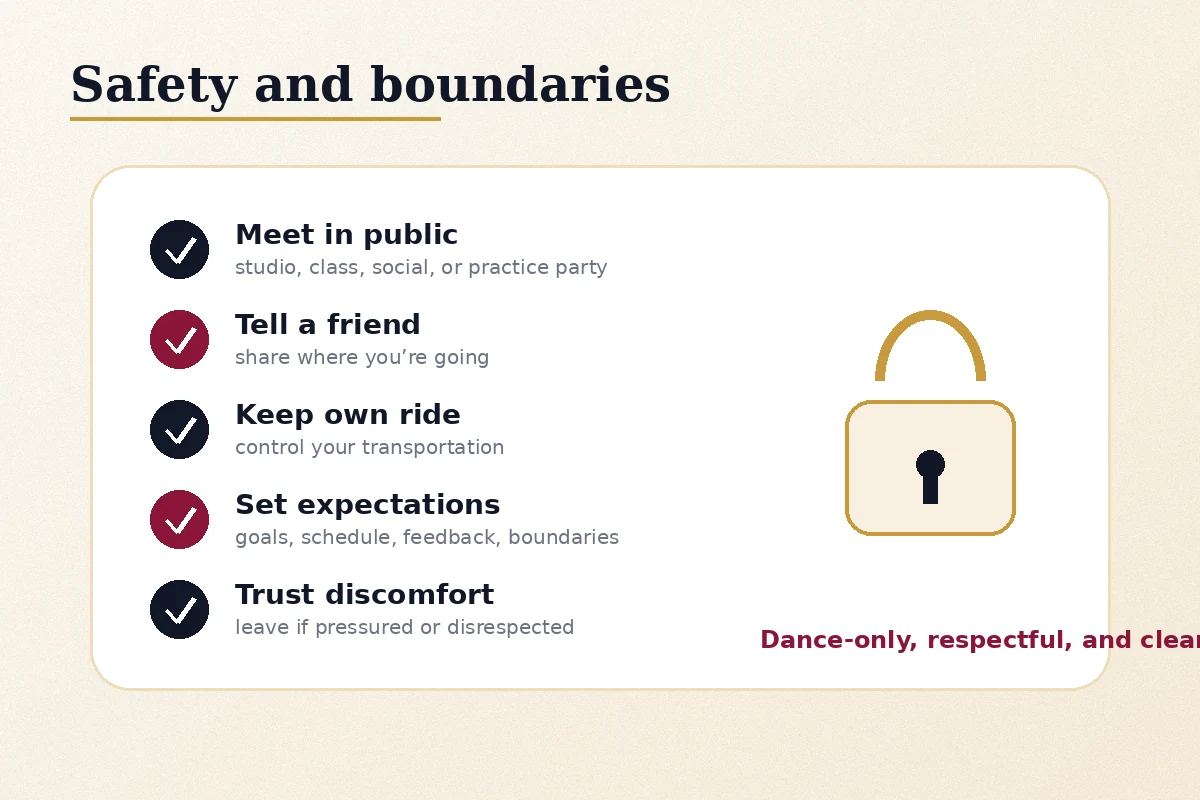
- Meet first in a public studio, class, social, or practice party.
- Do not share your home address or private schedule too early.
- Tell a trusted person where you are going and who you are meeting.
- Keep control of your transportation.
- Keep the first practice short.
- Leave if you feel pressured, disrespected, or uncomfortable.
- Do not send money, pay for someone’s lessons, or share financial information with someone you only know online.
Green flags
Signs of a good partner
- Clear about goals and level.
- Respects “no.”
- Suggests public studio, class, or social.
- Communicates schedule and budget honestly.
- Gives and takes feedback kindly.
- Understands role preferences and boundaries.
- Agrees on what to practice.
- Open to instructor feedback.
Red flags
Reasons to step back
- Pressures you to meet privately right away.
- Makes conversation dating-coded after dance-only expectations.
- Asks for home address or private details too soon.
- Repeatedly cancels without respecting your time.
- Criticizes harshly or treats you like a student, employee, or romantic prospect.
- Ignores physical comfort or personal space.
- Wants to practice everything at once.
- Wants money, favors, rides, or private access before trust is built.
For shared-floor manners once you are dancing, see social dance etiquette.
Dance partner compatibility checklist
Before committing to a regular partnership, talk through these together:
- Goals: social, practice, wedding, showcase, or competition.
- Schedule: how often and when you can realistically practice.
- Skill level: roughly compatible, or with a clear plan if not.
- Communication style: how you give and receive feedback.
- Practice temperament: relaxed, focused, or somewhere between.
- Music and style preferences: which dances you both want to do.
- Budget and lesson expectations: lessons, coaching, events.
- Roles and role-switching: leader, follower, or both.
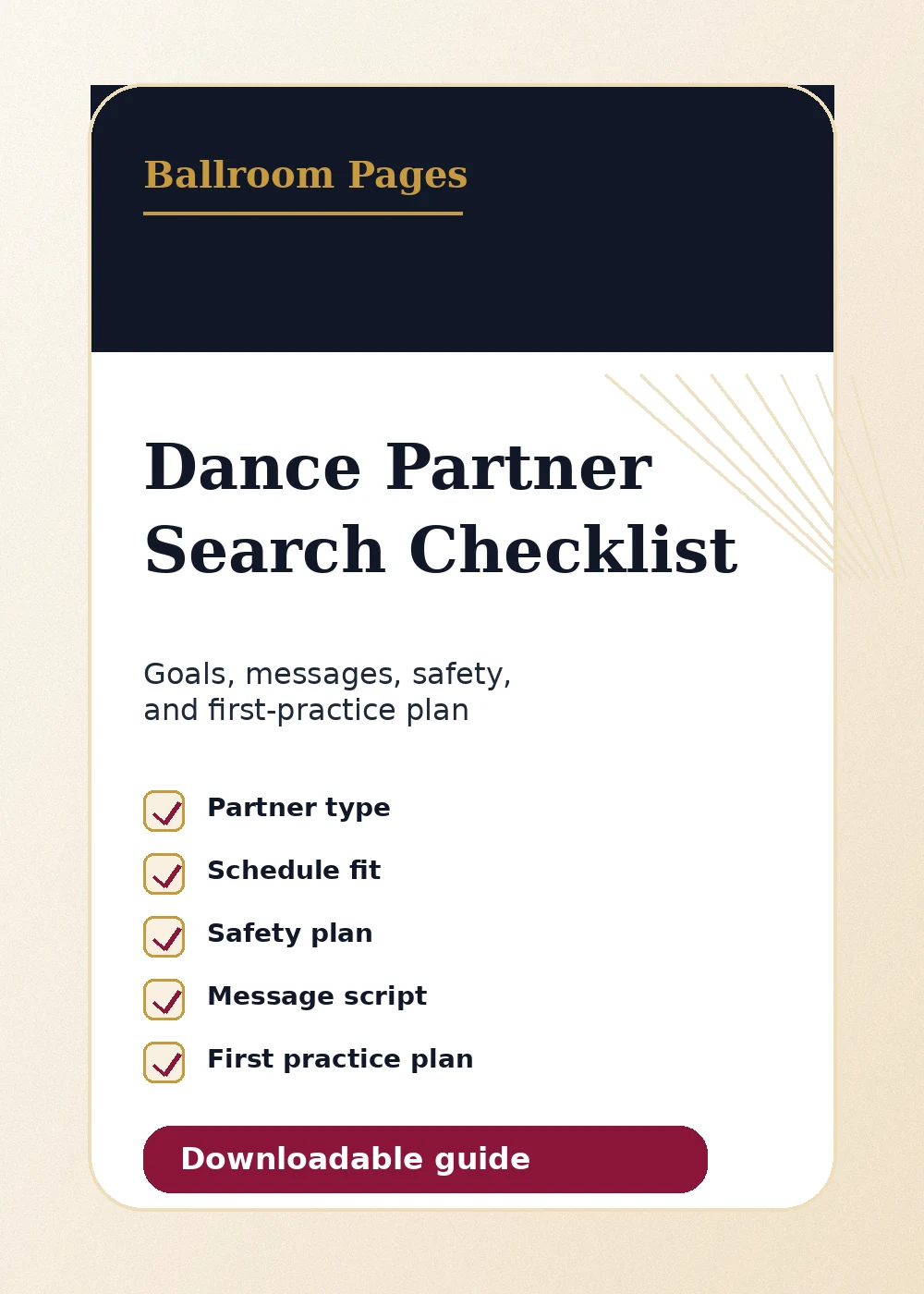
Download the Dance Partner Search Checklist
Keep your search simple: define your goal, compare schedules, set boundaries, plan your first practice, and avoid common red flags.
Get the checklistNo spam—just practical ballroom guides and beginner-friendly resources. Unsubscribe anytime.
Practice with music before your first partner session
A partner search goes better when you can hear the timing and name the dances you want to practice. Before messaging someone or meeting for a first practice, choose one or two dances, listen to a few songs, count the rhythm out loud, and write down what you want to work on.
Use Ballroom Pages playlists as a low-pressure prep step. You are not trying to become perfect before meeting a partner—just confident enough to say, “I’d like to practice Waltz timing,” or “I want to work on Rumba basics.”
- Pick one or two dances.
- Listen to a few songs for each.
- Count the basic rhythm out loud.
- Write down what you want to practice.
- Bring that plan to the first session.
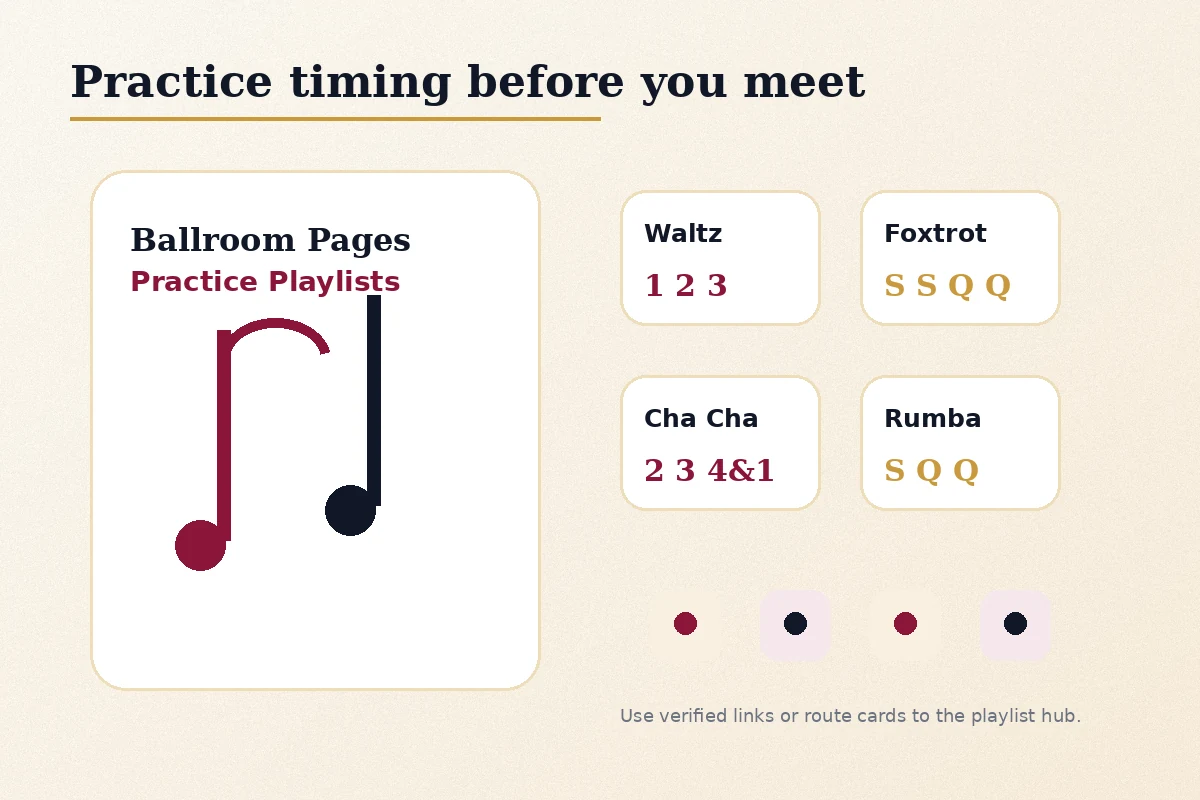
Ballroom / Standard playlists
Waltz, Tango, Foxtrot, Quickstep practice.
American Smooth playlists
Smooth-family practice songs.
American Rhythm playlists
Rumba, Cha Cha, Swing, and more.
International Latin playlists
Cha Cha, Samba, Rumba, Paso Doble, Jive.
Spotify / Apple / YouTube
Browse by platform in the playlist hub.
Open playlists Direct URLs to verify
BallroomPages Music on Telegram
Playlist updates and music discovery.
New to timing? Read how to count ballroom dance music, check the ballroom dance tempo chart, or explore Ballroom Music & Timing.
What to do at your first practice session
Keep the first practice simple. The goal is not to prove everything you know. The goal is to see whether you can communicate, repeat basics, and enjoy practicing together.
- Meet in a public dance setting.
- Keep it to 30–45 minutes.
- Choose one or two dances.
- Agree on the goal: timing, basic step, frame, lead/follow, or confidence.
- Warm up with easy walking or basic rhythm.
- Use beginner-friendly music.
- Practice one pattern at a time.
- Avoid heavy critique.
- End with either a next plan or a polite close.
- “This was helpful. Would you like to practice again next week?”
- “Thanks for practicing. I think I’m going to keep exploring a few options, but I appreciate the time.”
A steady frame and posture makes a first practice feel comfortable for both partners.
Common mistakes when looking for a dance partner
- Waiting for the perfect partner. You can progress now with classes, lessons, and solo practice.
- Treating a practice partner like a teacher. Practice partners repeat material together; they are not your coach.
- Skipping expectations. Unspoken assumptions about schedule, goals, or budget cause most partnership friction.
- Making it dating-coded. If you agreed on dance-only, keep it dance-only unless both clearly choose otherwise.
- Ignoring safety. Meet in public dance settings and trust discomfort early.
- Practicing too many dances at once. Pick one or two and build them.
- Forgetting music and timing. Prep with playlists so you can name what you want to work on.
No partner yet? What to practice alone
You can make real progress without a partner. Use solo practice to build the skills that make partner dancing easier later.
- Counting music
- Walking to rhythm
- Waltz box step footwork
- Rumba basic timing
- Cha Cha count
- Foxtrot slow/quick timing
- Frame and posture
- Balance and weight changes
- Simple turns without rushing
- Musicality and listening
Go deeper with how to count ballroom dance music, Ballroom Pages playlists, frame and posture, lead and follow, the beginner ballroom guides, a comparison of dance styles, and what to expect at your first ballroom dance lesson. Planning a wedding? See the wedding dance guide and what dance fits your wedding song, and pick up ballroom dance shoes for beginners.